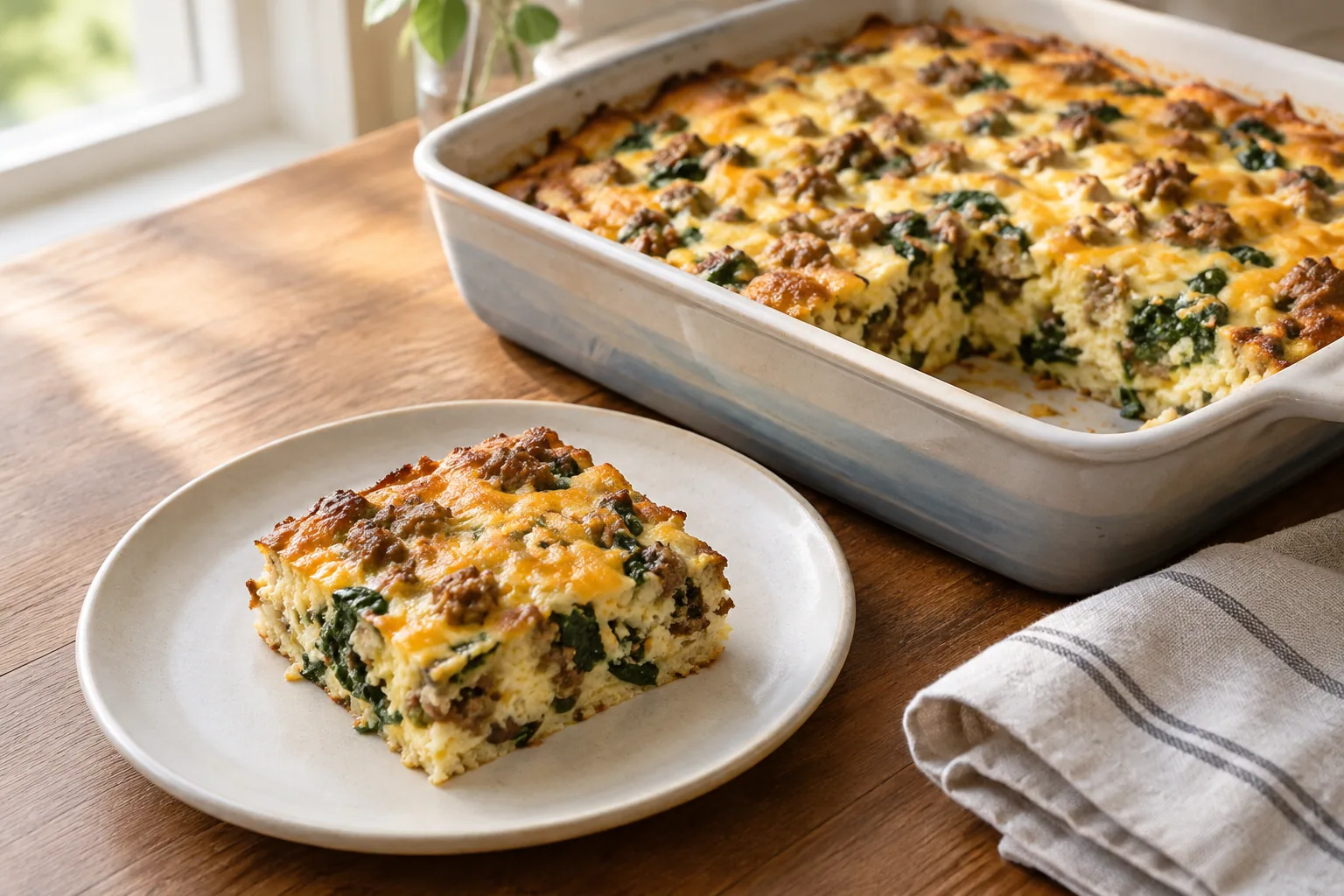
Make this keto breakfast casserole with sausage, spinach, eggs, cheddar, and heavy cream in a 9-by-13-inch pan. It makes 12 portions for a household breakfast or meal prep, with no bread or potatoes; the carb count depends on the packaged ingredients you choose and the size of your slice.
Keto breakfast casserole recipe
Yield: 12 portions, each 1/12 of the pan
Pan: 9-by-13-inch baking dish, at least 2 inches deep
Prep: About 20 minutes
Bake: Approximately 30–40 minutes
Rest: 10 minutes
Total: About 60–70 minutes
Oven: 350°F, conventional setting
This recipe formulation has not been kitchen-tested. Treat the baking range as an estimate and use the center temperature, rather than the clock or browned cheese, to judge doneness.
Ingredients
- 1 teaspoon butter (5 g), for greasing the dish
- 1 pound raw ground breakfast sausage (454 g), without casings
- 10 ounces frozen chopped spinach (283 g), thawed, then squeezed dry; weight is before draining
- 12 large eggs, approximately 600 g without shells
- 3/4 cup plain heavy whipping cream (180 g)
- 8 ounces cheddar cheese (227 g), shredded, approximately 2 cups loosely packed, divided
- 1/2 teaspoon garlic powder
- 1/2 teaspoon ground black pepper
- Up to 1/4 teaspoon salt, optional, depending on how salty your sausage and cheese are
Instructions
- Heat the oven and prepare the pan. Set a rack in the middle of the oven and heat to 350°F. Grease the bottom and sides of the baking dish with the butter.
- Brown the sausage. Cook it in a skillet over medium heat, breaking it into small crumbles, until cooked through, approximately 8–10 minutes. Ground pork or beef sausage should reach 160°F; poultry sausage should reach 165°F. Drain off pooled grease and let the meat cool slightly.
- Dry the spinach thoroughly. Put the thawed spinach in a clean kitchen towel and squeeze firmly over the sink. Open the towel, loosen the spinach, and squeeze again. Break apart the compressed clumps afterward so they distribute evenly.
- Mix the egg base. Whisk the eggs, cream, garlic powder, pepper, and optional salt until the whites and yolks are fully combined. Stir in approximately three-quarters of the cheese, reserving the rest for the top.
- Assemble. Spread the sausage and spinach evenly across the dish. Pour the egg mixture over them, gently redistribute any clumps with a fork, and sprinkle with the remaining cheese.
- Bake until the center is set. Begin checking at 30 minutes. The middle should no longer have a liquid ripple, and a food thermometer inserted into the center, away from the pan bottom, should read 160°F. If the top browns before the middle is ready, cover loosely with foil and continue baking.
- Rest and portion. Let the casserole stand for 10 minutes, then cut into 12 pieces. Refrigerate portions you will not serve promptly, following the storage guidance below.
Choose sausage, cheese, and dairy by their labels
A package labeled “breakfast sausage” does not tell you its carbohydrate content. Maple flavoring, added sugar, starches, and other ingredients can change the numbers, so compare the Nutrition Facts panels rather than relying on the front of the package.
| Ingredient | What to check | How to compare fairly |
|---|---|---|
| Breakfast sausage | Total carbohydrate, serving weight, added sugars, and ingredients such as syrup or starch | Compare the same weight, and check whether the label describes raw or cooked meat |
| Shredded cheddar | Total carbohydrate and any starch-based anticaking ingredients | Compare equal weights; do not assume every shredded cheese has more carbs than every block cheese |
| Heavy cream | Serving size, total carbohydrate, and whether it is plain or flavored | Account for the full 3/4 cup used, not just one label serving |
| Frozen spinach | Ingredients and whether sauce or seasoning is included | Choose plain spinach for the base recipe |
| Breakfast mixtures | Potatoes, bread, flour-based sauces, or sweetened additions | Check the entire mixture, not only its meat or egg content |
Block cheddar lets you shred the cheese yourself, but it is not automatically the lowest-carb choice. Likewise, turkey sausage can work in place of pork sausage, but its label and cooking instructions still matter.
Use the packaged-ingredient scanner guide to compare options while shopping. Keeto can scan sausage, cheese, and dairy barcodes to show net carbs and their share of your daily carb budget; match the amount you plan to use to the displayed serving size.
One shopping list for the base casserole
- 1 pound ground breakfast sausage
- One 10-ounce package plain frozen chopped spinach
- 1 dozen large eggs
- Heavy whipping cream, enough for 3/4 cup
- One 8-ounce block or bag of cheddar
- Butter
- Garlic powder, black pepper, and optional salt
Check your pantry first, then put the remaining items into a casserole shopping list. If you choose a variation below, replace the relevant ingredient on the list rather than buying both versions by mistake.
Keep moisture out and stop baking when the eggs are set
Spinach, vegetables, and pooled cooking liquid can leave a casserole wet even when the eggs are cooked. Overbaking creates a different problem: eggs become firm and can release liquid as their proteins tighten.
- Squeeze thawed spinach twice. A quick drain in a colander leaves water trapped in the leaves. Use a towel and firm pressure.
- Cook fresh vegetables separately. Mushrooms, peppers, and fresh spinach should release their moisture in the skillet, not in the egg mixture. Let visible liquid evaporate before assembling.
- Drain the sausage. Transfer the crumbles out of the pooled fat and liquid rather than pouring the skillet contents into the dish.
- Measure the cream. Extra cream, salsa, or sauce changes the egg-to-liquid balance. Serve wet toppings alongside individual portions instead.
- Keep the specified pan size. A smaller, deeper dish can have firm edges while its center remains undercooked.
A properly set center may tremble slightly as one piece when you gently move the pan. A liquid wave beneath the surface means it needs more time; a browned top alone proves neither doneness nor safety. Check the center temperature, then allow the resting time before slicing.
Calculate carbs for your actual ingredients and portion
A verified total-carb, fiber, and net-carb count is not available for this exact formulation. A number from another casserole would not reliably describe this one, especially if it uses different sausage, cheese, vegetables, or portions.
For a recipe-specific calculation, record each ingredient’s weight, its nutrition serving size, total carbohydrate, and dietary fiber. Use the manufacturer’s current label for packaged ingredients and a matching USDA FoodData Central entry for basic ingredients, keeping raw and cooked weights consistent.
- Scale each ingredient’s nutrition to the amount used. Divide the recipe weight by the nutrition serving weight, then multiply that result by the carbohydrate and fiber amounts per serving.
- Add all ingredient totals. Include the eggs, spinach, dairy, sausage, and seasonings rather than counting only the obvious carbohydrate sources.
- Calculate net carbs. For this recipe, subtract total dietary fiber from total carbohydrate.
- Divide by 12 for equal portions. Report total carbs, fiber, and net carbs for a serving defined as 1/12 of the finished casserole.
For uneven portions, weigh the finished casserole without the dish. Divide your portion’s weight by the full cooked weight, then multiply each whole-recipe nutrition total by that fraction. Distribute the filling evenly before baking so a slice is less likely to contain a disproportionate amount of sausage or vegetables.
Changing ingredients or cutting larger slices changes the result. No single breakfast can guarantee ketosis, so compare your portion with your own daily carb budget.
Make swaps while keeping the egg base consistent
These are untested starting variations, not verified equivalents. Keep the 12 eggs and 3/4 cup cream unchanged, precook the replacements, and recalculate nutrition.
| Variation | Suggested substitution | Preparation needed |
|---|---|---|
| Bacon instead of sausage | Replace the sausage with 8 ounces raw bacon (227 g) | Cook until crisp, drain, and chop. This supplies less filling volume than the sausage version; omit the optional salt initially |
| Meat-free mushrooms and peppers | Replace the sausage with 8 ounces mushrooms (227 g) and 1 medium bell pepper, about 150 g trimmed | Chop and sauté until softened and the skillet has no pooled liquid. Keep the spinach |
| Broccoli instead of spinach | Replace the spinach with 10 ounces broccoli florets (283 g), chopped small | Steam until just tender, drain thoroughly, cool, and pat dry before adding |
| Turkey sausage instead of pork | Use 1 pound raw turkey breakfast sausage (454 g) | Cook to 165°F and drain any liquid. Avoid cooking it longer than necessary before baking |
Do not substitute dairy-free milk and cheese automatically, one for one. Their water content, fat, melting behavior, and nutrition vary, so a dairy-free version needs separate testing and calculations.
Make ahead safely, then reheat only what you need
Assemble the night before or bake for several breakfasts
To assemble ahead, cook the sausage and prepare the spinach, then cool them promptly before combining with the egg mixture. Cover the assembled casserole, refrigerate at 40°F or below, and bake within 24 hours. Expect a refrigerated casserole to take longer than the estimated range, and follow your baking dish manufacturer’s directions about moving a cold dish into a hot oven.
For baked meal prep, refrigerate the casserole within two hours of cooking, or within one hour if the surrounding temperature is above 90°F. Divide it into portions in shallow containers so it cools promptly; do not leave the whole pan on the counter until completely cold. Use refrigerated portions within 3–4 days.
Freeze baked portions for later breakfasts
Freeze individual portions in airtight, freezer-safe containers or wrapping, and label them with the date. For best quality, plan to use them within 2–3 months. Thaw overnight in the refrigerator rather than on the counter.
Freezing baked portions is the approach described here; an unbaked frozen version has not been tested. Plan the rest of your week around the refrigerated portions with this meal-prep and storage guide.
Reheat gently to 165°F
These are starting methods, not tested reheating times. Portion thickness, starting temperature, and your appliance will determine how long reheating takes.
- Microwave, one refrigerated portion: Cover with a microwave-safe lid and heat at medium power in short intervals, rotating or repositioning between intervals. Check that the center reaches 165°F.
- Oven, several portions: Place in an oven-safe dish, cover with foil, and reheat at 325°F until the centers reach 165°F. Covering helps limit surface drying.
- Whole refrigerated casserole: Cover and reheat at 325°F, checking the middle rather than judging by hot edges. Allow more time than individual portions, and uncover only if the surface needs drying.
For a crowd, double the ingredients and use two 9-by-13-inch pans, yielding 24 portions. Do not put a double batch into one deeper dish and assume the same baking time; check each pan separately for a 160°F center when baking from raw.
FAQ
Can I make keto breakfast casserole without heavy cream?
You can make egg casseroles without heavy cream, but omitting or replacing it changes the texture and nutrition of this formulation. A cream-free version has not been tested here, so do not assume that the same volume of milk or a dairy-free drink will behave identically. For a breakfast that avoids the egg-and-cream base altogether, choose from these egg-free breakfast ideas.
What can I serve with keto breakfast casserole?
Try sliced avocado, a small green salad, or sautéed mushrooms, with portions that fit your daily carb budget. Serve salsa, ketchup, and other sauces on the side so you can check their labels and measure your serving. Portion the casserole first, then choose and log your sides before sitting down to eat.