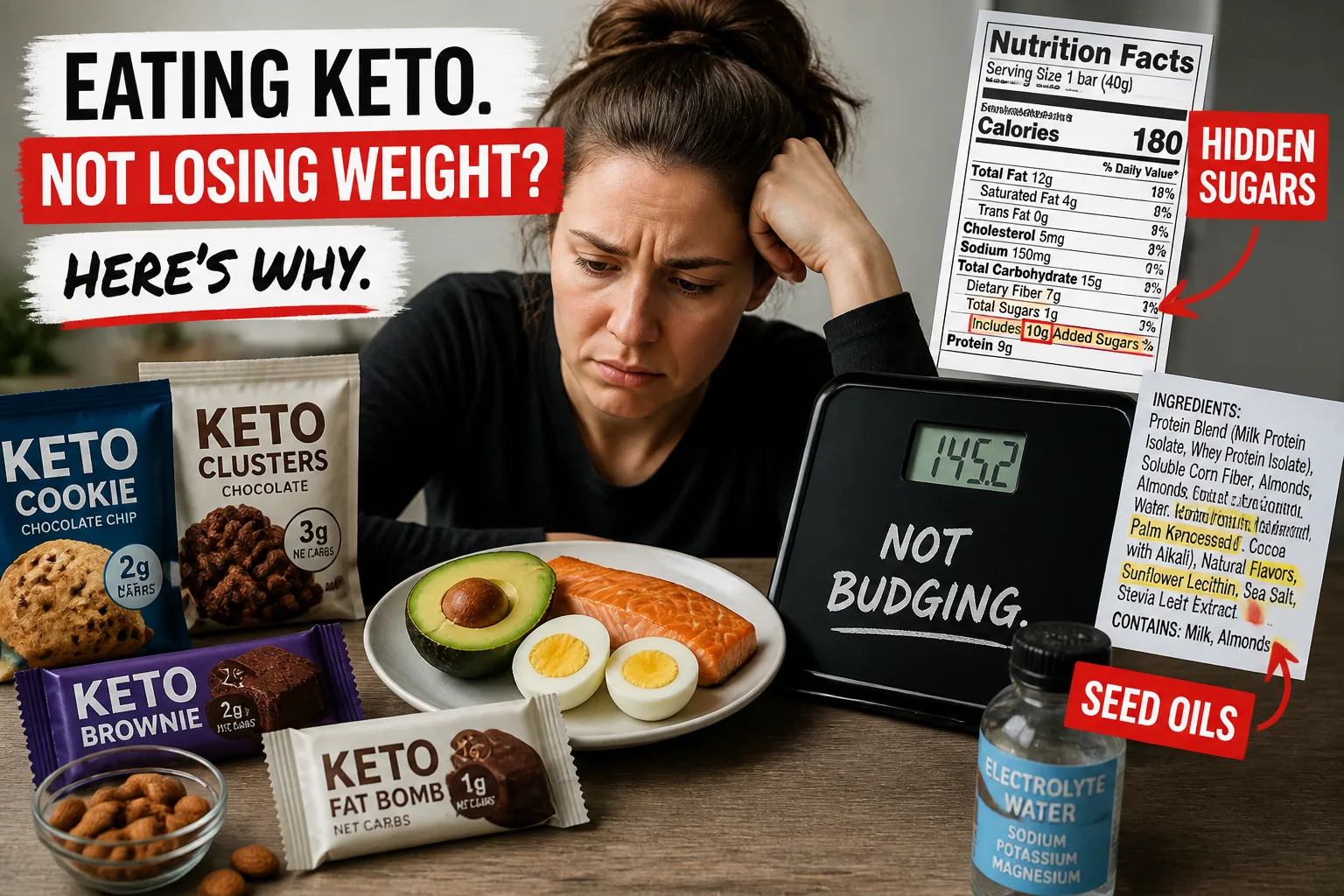
Why Keto Fails: Hidden Oversights That Sabotage Your Results
If you have been doing keto for a while and your carbs are genuinely under control, it can be frustrating when the scale stalls, energy dips, or cravings come back anyway. At that point, the problem is often not keto itself, but the hidden details that get missed after the beginner phase. In other words, once you stop eating obvious high-carb foods, the next round of progress depends on food quality, macro balance, hydration, and how much calorie density has quietly crept back in.
This is where many intermediate keto followers get tripped up. A product may be labeled keto-friendly, a meal may fit the macro math on paper, and yet progress still slows down. Ultra-processed snacks, hidden sugars, low-quality oils, electrolyte depletion, and overly aggressive fat intake can all interfere with the results you expect from low-carb eating. The good news is that these issues are fixable once you know what to look for.
Why Keto Can Stall Even When You’re Keeping Carbs Low
Keto is often explained as a carb-reduction strategy, but the real-world version is more complicated. Lowering carbs can help shift your body toward burning fat, yet the quality of your food still matters because satiety, digestion, mineral balance, and energy intake all influence whether you actually lose fat or just maintain weight in a different way. If you swap bread and pasta for packaged keto bars, fat bombs, and “approved” snacks, you may be technically low-carb while still overeating.
This is not just theory. In a randomized crossover trial, participants eating ultra-processed foods consumed about 508 extra calories per day and gained around 0.9 kg in two weeks, even though calories and macros were matched on paper. The unprocessed phase produced similar weight loss in the opposite direction. That matters for keto because many stalls are not caused by hidden carbs alone, but by the way ultra-processed foods drive passive overeating. The study summary is available through NEJM’s clinician resource: https://clinician.nejm.org/randomized-trial-ultra-processed-foods-led-greater-caloric-intake-nejm-jw.FW115425
So if keto has stopped working, the first question is not only “Am I staying under carbs?” It is also “What kind of foods am I eating, how much am I eating, and am I getting enough minerals and protein to support the diet?”
The Rise of “Keto-Friendly” Junk Food and Why It Matters
The modern keto market has made it easier than ever to stay low-carb, but it has also made it easier to stay low-carb in a way that is not especially healthy or effective. Bars, cookies, shakes, breads, and snack puffs often carry a keto label while relying on ingredients that are easy to overeat or difficult to verify. Some of these products use sugar alcohols, fiber blends, or resistant starches to reduce the listed net carbs. Others use ingredients that sound harmless but can still contribute digestible carbs or create a blood sugar response in certain people.
This problem is bigger than branding. A review of keto-labeled snacks found that more than 40% of tested products contained substances such as maltodextrin, rice syrup solids, or modified starch under ambiguous ingredient names. Those ingredients can quietly undermine the very carb control keto depends on. Even more importantly, “keto,” “keto-friendly,” and “keto approved” are marketing terms, not standardized regulatory categories. There is no legal definition of net carbs, and companies can calculate them inconsistently. For more on this issue, see: https://www.mysweetketo.com/keto-approved-labels-truth/
That means a snack can be low-carb in theory and still behave more like junk food in practice. The issue is not just the carb count. It is the combination of palatability, processed fats, hidden fillers, and easy overeating that makes these products dangerous for stalled progress.
Pantry Audit: How to Spot Hidden Sugars, Fillers, and Low-Quality Fats
If you want to break a plateau, start with the pantry. A pantry audit is one of the fastest ways to uncover why keto is not producing the results you expected. Look beyond front-label claims and check ingredient lists carefully. Common red flags include maltodextrin, dextrose, rice syrup solids, tapioca starch, modified food starch, corn fiber, and vague terms like “natural flavors” when they appear in a highly processed snack or sauce.
Also pay attention to fat sources. A food can be low in carbs but still be built on refined oils that are not ideal as daily staples. Seed oils and industrial vegetable oils such as soybean, canola, corn, safflower, and sunflower are commonly used because they are cheap and shelf-stable. The concern is not that every trace amount is harmful, but that relying on them heavily can push the overall fat profile toward excess omega-6 polyunsaturated fats relative to omega-3s. For a practical breakdown of better and worse keto fats, this guide is useful: https://www.doctorkiltz.com/high-fat-keto-foods/
A better pantry usually looks simpler. Prioritize whole foods, cooking fats you can recognize, and products with short ingredient lists. If a “keto” item needs a label to convince you it is healthy, that is usually a sign to inspect it more closely.
Six Common Keto Macro Mistakes That Block Progress
When keto stops working, the macro problem is often not one big mistake but several smaller ones stacking together. Here are six of the most common issues.
Eating too much fat because keto is misunderstood as unlimited fat. Keto is low-carb, not automatically high-calorie. Fat is a tool for satiety and energy, not a free pass to add cream, cheese, nuts, oils, and fat bombs to everything.
Eating too little protein. Many keto dieters under-eat protein because they fear it will kick them out of ketosis. In reality, protein is essential for muscle maintenance, recovery, and appetite control, especially if you are active or trying to lose fat.
Overdoing protein while underestimating total intake. Protein matters, but extremely high protein can make ketosis harder for some people, especially if meals become very lean and large. Traditional ketogenic ratios often land around 70 to 80% of calories from fat, 10 to 20% from protein, and 5 to 10% from carbs, according to Harvard Nutrition Source and related ketosis guidance: https://nutritionsource.hsph.harvard.edu/healthy-weight/diet-reviews/ketogenic-diet/
Depending on processed snacks for convenience. These foods can feel keto compliant while still driving hunger and overeating. They also train your palate to expect hyper-palatable foods, which makes real food less satisfying.
Ignoring fat quality. A keto diet built around highly refined seed oils and fried packaged foods will not behave the same as one built around olive oil, avocado oil, coconut oil where appropriate, butter, eggs, fatty fish, and quality meats.
Assuming the scale is a pure carb meter. Water retention, stress, sleep, gut changes, sodium fluctuations, and calorie intake all affect the number on the scale. Keto progress is broader than carbohydrate intake alone.
Are You Eating Too Much Fat and Not Enough Protein?
This is one of the most common plateaus on keto. People often begin the diet with the idea that they must chase fat to stay in ketosis, then keep pushing fat intake even after they have adapted. That can be useful at first, but if fat remains too high once your appetite stabilizes, it can prevent body fat loss because your body burns dietary fat first when it is available in large amounts.
At the same time, too little protein can leave you hungrier, weaker, and less able to preserve lean mass during weight loss. That is a bad combination because it encourages snacking, lowers training performance, and makes it easier to regain weight later. A practical approach is to treat protein as a priority, then use fat to satisfy hunger rather than to force calories upward.
If you are unsure where your balance is, ask a simple question: am I eating fat because I need it, or because keto told me fat is always the goal? Often, the fix is reducing added fats first while keeping protein adequate and meals more nutrient-dense.
The Problem With Inflammatory Fats and Processed Keto Staples
Not all fats play the same role in your diet. Some keto staples are convenient but not ideal as everyday defaults, especially when they come from industrial processing or repeatedly heated oils. Excess reliance on omega-6-heavy vegetable oils can push your diet away from a better balance, particularly if omega-3 intake is low. Many keto foods also hide these oils inside mayonnaise, dressings, nut mixes, protein snacks, and packaged meals.
This is one reason a keto diet can feel “off” even when carbs are controlled. You may be low-carb but still inflamed, puffy, tired, or unsatisfied because your food quality is poor. In contrast, a more stable keto setup tends to feature better fat sources such as extra-virgin olive oil, avocado oil, coconut oil when appropriate, grass-fed animal fats, eggs, fatty fish, and minimally processed whole foods. The issue is not perfection. It is pattern.
When you improve fat quality, many people notice better digestion, steadier energy, and less of the greasy, overfull feeling that can come from relying on packaged keto staples.
Why Electrolytes, Hydration, and Minerals Can Make or Break Keto
Electrolytes are one of the most underrated reasons keto feels hard. When carbohydrate intake drops, insulin levels fall and the body tends to excrete more sodium and water. That shift can leave you feeling lightheaded, crampy, foggy, tired, or flat during workouts, and many people misread those symptoms as a sign that keto is not working when the real issue is mineral depletion.
Virta Health recommends roughly 3,000 to 5,000 mg sodium, 3,000 to 4,000 mg potassium, and 300 to 500 mg magnesium daily for people following a ketogenic diet, depending on individual needs and medical guidance. Their FAQ is here: https://www.virtahealth.com/faq/sodium-potassium-magnesium-ketogenic-diet
That does not mean everyone needs to chase exact numbers, but it does mean many keto dieters are under-salted and under-mineralized. If you are consistently fatigued, getting headaches, experiencing muscle cramps, or feeling like keto is draining you, start by reviewing sodium intake, hydration, and magnesium first. Sometimes the fastest breakthrough is not a new recipe. It is better mineral support.
The Overlooked Role of Calories on a Low-Carb Diet
Keto can reduce appetite, but it does not make calorie balance disappear. If you eat enough energy, you can still maintain or gain weight on keto. This is especially true if your food choices are easy to overconsume, such as cheeses, nuts, cream-based coffee drinks, fatty cuts eaten in large portions, and packaged low-carb snacks.
The research on ultra-processed foods is important here because it shows how calories can rise almost automatically when food is highly processed. In the NIH-linked trial periods on ultra-processed foods, ad libitum energy intake still increased even when the macros were controlled, which helps explain why some people plateau despite doing everything “right” on paper. See the study overview here: https://pmc.ncbi.nlm.nih.gov/articles/PMC7946062/
In practice, that means you do not have to become obsessive about calorie counting, but you do need awareness. If weight loss has stalled for weeks, it may be time to look at portion sizes, snack frequency, hidden fats, and how often you are eating beyond true hunger.
How to Fine-Tune Your Food Choices to Break a Plateau
The best keto adjustments are usually simple, not extreme. Start by reducing ultra-processed snacks and replacing them with whole-food meals built around protein, vegetables, and quality fats. Then audit your pantry for products that use misleading carb math, hidden fillers, or refined oils. If you find yourself grazing on keto treats, cut back and return to more structured meals for a while.
Next, rebuild your macros with a more practical hierarchy. Prioritize protein first, add enough fat to feel satisfied, and keep carbs controlled without chasing “net carb” loopholes. Support that with better hydration and electrolytes, because many symptoms blamed on keto are actually caused by under-salting, low magnesium, or poor fluid intake. Finally, watch for calorie creep from cheese, nuts, coffee add-ins, and snack foods that are easy to underestimate.
It can also help to make shopping decisions easier in the moment. A smart scanner like Keeto - Keto Made Easy can help you verify products quickly while you shop, check net carbs, and avoid being fooled by flashy front labels. If you want a simple way to reduce guesswork, take a look here: https://findthe.app/keeto-5m0vbj
A Simple Keto Reset Plan for Better Results
If you want to reset your keto results, do not start with more restriction. Start with clarity. For one to two weeks, focus on these basics: remove packaged keto snacks, use whole-food meals, choose better fats, hit a reasonable protein target, and increase sodium, potassium, and magnesium as needed. Keep carbs low, but stop assuming that carbs are the only variable that matters.
A strong reset meal template is simple: a protein anchor such as eggs, chicken, fish, beef, or Greek yogurt if tolerated; a non-starchy vegetable; a quality fat source like olive oil, avocado, or butter; and water with electrolytes if you tend to feel depleted. Repeat that pattern until energy steadies and cravings settle down. Then evaluate whether you are eating to satiety rather than to the edge of fullness.
Keto fails most often when it becomes a processed-food diet with a low-carb label. It works better when it stays close to real food, uses fats wisely, respects protein, and supports the body with minerals. Once you fix those hidden oversights, progress usually becomes easier to sustain.