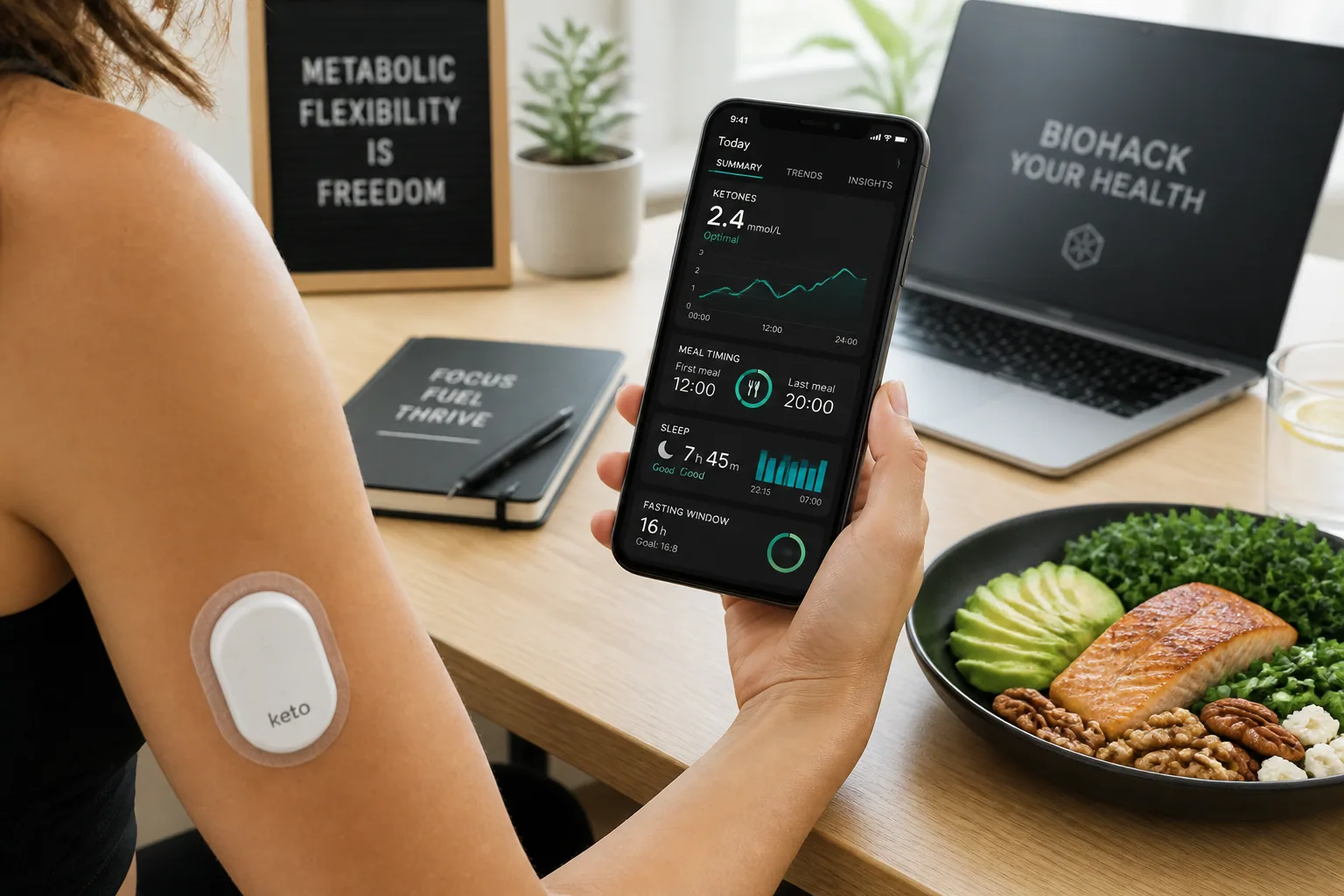
Wearable Ketone Monitoring & Meal Timing: Real-Time Insights for a Smarter Keto Lifestyle
Keto used to be a diet built on estimates. You counted carbs, checked the scale, maybe tested a blood ketone strip once in a while, and hoped your routine was working. But ketosis is not static, and your body does not respond to food timing, sleep, exercise, and stress in a neat, predictable way. That is why continuous ketone monitoring is such a promising shift. Instead of asking, “Am I in ketosis today?” you can start asking better questions like, “What meal knocked me out of range?” or “Why do my ketones rise on early dinners and fall after late-night snacking?”
That is the real value of wearables: not perfection, but feedback. When you combine real-time ketone data with chrononutrition, the study of when you eat, you get a clearer picture of how your lifestyle affects fat oxidation, appetite, energy, and metabolic health. And while no sensor can replace common sense, a good one can help you spot patterns you would otherwise miss.
Why Keto Needs Better Feedback Than Occasional Testing
Traditional ketone testing gives you snapshots. A fingerstick can tell you what happened at that exact moment, but it cannot show the trend across your day, your sleep, or your meals. That makes it easy to misread your results. You might think a low reading means your diet failed, when in reality you just measured after a meal, after a hard workout, or at a time when your body naturally uses more glucose.
This is where continuous or near-continuous ketone monitoring changes the game. Ketones fluctuate with food intake, fasting duration, exercise, and circadian rhythm. If you only test occasionally, you can easily mistake normal variation for a problem. Wearable monitoring helps move the focus from isolated numbers to overall metabolic behavior.
It also matters because keto is highly personal. Two people can eat the same meal and see different ketone responses based on sleep quality, insulin sensitivity, training load, or even what time of day they ate. Better feedback means better adjustments, especially if your goal is not only ketosis, but sustainable energy and appetite control.
What Continuous Ketone Monitoring Is and How It Works
Continuous ketone monitoring, often shortened to CKM, aims to track ketones in real time or near real time through wearable or minimally invasive sensors. Instead of relying on a single fingerstick, these devices aim to follow changes throughout the day, much like continuous glucose monitoring does for glucose.
Recent research shows how quickly this field is evolving. A microneedle-based continuous ketone monitoring patch developed in an ACS Sensors pilot study tracked interstitial β-hydroxybutyrate, or BHB, and closely followed intake of ketone drinks in humans, compared with fingerstick BHB. That is an important proof of concept because it shows wearable ketone data can reflect meaningful metabolic changes, not just lab noise. Source: https://pubmed.ncbi.nlm.nih.gov/38300831/
Other approaches are also emerging. A 2024 wearable sensor used iontophoresis-triggered sweat collection and a microfluidic channel to measure sweat β-HB with a low detection limit of around 10 μM, and it showed high correlation with blood β-HB during 7 days on a ketogenic diet. Source: https://www.sciencedirect.com/science/article/pii/S0925400524012486
Researchers are also exploring fluorescent microfluidic chips for sweat-based detection. A novel wearable microfluidic chip with a fluorescent probe called BHI was reported to provide highly selective detection of β-HB in human sweat, pointing toward rapid and non-invasive ketone diagnostics. Source: https://www.sciencedirect.com/science/article/pii/S0925400526000249
The big idea is simple: wearable ketone tracking aims to make ketosis visible in daily life, not just during occasional lab-style checks.
BHB vs Acetone: What Wearables Are Actually Measuring
Not all ketone measurements are the same. The two most common signals are β-hydroxybutyrate, usually shortened to BHB, and acetone. BHB is the main circulating ketone in blood and is often treated as the gold standard for nutritional ketosis. Acetone, by contrast, is a breakdown product that appears in breath and can also be detected in skin emissions.
Many wearable platforms try to infer ketosis from BHB, especially in interstitial fluid or sweat. That is useful because BHB is directly relevant to fuel metabolism. But acetone-based devices are also gaining attention because they can be non-invasive and may still capture whether you are in ketosis versus not in ketosis.
A recent Nature-linked study on skin acetone reported that the skin acetone excretion rate and breath acetone had ROC-AUC values of about 0.82 to 0.83 for distinguishing ketosis from non-ketosis compared with blood BHB. In plain language, that suggests acetone on the skin could be a fairly reliable non-invasive biomarker of ketosis. Source: https://pubmed.ncbi.nlm.nih.gov/42414265/
Breath acetone has also shown promise. In a 14-day validation study with a portable breath acetone meter, researchers collected about 1,214 paired readings from 21 subjects. Single time-point correlation with blood BHB was moderate, with R² around 0.57, but daily ketone exposure tracked much more strongly, with R² around 0.80 for the area under the curve. Source: https://pmc.ncbi.nlm.nih.gov/articles/PMC7520093/
That distinction matters. A single reading may not tell you much, but a pattern across hours or days can reveal the real metabolic story.
How Accurate Are Ketone Wearables Right Now?
Accuracy is improving, but it is still early. The best way to think about wearable ketone devices today is as trend tools rather than perfect diagnostic instruments. They can be helpful, but they are not yet interchangeable with lab-grade blood testing in every context.
One reason is sampling biology. Capillary blood ketone readings can be significantly higher than venous whole-blood readings using the same device. In a study on induced ketosis in healthy older adults, capillary versus venous BHB values showed regression slopes of about 0.64 to 0.78, which means cutoffs need to be interpreted differently depending on the sample source. Source: https://pubmed.ncbi.nlm.nih.gov/31821040/
Another reason is sensor stability. A 2025 continuous ketone monitoring trial reported sensor drift over time, with BHB concentrations declining day to day in both ketone ester and placebo groups, likely because of sensor degradation rather than a true physiological drop. That is a critical reminder that a wearable can drift even when your metabolism is stable. Source: https://pmc.ncbi.nlm.nih.gov/articles/PMC12799078/
So what should you trust? Use wearables to observe direction, timing, and relative response. For example, if a meal repeatedly lowers your ketones for several hours, that is more useful than obsessing over whether you are at 0.7 or 0.9 mmol/L in a single reading.
What Good Ketone Data Looks Like in Real Life
Good ketone data is not a perfect straight line. It usually shows understandable rhythms. You may see ketones rise overnight, dip after a larger meal, recover during a long fasting stretch, or increase after lower-intensity exercise. That is normal and useful.
The best patterns are the ones that repeat. If you consistently see stronger morning ketones after an early dinner, or a sharper dip after dessert, you have found a signal you can act on. If your data jumps randomly without a clear connection to meals, sleep, or workouts, you may be looking at sensor noise, hydration effects, or day-to-day variability.
In real life, good ketone monitoring helps answer practical questions. Which breakfast keeps me in ketosis longer? Does a late workout raise ketones or suppress them later? Does a higher-fat dinner help or hurt overnight ketone production? The goal is not to score your diet, but to learn how your body responds.
Chrononutrition 101: Why Meal Timing Changes Metabolism
Chrononutrition looks at how meal timing interacts with the body clock. Your metabolism is not identical at 8 a.m. and 10 p.m. Circadian biology affects glucose handling, insulin sensitivity, fat oxidation, hunger hormones, and sleep quality. That means two identical meals can have very different metabolic outcomes depending on when you eat them.
This is especially relevant for keto, where the goal is often to shift the body toward fat burning and ketone production. Eating late can work against that goal, not only because of extra calories, but because the body may be less metabolically flexible at night. In other words, timing can matter as much as food choice.
Research supports this idea. In a randomized crossover study, healthy adults who delayed dinner by about 4 hours, from 19:00 to 23:00, while keeping sleep time constant, had reduced fat oxidation and a higher respiratory quotient, which means they shifted toward carbohydrate metabolism. Source: https://pmc.ncbi.nlm.nih.gov/articles/PMC9691571/
That is a useful reminder for keto eaters: if ketones are lagging, the problem may not be the macros alone. It may be the clock.
Early Time-Restricted Eating and Its Impact on Ketosis
Early time-restricted eating, or eTRE, means placing your eating window earlier in the day. Instead of eating late into the evening, you finish dinner early and often stop eating by mid-afternoon or early evening. For many keto followers, this lines up naturally with improved energy, better appetite control, and more stable overnight ketones.
Evidence increasingly supports early eating windows. In a randomized trial published in JAMA Internal Medicine, participants doing an 8-hour early eating window from about 7:00 to 15:00 lost more weight over 14 weeks than those eating across a window of at least 12 hours, with -6.3 kg versus -4.0 kg. Source: https://jamanetwork.com/journals/jamainternalmedicine/fullarticle/2794819?cmp=1
A broader 2026 systematic review and network meta-analysis in BMJ Medicine, spanning 41 randomized controlled trials and 2,287 participants, found that eTRE with the last meal before about 17:00 produced greater improvements in weight, BMI, waist circumference, fasting glucose, insulin, and triglycerides than late TRE. Source: https://pubmed.ncbi.nlm.nih.gov/41586347/
Another randomized crossover trial in healthy adults found that eating between 08:00 and 14:00 for 9 days reduced 24-hour mean glucose and glycemic variability compared with consuming the same calories later between 08:00 and 20:00, even though intestinal nutrient absorption did not change. Source: https://pubmed.ncbi.nlm.nih.gov/38232698/
For keto, the practical takeaway is clear: earlier eating windows may make ketosis easier to maintain, especially overnight and the following morning.
How Late-Night Eating Can Disrupt Ketones, Sleep, and Appetite
Late-night eating is one of the easiest ways to flatten a ketone curve without realizing it. A meal close to bedtime can delay the period when insulin drops, suppress overnight fat oxidation, and reduce the chance that ketones rise strongly during sleep.
But the impact is not only metabolic. Eating late can also affect sleep quality, and poor sleep can increase hunger, cravings, and next-day glucose instability. That creates a loop where you snack more, sleep worse, and generate less ketone production the next day. Wearables can help identify that loop before it becomes a habit.
If your sensor shows a consistent ketone dip after evening snacking, that is valuable. It may not mean your diet is wrong. It may simply mean your eating window is too late for your physiology. Even a modest adjustment, like finishing dinner two or three hours earlier, can produce a meaningful difference over time.
Using Real-Time Ketone Data to Test Meals and Fasting Windows
One of the smartest uses of wearable ketone data is self-experimentation. Instead of changing everything at once, test one variable at a time. For example, keep your breakfast constant and compare a high-fat lunch to a protein-forward lunch. Or compare a 14-hour overnight fast with a 16-hour fast and watch the ketone response.
The best experiments are simple and repeatable. Track the time of the meal, what you ate, your ketone trend in the next 2 to 6 hours, and how you felt the next morning. Over time, you will start to see whether your body prefers smaller dinners, earlier meals, or a specific fasting window.
This is where wearables shine. They let you see response patterns in real time rather than relying on memory. If a certain meal consistently lowers ketones for the rest of the evening, that is a strong clue. If a short fast raises ketones but leaves you hungry and irritable, that is also useful data. The goal is not maximum ketones at all costs. The goal is a sustainable routine that supports energy, appetite control, and long-term adherence.
And if you are still figuring out which foods fit your plan, a tool like Keeto - Keto Made Easy can help simplify the food side of the equation. You can scan products, check net carbs instantly, and reduce the guesswork while you focus on how timing affects your ketones. Learn more here: https://findthe.app/keeto-5m0vbj
How to Sync Ketone Tracking With Sleep, Exercise, and Daily Routine
Ketone data becomes much more useful when you layer it onto the rest of your routine. Sleep, exercise, caffeine, stress, and meal timing all influence what your sensor shows. That is why context matters so much.
Sleep is especially important because poor sleep can increase hunger and alter glucose regulation, which may lower ketone stability the next day. If your overnight ketones look great after a solid sleep but flatline after a short night, the sensor may be showing a real circadian effect, not random noise.
Exercise is another major variable. Some people see ketones rise after walking or low-intensity training, while others notice temporary dips after harder workouts because the body is replenishing glycogen or responding to stress hormones. The key is to identify your own response. Wearable ketone data can help you decide whether to train before breakfast, after your first meal, or later in the day.
You can also use routine anchors. For example, keep a consistent dinner time for a week, then adjust it earlier by 60 to 90 minutes and compare the trend. Or keep your training schedule steady and shift only your evening meal. The more consistent the rest of your routine, the easier it is to see what really changes your ketones.
Common Pitfalls: Sensor Drift, Overreacting to Readings, and Hormonal Mismatch
The first common mistake is sensor drift. A wearable may slowly lose accuracy over time, which can make it seem like your ketones are dropping even when your diet has not changed. That is why trends should always be interpreted alongside your actual routine. If the device trends downward across days in a way that does not match your behavior, consider drift as a possibility rather than assuming your metabolism has suddenly changed.
The second mistake is overreacting to single readings. Ketones naturally bounce around. One low value after lunch does not mean your body is out of ketosis forever, and one high value after fasting does not mean you have achieved perfect metabolic flexibility. Look for repeated responses to repeated behaviors.
The third mistake is what you might call hormonal mismatch. You may be following keto macros well, but if you are eating late, sleeping poorly, or training hard without enough recovery, your ketone data may look underwhelming. That is not necessarily a failure of keto. It may be a sign that your lifestyle inputs are working against your desired state.
In practice, the best correction is patience. Use the data as a conversation, not a verdict.
A Practical Daily Framework for Smarter, More Sustainable Keto
A smarter keto routine does not start with chasing the highest possible ketone number. It starts with creating a repeatable structure and then using feedback to fine-tune it.
Here is a practical framework. First, keep your meal composition consistent enough to interpret your data. Second, choose an eating window that is realistic, preferably one that ends earlier in the day if your schedule allows. Third, observe how your ketones change after meals, after workouts, and overnight. Fourth, note how those patterns affect hunger, energy, and sleep. Fifth, make one small change at a time and compare the next several days, not just the next hour.
If your ketones rise more reliably after early dinners, keep that habit. If a certain snack causes a recurring dip in the evening curve, replace it. If late-night eating crushes your overnight trend and makes you hungrier the next morning, treat that as actionable evidence. Over time, your wearable becomes less like a gadget and more like a guide.
That is the promise of continuous ketone monitoring paired with meal timing. It gives you a more personal version of keto, one based on your own biology instead of generic advice. And once you stop guessing, keto becomes easier to sustain.