Traveling Keto: How to Stay in Ketosis on the Go Without Stress
Travel can make keto feel harder than it really is. Between airport food courts, client dinners, hotel buffets, delayed flights, and changing time zones, even a disciplined routine can get messy fast. The good news is that ketosis is usually resilient once you understand what actually knocks you off track and what helps you recover quickly.
For most people, keeping daily carbs around 20 to 50 grams is enough to enter nutritional ketosis within 2 to 4 days (healthline.com). And if you are already keto-adapted, a travel slip does not have to turn into a long detour. Research suggests returning to ketosis after a carb mistake can take roughly 24 to 48 hours for adapted eaters (biologyinsights.com). The key is to have a simple system before you leave, not willpower in the middle of a rushed travel day.
Why Traveling Can Throw Keto Off Track
Travel disrupts the exact habits keto depends on most: predictable meals, easy access to protein, and enough water and electrolytes. When you are rushing through terminals or living out of a suitcase, it becomes much easier to grab something carb-heavy because it is convenient, familiar, or the only option available.
There is also a biological side to it. Air travel and dry cabin environments can promote dehydration and electrolyte loss, and studies note that maintaining hydration helps alertness and can reduce the drained feeling often called airplane fatigue (ketozone.com). On keto, this matters even more because the diet itself causes the body to shed glycogen, which releases water and increases excretion of electrolytes, especially sodium and potassium (drberg.com).
Travel also tends to shift meal timing, sleep, and light exposure, which can affect glucose regulation and digestion. When meals are mistimed relative to local schedules, studies on shift work and jet lag show disruptions in glucose, triglycerides, digestion speed, and metabolic efficiency (openresearch.surrey.ac.uk). In other words, the challenge is not only what you eat, but when you eat it.
Pre-Trip Keto Planning That Prevents Slip-Ups
The best way to stay keto on the road is to decide in advance how you will handle the common problem points: breakfast, airport waits, late arrivals, and restaurant menus. A little planning turns a stressful trip into a mostly automatic one.
Start by mapping out your travel window. Ask yourself where the weak spots are likely to be. Are you leaving before breakfast? Do you have a long layover? Will you arrive late and too tired to think? Once you know the pressure points, you can pack food, decide your fasting window, and identify one or two safe meal options before you leave.
It also helps to pre-check your destinations. A quick scan of nearby grocery stores, salad bars, steakhouses, or low-carb friendly restaurants removes a lot of guesswork. Tools that help you track macros, review menus before arriving, and locate health-food stores can dramatically reduce stress and carb surprises (carbmanager.com).
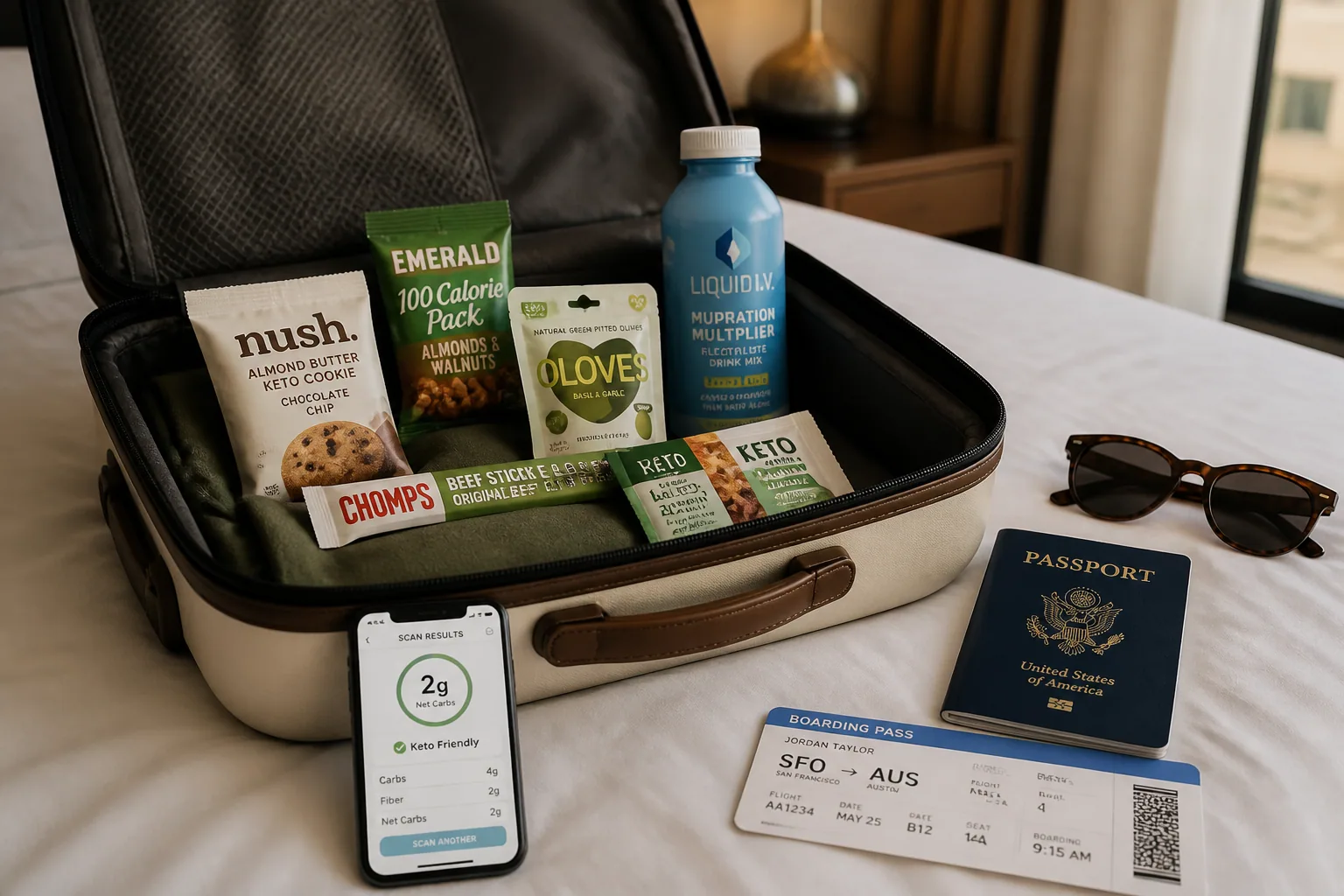
If you want to make this even easier, a scanner app like Keeto can be a practical travel companion. It gives you an instant keto verdict from a barcode scan, shows net carbs, and tracks how much of your daily budget you have left. For travel days, that kind of quick feedback can save you from guessing in a gas station, grocery aisle, or hotel market. You can learn more here: https://findthe.app/keeto-5m0vbj
Best Carb-Scanning Tools and Apps for Travel Days
Travel is where carb-scanning tools shine. A label that looks harmless can hide enough sugar or starch to push you over your limit, especially if you are grazing all day instead of eating one or two planned meals. Scanning tools reduce the mental load and let you make fast decisions without doing math under pressure.
The most useful features are simple: barcode scanning, net carb counts, saved favorites, and a clear daily limit. Some travelers also like apps that help them search restaurant menus, log meals, or build shopping lists before departure. The point is not to micromanage every bite. It is to give yourself a fast yes or no when you are tired, hungry, and surrounded by convenience food.
If you are the kind of traveler who likes structure, consider combining a scanner with a short list of default purchases you know are safe. That way, instead of wondering what to buy in an unfamiliar store, you already know your backup staples and can get in and out quickly.
What Keto Snacks to Pack for Flights, Road Trips, and Hotel Stays
A strong keto travel bag is your safety net. It should include foods that are shelf-stable, easy to portion, and unlikely to melt, spoil, or crumble into a mess. The goal is to prevent desperation eating, not just survive hunger.
Some of the most reliable portable keto snacks include sugar-free beef jerky, nuts like macadamias, walnuts, and almonds, nut butter packets, dark chocolate with 85 percent cacao or higher, cheese crisps, seaweed, olives, and tuna pouches (sibiosensor.com). These are useful because they are compact, filling, and easy to eat in transit without needing a full meal setup.
A good rule is to pack a mix of protein, fat, and a little texture. Protein helps with satiety. Fat buys you endurance between meals. Crunchy snacks can make travel food feel more normal and less restrictive. If you know you get hungrier on long flights, pack enough for the return trip too, not just the outbound leg.
Also think in terms of zones. Keep one snack in your personal item, one in your carry-on, and one in the car or checked luggage if applicable. Travel is unpredictable. Food access should be too easy to fail.
How to Eat Keto in Airports Without Settling for Junk
Airports are designed to make you grab whatever is closest, not whatever is best for your metabolism. That is why having a default airport strategy matters. You do not need a perfect meal, just a deliberate one.
Start by looking past the obvious snack shops and toward simple protein-first options. Think omelets, eggs, bunless burgers, salads with grilled chicken, plain deli meat, or a cheese and nuts combination. If there is a grocery kiosk, use it. A rotisserie chicken, hard-boiled eggs, olives, cheese sticks, and bottled water are often easier to find than a truly keto restaurant meal.
When the best option is still imperfect, reduce the damage. Skip the bread, fries, crackers, juice, and sweet coffee drinks. Ask for sauces on the side. Choose sparkling water or plain coffee instead of a drink that turns a small carb load into a large one. In airports, the win is usually choosing the least processed option with the highest protein and lowest hidden sugar.
If you are facing a long layover, it can be smart to eat one clean keto meal early and then fast until you land. That keeps you from snacking your way through the terminal and helps preserve your routine.
Smart Ordering Tips for Hotels, Conferences, and Restaurants
Hotels and business trips are often where keto goes sideways, because meals become social instead of intentional. The trick is to simplify your order and make the kitchen do the customizing for you.
At hotels, breakfast is usually the easiest place to win. Look for eggs, bacon, sausage, smoked salmon, avocado, unsweetened yogurt if it fits your macros, and vegetables if available. Skip pastries, cereal, waffles, juice, and flavored coffee creamers. If the hotel buffet is weak, ask whether you can order eggs or a side of protein instead of settling for whatever is on display.
At conferences, prioritize the main protein and vegetables first. Build your plate around chicken, fish, beef, or eggs, then add salad or low-carb vegetables. Be cautious with buffet sauces and “healthy” bowls, because those often contain more sugar or starch than they seem to at first glance. If lunch is a sandwich-only setup, eat the fillings and leave the bread.
In restaurants, the easiest keto orders are usually built from a protein, a vegetable, and a fat source. Examples include steak with asparagus, salmon with salad, grilled chicken with broccoli, or a bunless burger with extra vegetables. Ask for butter, olive oil, or mayo-based sauces when appropriate. You are not being difficult. You are just making the meal fit your goal.
How to Spot Hidden Carbs in Sauces, Dressings, and ‘Healthy’ Options
The most common travel keto mistake is assuming that a meal is low carb because it looks clean. Sauces, marinades, glazes, dressings, and “light” menu items often contain the carbs that quietly add up.
Watch out for teriyaki, barbecue sauce, sweet chili sauce, honey mustard, balsamic glaze, and anything described as honey-roasted or glazed. In salads, the biggest traps are sweet dressings, dried fruit, candied nuts, and crispy toppings. In breakfast foods, granola, flavored yogurt, and oatmeal can seem healthy while being highly carb-dense.
When in doubt, ask for ingredients or keep it simple. Oil and vinegar, plain butter, mayo, sour cream, avocado, and cheese are usually easier to work with than mystery sauces. If you are trying to avoid a carb surprise, fewer ingredients is usually better.
This is where pre-trip menu checking can pay off. If you already know what the likely hidden carb sources are, you can ask for substitutions before the meal even arrives.
Adjusting Meal Timing and Fasting Windows Across Time Zones
Traveling keto is not only about food quality. It is also about timing. Meal timing can help your body adapt to a new schedule more smoothly, especially when crossing time zones.
A practical approach is to fast for 12 to 16 hours before your first meal in destination time, then break the fast with a protein-rich meal aligned with local breakfast or lunch hours (uncompromised.travel). This gives your body a clear cue that the day has started in the new time zone. It can also help reset peripheral clocks and make the transition feel less chaotic.
Jet lag tends to be worse when traveling eastward, and central body clocks shift only about an hour per day without intervention (link.springer.com). That means a big time zone jump can take several days to normalize. If you can, anchor your meals to local daylight and local sleep timing rather than eating by your home schedule.
A good travel rule is to avoid random snacking during the transition. Pick one or two meal windows, eat enough protein to stay satisfied, and let fasting do some of the work for you. If you are used to intermittent fasting at home, travel can actually be a chance to lean on that habit more intentionally.
Hydration and Electrolytes: The Travel Keto Fix Most People Miss
If traveling makes you feel oddly tired, headachy, or foggy, the problem may not be carbs at all. It may be dehydration and electrolyte loss. Keto already increases fluid and sodium needs because glycogen depletion releases water and increases electrolyte excretion (drberg.com). Add dry airplane air, more walking, more coffee, and less predictable meals, and your hydration needs go up fast.
This is one of the most overlooked parts of travel keto. Studies note that dehydration and electrolyte losses are common during travel, and maintaining hydration can improve alertness and reduce airplane fatigue (ketozone.com). That means a bottle of water and a plan for sodium can matter as much as your snack bag.
A simple travel hydration strategy is to drink water consistently, not all at once, and to include sodium through broth, salted food, or an electrolyte mix that fits your preferences. If you tend to cramp, feel lightheaded, or get headaches on travel days, pay even closer attention. Sometimes what feels like a keto problem is really a hydration problem.
If you are crossing multiple time zones or flying overnight, hydration can also help you recover faster on arrival. You will still feel the time shift, but you are less likely to stack dehydration on top of jet lag.
What to Do If You Get Kicked Out of Ketosis While Traveling
Sometimes travel wins. You miss a meal, eat the wrong thing, or get stuck with whatever was available. The important thing is not to panic. One carb-heavy meal does not erase your progress.
If you do slip, your first step is to return to your normal keto basics at the very next meal. Keep carbs low, prioritize protein, and avoid the urge to turn one off-plan meal into a whole day of grazing. If you are already keto-adapted, research suggests you may be back in ketosis in roughly 24 to 48 hours (biologyinsights.com).
A short fast can help if it feels natural for you. So can a walk after meals, extra water, and a clean plate pattern for the rest of the day. If you use ketone monitoring, continuous ketone devices have shown stable and responsive readings in human trials over 14 days, which may be useful for seeing how meals, fasting, and travel conditions affect ketosis in real time (pmc.ncbi.nlm.nih.gov).
The main goal is to recover quickly, not to punish yourself. Keto works best when it feels like a system you can return to, not a test you can fail.
Post-Trip Recovery: Resetting Macros and Rebuilding Momentum
When you get home, do not wait for Monday. The sooner you return to your normal rhythm, the easier it is to feel back in control. Start with a clean keto meal, a normal shopping routine, and a reset of your carb targets in whatever tracker or app you use.
If your trip was especially chaotic, it can help to spend one day simplifying everything. Eat familiar meals, avoid restaurant extras, hydrate well, and get back to your usual fasting window. If you have been eating later than usual, bring your meal timing back toward home schedule gradually over a day or two.
For people who traveled eastward and feel especially off, expect that it may take a bit longer to feel normal. The body does not always snap back instantly, especially after sleep disruption. But the combination of low-carb meals, a stable fasting window, hydration, and sleep can restore momentum surprisingly fast.
This is also a good time to restock your travel bag. Replace eaten snacks, charge your scanner device or phone tools, and make a note of what worked and what did not. The best travel keto system gets better with every trip.
A Simple Keto Travel Checklist to Use Before Every Trip
Use this as a quick pre-departure system so you are not improvising later:
Check your destination and identify at least one safe restaurant, grocery store, or hotel breakfast option.
Pack shelf-stable keto snacks such as jerky, nuts, tuna pouches, cheese crisps, seaweed, olives, or nut butter packets.
Load a carb-scanning or macro-tracking tool so you can verify foods quickly.
Decide your travel-day meal timing, especially if you are crossing time zones.
Bring water and a plan for electrolytes, especially for flights and long driving days.
Know your default restaurant order in advance: protein, vegetable, no bun, sauce on the side.
If you slip, reset at the next meal instead of waiting until the trip is over.
Traveling keto gets much easier when you stop expecting perfect conditions. With a few repeatable habits, you can stay in ketosis, eat well, and still enjoy the trip without feeling restricted.