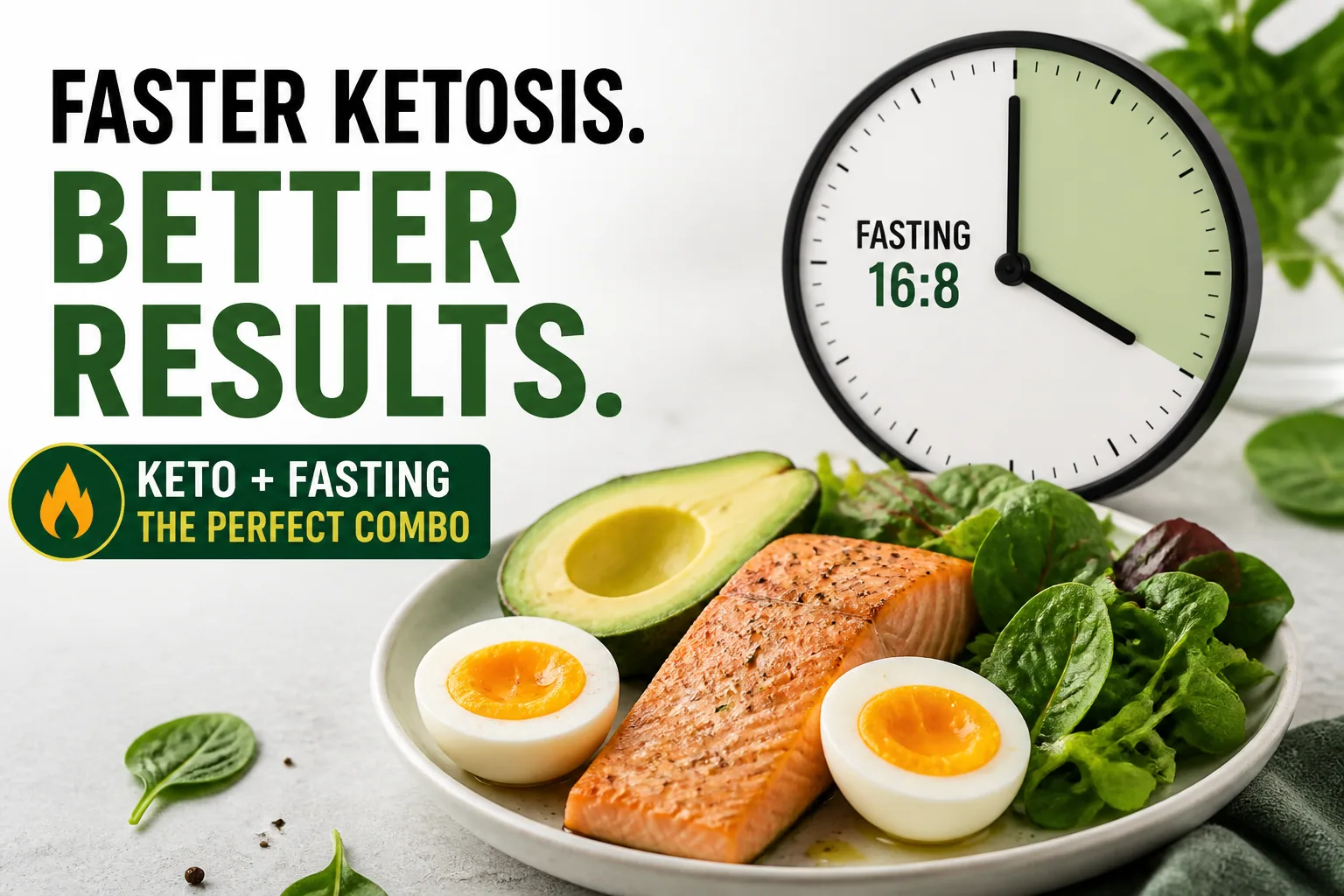
The Keto + Fasting Power Duo: How Intermittent Fasting Speeds Up Ketosis and Boosts Results
Keto and intermittent fasting are often talked about separately, but they tend to work even better when used together. Keto lowers your carbohydrate intake so your body relies more on fat for fuel, while fasting shortens the time you spend refueling with glucose. Put simply, keto changes what you eat, and fasting changes when you eat. When both are aligned, many people find it easier to enter ketosis, stay there longer, and make progress with fewer cravings and less meal-driven decision fatigue.
This combination is appealing because it can speed up glycogen depletion, encourage greater fat oxidation, and help create the metabolic conditions that support ketosis. Research suggests that liver glycogen stores are typically depleted within 18 to 24 hours of fasting, and measurable ketosis often begins around 12 to 16 hours after fasting starts, depending on activity level, carb intake, and metabolic history. Sources: https://superpower.com/guides/how-long-to-deplete-glycogen and https://myfastingcalc.com/blog/when-does-ketosis-start-fasting
Why Keto and Intermittent Fasting Work So Well Together
The reason this duo feels so powerful is that both strategies push the body toward lower insulin levels and greater use of stored fat. On keto, your daily carb intake is already low enough that glycogen replenishment is reduced. Add a fasting window, and you reduce glucose availability even further. That makes the body more likely to switch from burning dietary glucose to burning fatty acids and producing ketones.
In practical terms, keto lays the groundwork, and fasting helps finish the job. Instead of waiting for your body to gradually burn through a large carbohydrate reserve, you narrow the window in which glycogen can be topped up. For many people, that means faster entry into nutritional ketosis and a smoother transition into fat-adapted metabolism.
There is also a behavioral advantage. Fasting naturally limits opportunities to snack, which can make it easier to keep carbs low without constant willpower battles. That matters because consistency is often the difference between barely getting into ketosis and staying there long enough to notice changes in hunger, energy, and appetite control.
How Fasting Helps You Reach Ketosis Faster
Ketosis begins when glycogen availability drops low enough that the liver increases ketone production to help supply energy. Fasting speeds this process because it reduces the incoming glucose stream and lowers insulin, which increases lipolysis and encourages the body to tap into stored fat. If you are already eating very low carb, the transition can happen faster than most people expect, sometimes in less than 24 hours with the right activity level and a prior low-carb background.
That said, the speed of the transition depends on context. Someone coming from a high-carb diet may take longer to deplete glycogen than someone who has already been eating keto for several days. Exercise can accelerate the process as well, because activity increases glycogen use. In other words, fasting does not create ketosis by magic. It simply removes one of the biggest obstacles to getting there: repeated carbohydrate refueling.
A useful way to think about it is this: keto lowers the ceiling on glucose intake, while fasting gives your body time to spend what is already stored. Together, they create a stronger signal to shift into fat burning and ketone production.
Keto Alone vs. Keto Plus Fasting: Timelines and Trade-Offs
Keto alone can absolutely produce ketosis, but the timeline is often slower and more variable. If someone eats very low carb consistently, ketosis may begin within a day or two, but many people notice a more stable adaptation phase over one to three weeks. Fasting can compress that timeline by reducing the time available for glycogen replenishment and by lowering insulin between meals.
Research also shows that the benefits are not just about getting ketones on a meter. A three-week ketogenic diet in people with obesity increased skeletal muscle insulin sensitivity, reduced basal endogenous glucose production, and lowered fasting glucose, with an average weight loss of 2.2 kg. Source: https://pmc.ncbi.nlm.nih.gov/articles/PMC11417439/
But the trade-offs matter too. In obese individuals with type 2 diabetes, a weight-maintaining ketogenic diet over 10 days achieved ketosis without improving glycemic control or tissue insulin sensitivity. Source: https://pmc.ncbi.nlm.nih.gov/articles/PMC11492932/ That is a good reminder that ketosis is not identical to metabolic improvement. For many people, weight change, energy balance, and overall diet quality still play major roles.
A smart takeaway is to use fasting as a tool, not a shortcut. It may help you reach ketosis faster, but long-term results still depend on food quality, protein adequacy, hydration, sleep, stress management, and whether the protocol fits your life.
The Best Fasting Protocols to Pair With Keto
The best fasting method is usually the one you can follow consistently without overthinking every meal. On a ketogenic diet, the most common approaches are time-restricted eating patterns such as 16:8, 18:6, 20:4, and OMAD, which stands for one meal a day.
A 16:8 schedule, where you fast for 16 hours and eat within an 8-hour window, is often the easiest entry point. It can support mild ketosis, especially if carbs stay low during the feeding window. An 18:6 or 20:4 pattern tends to push ketone levels a bit higher because the fasting period is longer and the body spends more time relying on fat stores. OMAD and 24-hour fasts may produce the deepest fasting-related ketone rise, but they are also harder to sustain and can make it more challenging to meet protein and micronutrient needs.
According to one guide, 16:8 often corresponds to mild ketosis around 0.5 to 1.0 mmol/L after about 16 hours, while 18:6 or 20:4 may support deeper mild ketosis around 1.0 to 2.0 mmol/L. OMAD or 24-hour fasts can be associated with ketone levels above 1.5 to 3.0 mmol/L when paired with a low-carb background. Source: https://beketo.uk/ketosis/intermittent-fasting/
For most people, the sweet spot is a protocol that lowers insulin exposure without creating burnout. If you are new to fasting, starting with 12:12 or 14:10 and gradually moving into 16:8 is often more realistic than jumping straight into OMAD.
How to Structure Meals, Macros, and Carb Limits During Feeding Windows
Once you compress eating into a smaller window, meal composition matters even more. The feeding window should not become a free-for-all. Instead, it should be built around enough protein, enough healthy fat for satiety, and carbohydrate intake that stays within your keto target.
For many people, strict keto means staying near 20 grams of net carbs per day, while some do well with 30 grams or a customized limit based on activity, metabolic health, and personal tolerance. Protein should be adequate, not overly restricted. If protein is too low, you may lose muscle mass or feel unsatisfied between meals. If it is excessively high for your personal carb and calorie target, it may make hunger and ketosis management harder for some people.
A practical structure is to center each meal around a protein source, add low-carb vegetables, then include fat to complete the meal and support satiety. If you are fasting, this also helps prevent the all-too-common pattern of breaking a fast with random snacks that are technically keto but nutritionally thin.
The goal is to make every eating window count. Since you have fewer chances to eat, each meal should provide real nutritional value instead of just fitting the macro numbers.
Benefits Beyond the Scale: Fat Loss, Insulin Sensitivity, Focus, and Autophagy
People often start keto plus fasting for weight loss, but the benefits many notice first are lower hunger, steadier energy, and clearer mental focus. That makes sense biologically. When insulin is lower and blood sugar is less volatile, many people experience fewer energy crashes and less urge to snack.
From a fat loss perspective, ketogenic diets appear to improve body composition through multiple pathways, including increased lipolysis, reduced lipogenesis, smaller adipocyte size, lower inflammatory cytokines, and greater adiponectin secretion. A review also notes that many of these benefits can occur with or independently of weight loss. Source: https://pubmed.ncbi.nlm.nih.gov/37513538/
There is also interesting evidence for fasting and metabolic health. In one study, moderate calorie restriction combined with low carbohydrate intake showed that liver insulin sensitivity improved after about 48 hours, while muscle insulin sensitivity tended to improve later and with greater weight loss. Source: https://pubmed.ncbi.nlm.nih.gov/19208352/ That supports the idea that the early benefits of keto plus fasting may show up in the liver first, with broader changes following over time.
Some people are also interested in autophagy, the cellular recycling process often associated with fasting. While this is an area of ongoing research and the exact timing in humans is still debated, the general logic is straightforward: when feeding is reduced and energy demand must be met from internal reserves, the body shifts its maintenance priorities. Fasting may contribute to that shift, but it should not be treated as a guaranteed therapy.
What the Current Research Says About Combining Keto and IF
The research picture is encouraging but nuanced. On the positive side, ketogenic diets have been associated with improved insulin sensitivity, lower fasting insulin, lower triglycerides, and reduced postprandial lipemia in several studies. For example, a six-week ketogenic diet in normal-weight, normolipidemic men reduced fasting insulin by about 34 percent, triglycerides by about 33 percent, and postprandial lipemia by about 29 percent. Source: https://pubmed.ncbi.nlm.nih.gov/12097663/
At the same time, not every ketogenic intervention produces the same outcome. The weight-maintaining diabetes study mentioned earlier showed ketosis without metabolic improvement, which suggests that calorie balance, baseline insulin resistance, and duration all matter. Fasting may help by increasing the time spent in a low-insulin state, but it is not a replacement for overall metabolic strategy.
Taken together, the research supports a balanced conclusion: keto plus fasting can be a powerful tool for many people, especially for appetite control, fat oxidation, and improving markers like fasting insulin and triglycerides. But the best outcomes usually come from a well-formulated plan rather than extreme restriction.
Risks, Side Effects, and Who Should Be Cautious
As helpful as keto and fasting can be, they are not appropriate for everyone. People with a history of eating disorders, pregnant or breastfeeding individuals, and anyone with a medical condition that affects glucose regulation should be cautious and speak with a clinician before starting. The same is true for people taking insulin, sulfonylureas, blood pressure medication, or any treatment that may need adjustment when food timing changes.
The most common early side effects are fatigue, headaches, dizziness, constipation, irritability, and poor exercise performance. Some of this comes from the transition itself, but some of it comes from electrolyte loss and inadequate fluid intake. If you try to combine aggressive fasting with very low carb intake too quickly, you can end up feeling worse instead of better.
It is also worth remembering that more fasting is not always better. If your fasting schedule makes you under-eat protein, obsess over food, or feel chronically stressed, the protocol may be too intense for your current lifestyle.
Electrolytes, Hydration, and Common Mistakes That Stall Progress
Electrolytes are one of the biggest reasons people struggle with keto and fasting. During the initial adaptation to keto, water loss increases and lower insulin leads to greater renal excretion of sodium. Potassium and magnesium can also drop, which contributes to the classic keto flu symptoms. Source: https://ketoframework.com/electrolytes-on-keto/
A common guideline on a well-formulated ketogenic or keto-plus-fasting protocol is about 3,000 to 5,000 mg of sodium per day, along with roughly 300 to 400 mg of magnesium. Source: https://ketoframework.com/electrolytes-on-keto/ and https://fastingpioneer.com/best-electrolyte-supplements-for-fasting/ Hydration matters too, but drinking more water alone will not solve the problem if sodium intake is too low.
Other common mistakes include eating too little protein, hiding too many carbs in sauces and snacks, fasting too aggressively too soon, and assuming hunger always means you need to break the fast. Often, thirst, low sodium, or simply habit are the real issues. Another frequent stall is inconsistency. A few clean keto meals with a regular fasting schedule usually work better than alternating strict days with high-carb rebounds.
This is where practical tools can make a big difference. A scanner like Keeto, the smart keto scanner at https://findthe.app/keeto-5m0vbj, can help you check net carbs at the grocery store, set carb limits, and reduce the mental load of constant label reading. That kind of friction reduction matters when your plan depends on consistency.
Practical Tools to Make Keto + Fasting Easier
The easiest keto and fasting plans are the ones that remove unnecessary decisions. Macro tracking can help in the beginning, but only if it stays simple enough to use. Grocery scanning can prevent accidental carb creep. Meal planning can keep you from breaking a fast with whatever happens to be available.
AI recipe tools are especially useful because they turn a handful of approved ingredients into a real meal plan instead of a vague intention to cook later. That is valuable when you are feeding within a short window and need meals that are fast, satisfying, and aligned with your macro goals.
A good routine might look like this: scan products before buying, save keto-friendly staples, build a short weekly shopping list, and create repeatable meals you enjoy. When the routine is easy, fasting becomes less about willpower and more about habit.
A Simple Step-by-Step Plan to Start Safely
If you want to combine keto and fasting without overwhelming yourself, start small and build gradually. First, get comfortable with keto by reducing carbs to your target range for at least several days. Make sure protein is adequate and add electrolytes early, not after symptoms begin.
Next, introduce a gentle fasting schedule such as 12:12 or 14:10. Once that feels normal, move to 16:8 if it fits your lifestyle. Keep meals structured, avoid grazing, and pay attention to energy, sleep, digestion, and mood. If you feel stable, you can experiment with 18:6 or occasional 20:4 days.
Throughout the process, prioritize recovery and sustainability. Use fasting to support your keto lifestyle, not to punish yourself. The best plan is the one you can repeat next week, next month, and long enough to create real results.
Is the Keto + Fasting Combo Right for You?
For many people, the answer is yes, especially if the goals are fat loss, appetite control, better glucose management, and fewer food-related decisions. Keto plus fasting can be a highly effective power duo because both strategies reduce insulin exposure and help the body rely more on stored fat. That is why the combination often feels easier than strict calorie counting or constant snacking.
Still, the right choice depends on your health history, stress load, and ability to meet nutritional needs within fewer meals. If you are metabolically healthy and enjoy structured eating, this approach may be a strong fit. If you have blood sugar issues, a history of disordered eating, or a demanding lifestyle that makes long fasts impractical, a gentler version may work better.
The bottom line is simple: keto and fasting can complement each other very well, but the real win comes from using them intelligently. When you combine the right carb intake, the right fasting protocol, enough electrolytes, and a sustainable meal routine, the results can be impressive and far easier to maintain than many people expect.