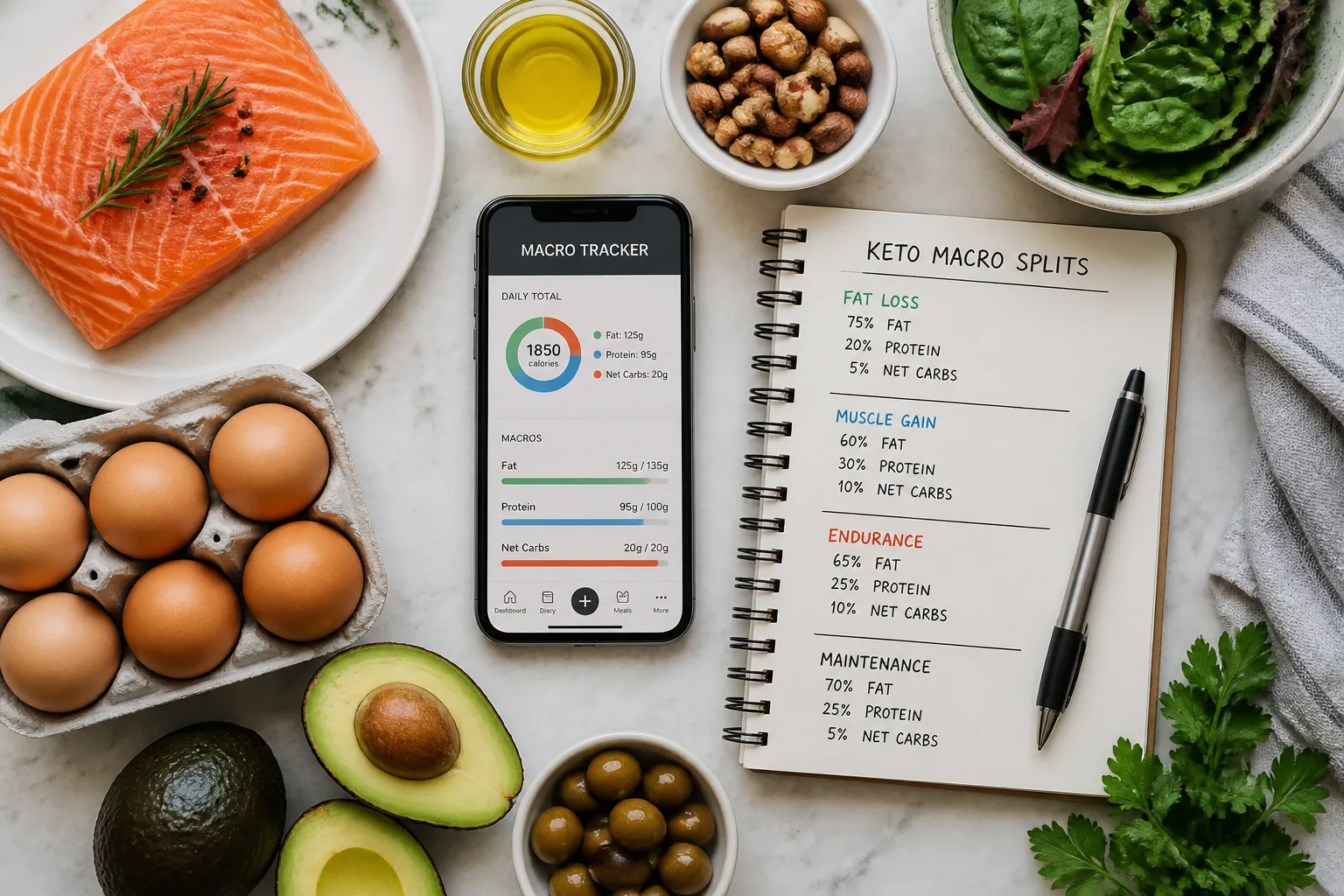
Optimal Macro Splits for Different Keto Goals: How to Balance Fat, Protein & Carbs
If you have been doing keto for a while, you already know that the classic macro formula is only a starting point. The right keto split for fat loss is not always the best split for muscle gain, training performance, or long-term maintenance. That is because fat, protein, and carbs do not play the same role in every phase. Once you understand what each macro is doing, it becomes much easier to personalize keto without fighting your results.
The goal is not to chase a perfect percentage chart. It is to build a macro setup that supports your body composition, energy, recovery, appetite, and ketone levels. For most well-formulated ketogenic diets, carbs stay low, protein stays adequate, and fat becomes the adjustable lever. In nutritional ketosis, blood beta-hydroxybutyrate levels are generally considered in the range of 0.5 to 3.0 mmol/L, with around 1.5 to 3.0 mmol/L often cited as a useful range for fat loss, while any consistent level above 0.5 mmol/L is typically enough to indicate ketosis. Research-based keto guidance also commonly places carbs around 5 to 10% of calories, protein at a level that preserves lean mass, and fat as the remaining energy source until satiety. Sources: https://www.healthline.com/nutrition/ideal-ketosis-level-for-weight-loss and https://pmc.ncbi.nlm.nih.gov/articles/PMC11212571/
Why Keto Macro Ratios Should Change With Your Goal
A strict one-size-fits-all keto ratio sounds neat, but it ignores reality. A sedentary person trying to lose fat has very different needs from a lifter trying to add muscle, and both are different again from a cyclist or runner trying to perform well on low carb. The amount of training stress, total daily activity, sleep, and recovery all influence how much protein you need, how much fat you can tolerate, and whether a small increase in carbs might actually improve outcomes without ruining ketosis.
This is also why percentages can be misleading. Two people can both eat 70% fat, 20% protein, and 10% carbs and end up with totally different gram intakes based on their calorie needs. If one is trying to lose fat and the other is trying to maintain or build, those percentages may not serve both equally well. Gram targets based on body size and goal are usually more useful than rigid percentage targets.
The Core Role of Fat, Protein, and Carbs on Keto
On keto, carbs are the macro most people manage first because they have the strongest effect on insulin and ketone production. Most well-formulated ketogenic diets keep carbs around 20 to 50 grams total per day, or roughly 5 to 10% of calories. That range helps many people maintain nutritional ketosis while still leaving room for vegetables, dairy, nuts, or small amounts of berries.
Protein is the macro that deserves the most careful attention. Too little protein can lead to muscle loss, poor recovery, and increased hunger, especially if you train hard. Research and position stands on ketogenic diets commonly support adequate protein intake, with figures often around 1.0 to 1.5 grams per kilogram per day for general keto use, and higher ranges for strength training and hypertrophy. Fat, meanwhile, is your main energy source and the macro you adjust up or down depending on whether your priority is fat loss, performance, or maintenance. It is not a license to overeat. It is the energy dial.
If you want a practical way to think about the three macros, use this framework: carbs set the ketosis boundary, protein protects your lean mass and recovery, and fat fills in the remaining energy needs. That order makes planning much easier and helps avoid the common mistake of forcing fat too high just because the diet is ketogenic.
Best Keto Macro Splits for Weight Loss
For fat loss, the best keto macro split is usually the one that keeps you in ketosis, preserves muscle, and creates a calorie deficit without making you miserable. Many experienced keto dieters do well with carbs held near the lower end of the ketogenic range, protein pushed high enough to protect lean mass, and fat reduced enough to allow fat loss from body stores rather than from the plate.
A strong starting point for weight loss is often: carbs below 20 to 30 grams net per day, protein around 1.0 to 1.2 grams per pound of lean body mass, and fat set to the minimum needed for satiety and adherence. Some guides suggest protein around 1.0 to 1.2 grams per pound of lean body mass, or goal body weight if lean mass is not known, with a calorie deficit often around 15 to 25% for steady fat loss. In percentage terms, that might still look like something close to 60 to 75% fat, 20 to 30% protein, and 5 to 10% carbs, but the actual grams matter more than the percentage label.
The biggest mistake in fat loss keto is eating too much fat because the diet says high fat. If your body has plenty of stored fat available, your meals do not need to be fat-heavy at every opportunity. A good keto fat-loss plan uses dietary fat to control hunger, not to override the calorie deficit. If weight and measurements are not changing after 2 to 3 weeks of real adherence, fat intake is often the first place to adjust.
Best Keto Macro Splits for Muscle Building
Muscle gain on keto requires a different mindset. You still need low carbs to stay ketogenic, but protein becomes more important because muscle protein synthesis depends on enough amino acids and enough total training stimulus. The ISSN position stand on ketogenic diets supports higher protein intakes for resistance training, with a range around 1.4 to 2.2 grams per kilogram of bodyweight, or roughly 0.64 to 1.0 gram per pound.
A workable muscle-building keto split often starts with carbs at 20 to 40 grams net per day, protein at the higher end of the range, and fat increased enough to support training volume and a slight calorie surplus if size gain is the goal. For many people, this means protein is no longer moderate. It becomes a primary macro, especially if lifting is frequent and progressive overload is the focus.
Do not worry if your protein is higher than what many standard keto charts recommend. In practice, a higher-protein ketogenic diet can still be compatible with ketosis, especially when carbs stay controlled and training demand is high. The real question is whether your plan is helping you add lean mass, recover well, and keep body fat in check. If performance is flat, soreness lingers, or your lifts stall, protein and total calories are usually worth reviewing before you blame ketosis.
Best Keto Macro Splits for Athletic Performance and Training
Athletic keto is often less about the lowest carb number and more about strategic carb timing, training support, and recovery. Endurance athletes and hybrid athletes may benefit from targeted keto or cyclical approaches, especially when training intensity rises. In those cases, slightly more carbs around workouts can improve performance without completely abandoning low-carb structure.
For performance-focused keto, protein should remain adequate to support repair, and fat should supply enough baseline energy so that total intake does not drift too low. Carbs may stay low on rest days and rise modestly on hard training days, particularly before or after sessions. This is where activity level matters a lot. A person doing long steady-state cardio may tolerate a different carb and fat balance than someone doing repeated sprints, interval work, or heavy compound lifts.
If training is intense, recovery is poor, or your output drops, the answer is not always to add more fat. Sometimes the body needs a small carb bump, better protein distribution, or simply more total calories. A ketogenic athlete is still an athlete, and the macro split should serve the sport, not the other way around.
Best Keto Macro Splits for Maintenance and Long-Term Adherence
Maintenance is where keto becomes more flexible. Once fat loss has been achieved, many people can raise carbs slightly within the ketogenic range and eat a bit more fat to keep weight stable. For maintenance, carbs often move toward the upper end of keto, such as 20 to 50 grams net per day, while protein stays moderate and supportive, often around 0.8 to 1.0 gram per pound of lean mass, depending on activity.
This phase is less about pushing ketones as high as possible and more about staying consistent for the long term. If you are hungry all the time, obsessing over macros, or struggling socially, your maintenance split may be too restrictive. Sustainable keto should feel repeatable. It should leave room for normal life, not just perfect tracking.
Maintenance is also a good time to test which foods keep you satisfied, which carb levels affect your energy, and whether your ketone readings matter to you at all. Some people maintain weight and health just fine with modest ketone levels, as long as their diet stays low carb, protein is adequate, and calories are stable.
How Activity Level and Workout Type Affect Your Macros
Activity level changes macro needs more than many people expect. A highly active person burns through energy faster, recovers differently, and may tolerate more total food even if carb intake stays low. On the other hand, a desk-based person who trains lightly may need less fat overall and may not need as much protein as a serious lifter, though still enough to preserve lean tissue.
Workout type matters too. Strength training tends to increase protein needs because the body is repairing and building muscle tissue. Endurance work may increase overall calorie needs and make carb timing more useful. High-intensity interval training can be the most challenging on strict keto, because glycolytic efforts rely more heavily on readily available carbohydrate. In all of these cases, the main adjustment lever is not just fat. It may be protein, carb timing, or total calories.
This is why two keto dieters with the same body weight can have very different macro targets. One might need more protein and slightly more carbs around training. Another might need less fat because their day is mostly sedentary. Personalization is not optional if you want good results.
Can Too Much Protein Kick You Out of Ketosis?
This is one of the most common keto concerns, and it often leads people to under-eat protein. In real life, the fear is usually overstated. Yes, protein can be converted into glucose through gluconeogenesis, but that process is demand-driven, not a simple switch where extra protein automatically stops ketosis. For most keto dieters, especially those lifting weights or trying to preserve muscle, adequate protein is beneficial rather than harmful.
The better question is not whether protein is too high in a vacuum. It is whether your carb intake is low enough, your total calories are aligned with your goal, and your body is adapting well. If ketone readings dip a bit when protein rises, that does not always mean you are failing. If body composition, hunger, and performance improve, the change may be a net win.
In other words, do not sacrifice lean mass just to chase a higher ketone number. Nutritional ketosis is useful, but it is not the only outcome that matters. A stable plan that supports recovery and progress is better than a fragile plan built around fear of protein.
How to Set Macro Targets in Grams, Not Just Percentages
Percentages can help you understand the overall shape of a keto diet, but gram targets make execution much easier. Start by setting carbs first, usually in the 20 to 50 gram net range depending on how strict you need to be. Then set protein based on body size and goal. Finally, set fat to fill the remaining calories or to match satiety and energy needs.
For fat loss, a practical structure might be: 20 to 30 grams net carbs, protein based on lean mass or goal weight, and fat adjusted downward until you are losing at a reasonable pace. For muscle gain or athletic performance, protein may be set higher and fat raised enough to support the higher calorie intake. For maintenance, calories should be approximately stable, so fat becomes the main tuning tool after carbs and protein are set.
This approach works because it respects physiology. Carbs have a relatively fixed ceiling on keto. Protein has a goal-driven floor. Fat floats based on the rest of the equation. If you track only percentages, you can miss whether you are actually hitting those gram-based needs.
What to Track: Weight, Measurements, Performance, Energy, and Ketones
Progress on keto should never be judged by the scale alone. Scale weight can move because of water, glycogen, sodium, digestion, menstrual cycle changes, and training inflammation. That is why body composition, waist measurements, photos, and strength numbers matter so much more than daily weight noise.
A complete tracking system should include body weight trends, tape measurements, progress photos, workout performance, hunger and satiety, energy levels, sleep quality, and ketones when appropriate. Ketone readings can be helpful if you are trying to confirm nutritional ketosis or troubleshoot a stalled phase, but they should not override everything else. A blood BHB reading above 0.5 mmol/L usually indicates ketosis, and some people see fat-loss-friendly readings around 1.5 to 3.0 mmol/L. Still, a lower number with better performance and better adherence may be the smarter outcome.
If you are tired of guessing which products fit your carb target while you track these metrics, a tool like Keeto - Keto Made Easy can save time in the grocery store by scanning barcodes and showing net carbs instantly: https://findthe.app/keeto-5m0vbj
Signs Your Current Macro Split Is Not Working
There are clear signals that your current split needs adjustment. If fat loss has stalled for 2 to 3 weeks despite consistency, your calorie intake may be too high, often from fat. If you are losing weight too quickly, especially more than about 2 pounds per week, you may be under-eating and risking muscle loss or poor recovery.
Other warning signs include low energy, poor gym performance, weak recovery, constant hunger, or the opposite problem, feeling so suppressed that you cannot meet protein or calorie needs. Inconsistent ketone readings can also be a clue, especially if they come with poor adherence or hidden carb creep. The message is not always to cut harder. Sometimes the macro split simply does not match your current activity or goal.
If your workouts are getting worse while your scale is dropping, that is a sign to re-evaluate before you assume the plan is working. Good keto is not just lighter bodyweight. It is stable progress with preserved function.
Common Keto Macro Mistakes That Stall Progress
One of the biggest mistakes is overeating fat because keto is high fat. That can completely erase the calorie deficit needed for fat loss. Another common mistake is under-eating protein, which can make hunger worse, slow recovery, and increase the risk of losing lean mass. These two errors often happen together when people focus more on food rules than on outcomes.
A third mistake is relying too heavily on percentages. Fifty percent fat means nothing without context. If your total calories are too low, you may feel exhausted. If they are too high, you may gain fat even while staying in ketosis. Another mistake is changing macros too quickly. The body often needs 2 to 4 weeks to adapt before you can judge whether a change worked. Constant tinkering makes it hard to know what actually helped.
Finally, many people ignore recovery. Sleep, stress, sodium, potassium, magnesium, and training volume all affect how a keto macro split feels. Sometimes what looks like a macro problem is really a recovery problem.
How to Adjust Your Macros Without Overcorrecting
When you need to adjust, change one variable at a time. If fat loss is stalled, reduce fat slightly first, or increase activity if that fits your goal. If performance is dropping, consider a small increase in protein or targeted carbs around training before making bigger changes. If hunger is out of control, you may need more protein, more fat for satiety, or simply a better meal schedule.
Small changes are better than dramatic ones. In practice, a modest adjustment is often enough to get things moving without disrupting ketosis or recovery. Then give it time. Monitor for at least 2 weeks, and ideally closer to 3 or 4 weeks, unless there is an obvious problem like severe fatigue or rapid loss of strength.
The goal is to create a stable feedback loop. Adjust, observe, and only then adjust again. That is how you refine a macro split without spiraling into constant overcorrection.
A Simple Framework to Find Your Ideal Keto Macro Split
If you want a simple way to personalize keto, use this order. First, set your carb limit based on how strict ketosis needs to be for your goal. Second, set protein based on body weight, lean mass, and training demand. Third, choose fat based on your calorie target and how hungry or energetic you feel. That sequence works for fat loss, muscle gain, performance, and maintenance because it keeps the most important variables in the right order.
Then track the right outcomes. If your goal is fat loss, watch body weight trends, waist size, and body composition. If your goal is muscle gain, watch strength, recovery, and lean mass. If your goal is performance, watch training output and energy availability. If your goal is maintenance, watch adherence, appetite, and stability over time. Ketones can help, but they are only one piece of the picture.
In the end, the best keto macro split is the one that fits your goal, your training, and your real life. Use carbs to stay within keto, protein to protect and build, and fat to fine-tune energy. That is the simplest way to make keto work long term without losing sight of results.