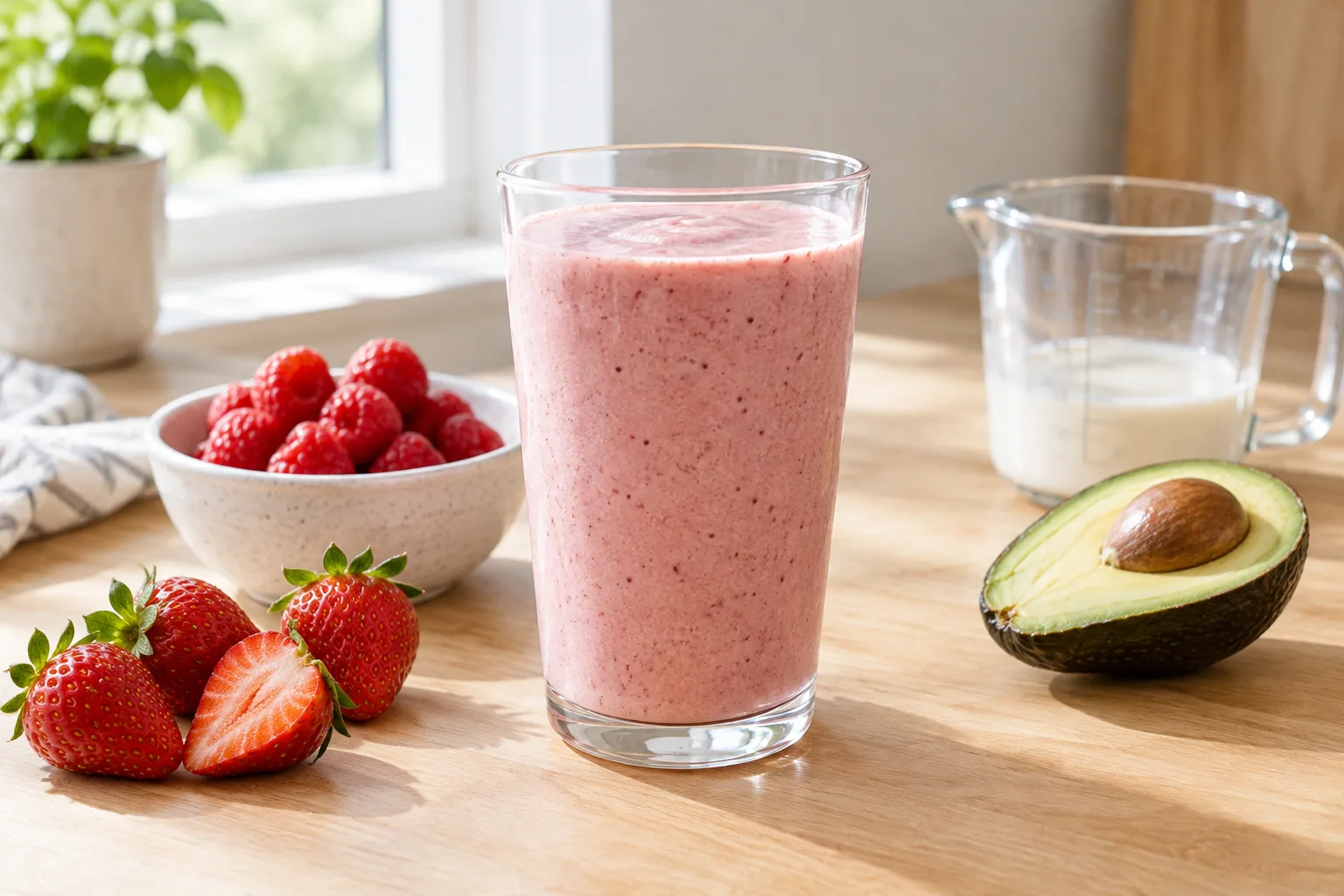
Strawberries, raspberries, blackberries, and avocado are good fruits to compare first for a low-carb smoothie. Avocado adds creaminess rather than sweetness; blueberries can also fit, but measure a smaller portion instead of pouring freely. Count the whole drink, including its milk, yogurt, protein powder, and other additions.
Which low-carb fruits work best in smoothies?
Start with berries for fruit flavor and avocado for a thicker texture. Diet Doctor’s low-carb fruit guide identifies berries as options to consider while emphasizing that portions matter, particularly with blueberries.
These are practical starting portions, not nutritionally equivalent servings. Weigh the edible fruit after removing strawberry tops or avocado skin and pits.
| Fruit | Starting amount per smoothie | Flavor | Texture after blending | Pair it with |
|---|---|---|---|---|
| Strawberries | 50 g | Sweet-tart | Light, with small seeds | Unsweetened almond milk |
| Raspberries | 50 g | Tart, pronounced berry flavor | Seedy | Unsweetened coconut beverage |
| Blackberries | 50 g | Tart to sweet | Seedy, slightly thicker | Avocado and water |
| Avocado | 50 g | Mild, not sweet | Creamy and thick | Any measured berry portion |
| Blueberries | 25 g | Sweet, mild | Small skin flecks | Plain yogurt or an unsweetened base |
A fruit portion is not a carb allowance. Before logging it, match the fruit and its weight to a nutrition entry that includes total carbohydrate and fiber. For plain whole fruit, net carbs are total carbohydrate minus fiber.
If you miss banana’s thickness, try avocado before increasing the fruit portion. This guide to avocado on keto can help you decide how it fits alongside the rest of your ingredients.
Choose a fruit portion that fits the whole smoothie
A lower-carb fruit does not automatically make the finished drink keto-friendly. A measured berry portion can still come with a large contribution from sweetened milk, juice, yogurt, or several spoonfuls of nut butter.
Use your own chosen daily carb limit rather than treating any smoothie as universally suitable:
- Choose the drink’s allowance. Decide how much of your remaining daily carb budget you want to spend on it.
- Count the base first. Check the amount you will actually pour, not just the label’s serving size.
- Add protein and extras. Include yogurt, powder, seeds, nut butter, and any sweetener that contributes carbohydrates.
- Allocate what remains to fruit. Adjust the weighed portion until the whole recipe fits.
- Record the finished yield. If you divide the blender between two people, divide the recipe’s nutrition totals by two as well.
For fresh and frozen fruit, use a kitchen scale rather than comparing scoops or cups. Put the blender jar on the scale, tare it, and add each ingredient separately. Choose a nutrition entry that matches the fruit’s form, such as raw strawberries or unsweetened frozen strawberries.
For a packaged ingredient, multiply its listed carbohydrates and fiber by the number of label servings you use. Keep total carbs and net carbs separate throughout the calculation so you do not accidentally mix tracking methods.
Choose a base before adding creaminess or protein
These bases serve different purposes. Compare the specific carton or container rather than assuming that every unsweetened product has the same nutrition.
| Base | What it contributes | What to check | Best practical use |
|---|---|---|---|
| Water | Liquid without creaminess | Nothing beyond your preferred drinking water | Let berries and avocado provide flavor and texture |
| Unsweetened almond milk | Mild flavor and a lighter texture | Serving size, total carbs, fiber, and ingredients | Strawberry blends |
| Unsweetened coconut beverage | Coconut flavor and pourable consistency | Whether it is a carton beverage or canned milk | Raspberry blends |
| Plain yogurt | Tang, thickness, and protein | Carbohydrates, protein, and whether sugar is added | Replace part of the liquid, then thin with water |
“Unsweetened” does not mean carb-free. Use this packaged almond milk guide as a starting point, then check the label on the product you buy.
Carton coconut beverage and canned coconut milk are not interchangeable. Canned coconut milk is generally richer and thicker, so substituting it changes both texture and nutrition. Review coconut milk as a keto ingredient, and measure the particular product rather than logging a generic entry.
Adjust texture without losing track of additions
- Too thin: Add a measured portion of avocado or a few ice cubes. Ice thickens a frozen drink initially but dilutes it as it melts.
- Too thick: Add water a tablespoon at a time, blending briefly between additions.
- Too seedy: Blend longer if your blender allows it. Straining removes some solids and fiber, so the original whole-fruit nutrition entry becomes less representative.
- Not filling enough: Consider plain yogurt or a measured protein powder, checking its label before adding it.
- Using seeds or nut butter: Weigh them. They change texture and contribute carbohydrates, even when the portion looks small.
Build three measured fruit smoothie combinations
Use these as starting formulas and adjust them for your blender and preferred thickness. Each makes one 350 mL serving, after topping up with water; nutrition depends on your exact ingredients. Optional additions are separate so you can calculate the base recipe first.
Strawberry-almond blend
Base ingredients
- 50 g strawberries, fresh or plain frozen
- 180 mL unsweetened almond milk
- 40 g ice
- Water as needed to reach a final volume of 350 mL
- Add almond milk, strawberries, and ice to the blender.
- Blend until the fruit and ice are broken down, stopping to scrape the jar if necessary.
- Pour into a measuring jug. Add water to reach 350 mL, then stir or briefly blend again.
Optional: Add a measured portion of almond butter for a thicker drink, or protein powder according to its label. Count either addition separately.
Raspberry-coconut blend
Base ingredients
- 50 g raspberries, fresh or plain frozen
- 180 mL unsweetened carton coconut beverage
- 40 g ice
- Water as needed to reach a final volume of 350 mL
- Add the coconut beverage, raspberries, and ice.
- Blend until evenly combined. Raspberry seeds may remain noticeable.
- Measure the finished drink and add water to reach 350 mL.
Optional: Add 1 teaspoon of chia seeds, weighed and logged separately. Let the drink stand briefly before deciding whether it needs more liquid, because chia thickens as it absorbs moisture.
Blackberry-avocado blend
Base ingredients
- 50 g blackberries, fresh or plain frozen
- 50 g avocado flesh
- 180 mL water
- 40 g ice
- Additional water as needed to reach a final volume of 350 mL
- Add water first, followed by avocado, blackberries, and ice.
- Blend until the avocado is smooth and the berries are broken down.
- Add water to reach 350 mL. If it is still thicker than you prefer, add more water and record the larger finished serving.
Optional: Replace part of the water with a measured amount of plain yogurt. Recalculate the recipe before treating the replacement as equivalent.
For variations using what you already have, enter your measured ingredients into the personalized recipe generator. Check suggested amounts against your product labels and chosen carb budget.
Check frozen fruit bags and smoothie mixes before buying
Plain frozen fruit makes portioning convenient. Look for a single fruit, or a clearly identified blend, without syrup or added sweeteners. Frozen pieces vary in size, so weighing is more consistent than counting them.
A bag labeled “berry smoothie mix” may also contain banana, mango, juice concentrate, or sweetened components. Read the ingredient list and nutrition panel together: the list tells you what is inside, while the panel tells you what the labeled serving contributes.
Dried fruit, fruit juice, and large portions of banana or mango can use more of your carb budget. They are not universally forbidden, but substituting them for a measured berry portion changes the calculation. Juice also is not nutritionally equivalent to blending whole fruit.
For packaged bases and additions, Keeto lets you scan a barcode to see net carbs and their share of your chosen daily carb budget. Match the amount you log to the amount you actually use.
Before you put ingredients in your cart, check:
- Fruit: Plain fresh or frozen fruit you can weigh into individual portions.
- Base: Water or an unsweetened product with a checked serving size and nutrition panel.
- Optional protein: Plain yogurt or protein powder with its carbohydrates included in your calculation.
- Measured additions: Seeds, nut butter, avocado, and sweeteners recorded separately.
- Smoothie packs: Ingredients and serving count checked, including whether one pouch contains more than one labeled serving.
FAQ
Does blending whole fruit remove its fiber?
No. Blending whole fruit breaks it into smaller pieces but does not remove its fiber. Straining the smoothie or using juice instead leaves some fiber-containing material behind.
Can I make a low-carb fruit smoothie without dairy?
Yes. Use water, an unsweetened almond milk, or an unsweetened coconut beverage, then add avocado if you want creaminess. Check the specific product’s carbohydrates rather than assuming a dairy-free base is carb-free.
Can I prepare a fruit smoothie the night before?
Yes. Refrigerate it promptly in a sealed container and keep it cold until you drink it; separation, thickening, or some browning may occur. Shake or reblend before serving, or portion your fruit tonight and add the liquid when you are ready to blend.