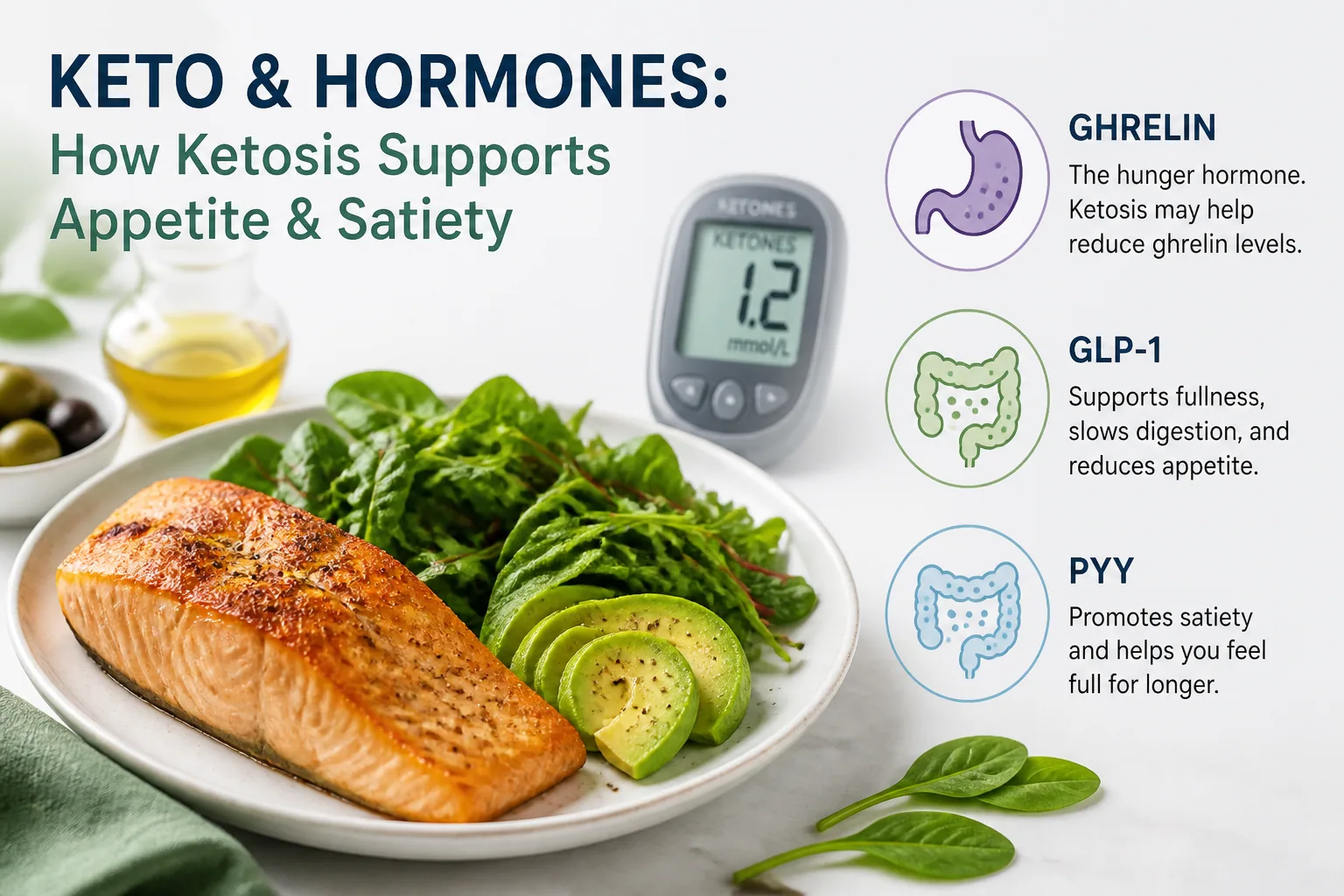
Keto Satiety & Appetite Hormones: How Ketosis Rewires Hunger Signals
If you have ever started keto and noticed your hunger change, you are not imagining it. For some people, appetite drops quickly and meals feel more satisfying. For others, the first days can feel surprisingly hungry before things settle down. The reason is that ketosis does not just change what you eat. It also changes how your body talks about hunger, fullness, and energy balance.
That conversation is driven by appetite hormones and metabolic signals such as ghrelin, peptide YY (PYY), GLP-1, leptin, insulin, and cholecystokinin. Some of these shift rapidly when carbs fall. Others respond more slowly as weight loss progresses and the body adapts. Research suggests ketogenic diets can blunt the usual rise in ghrelin that often follows weight loss, while also preserving satiety hormones better than non-ketogenic very low-energy diets. In other words, keto may help you feel fewer of the biological signals that normally push you to eat more when calories drop. See the research summary here: https://pubmed.ncbi.nlm.nih.gov/32193016/
Why Hunger Often Changes on Keto
The first thing to understand is that appetite is not only about willpower. It is a coordinated response involving the brain, gut, pancreas, fat tissue, and the nervous system. When you reduce carbohydrate intake and enter ketosis, insulin falls, stored fuel becomes more available, and ketone levels rise. That alone can make eating feel different, but the shift in hunger is usually a mix of biology and behavior.
Behaviorally, keto often removes many highly palatable, fast-digesting foods that can keep appetite bouncing up and down. Biologically, stable blood sugar and lower insulin can reduce the roller coaster that sometimes drives cravings. But the transition period matters. During the first few days, your body is still adapting, glycogen stores are falling, and hunger can feel more noticeable even if ketosis has begun.
In weight-loss trials using very-low-energy ketogenic diets, fasting hunger tends to rise significantly by day 3, around 5% weight loss, and can stay elevated through larger losses. At the same time, satiety hormones do not drop as much during ketosis as they do in comparable non-ketogenic phases. That matters because it suggests keto may not completely erase hunger, but it can make the body’s normal starvation response less aggressive. Source: https://pmc.ncbi.nlm.nih.gov/articles/PMC5550564/
The Main Appetite Hormones Behind Satiety and Cravings
To understand why keto works for some people, it helps to know the main players.
Ghrelin is often called the hunger hormone. It rises before meals and tends to signal that it is time to eat. When food intake drops, ghrelin often rises further, which is one reason diets can feel hard.
PYY and GLP-1 are gut-derived satiety hormones. They are released after eating and help slow digestion, increase fullness, and reduce food intake. Cholecystokinin, or CCK, also supports satiety by helping you feel satisfied after a meal, especially when fat and protein are present.
Leptin is produced by fat tissue and helps the brain gauge long-term energy stores. When body fat decreases during weight loss, leptin usually falls, which can make the body more food-focused. Insulin, meanwhile, is closely tied to carbohydrate intake and energy storage. When insulin is high, the body is more in storage mode. When it falls, the body more easily mobilizes stored fuel.
The important point is that appetite is not controlled by one hormone alone. Keto changes the whole pattern. Some signals move quickly, others slowly, and the overall result depends on your calorie intake, protein intake, body composition, activity level, sleep, and how deeply you are actually in ketosis.
What Happens to Ghrelin, PYY, and GLP-1 During Early Ketosis
The early phase of keto is where many people notice the biggest mismatch between expectation and reality. They expect appetite to disappear immediately, but instead they may feel hungry for the first several days. That does not mean keto is failing. It often means the body is still switching fuel systems.
Research on very-low-energy ketogenic diets shows that subjective hunger can increase early, even when appetite hormones are not changing dramatically yet, except for insulin, which tends to fall. This is an important distinction. Your feelings of hunger can rise before your hormonal adaptation catches up. Over later weeks, hunger often stabilizes or decreases as the body adjusts. The same research notes that satiety hormones remain more preserved in ketogenic conditions than they do in non-ketogenic dieting. Source: https://pmc.ncbi.nlm.nih.gov/articles/PMC5550564/
There is also evidence that ketogenic diets can suppress the usual post-weight-loss rise in ghrelin and attenuate reductions in PYY, GLP-1, and CCK that are common with non-ketogenic very low-energy diets. That means keto may help prevent the body from sending as strong a biological message to eat back lost weight. Source: https://pubmed.ncbi.nlm.nih.gov/32193016/
The practical takeaway is simple. If hunger is higher in your first week of keto, that is not unusual. The goal is not to force appetite to zero, but to let the transition happen while supporting satiety with enough protein, electrolytes, and well-structured meals.
How Appetite Signals Adapt After Weeks or Months on Keto
Once keto adaptation is underway, hunger often becomes more predictable. Many people report fewer crashes between meals, less preoccupation with food, and a greater ability to stop eating when comfortably full. This does not happen at the same speed for everyone, but the trend is common enough that it shows up in research on ketogenic low-carbohydrate diets.
Meta-analyses of ketogenic low-carbohydrate diets and very-low-energy diets suggest that keto can reduce hunger and desire to eat while increasing fullness and satiety, even during calorie restriction. The effect may be modest in absolute terms, but it helps counter the appetite increase that usually accompanies an energy deficit. Source: https://pubmed.ncbi.nlm.nih.gov/25402637/
Why does this happen? Part of it may be metabolic stability. With lower carbohydrate intake, fewer large swings in blood sugar and insulin occur after meals. Part of it may be the effect of ketones themselves. And part of it may simply be that the body is using a different fuel pattern that makes fasting intervals feel easier. For many people, appetite becomes less urgent because the energy supply is steadier and less dependent on frequent eating.
That said, not everyone experiences dramatic appetite suppression. Some people feel best on keto but still need structured meals. Others find that their hunger decreases only after several weeks, once they are fully adapted and their food choices are more dialed in. Both are normal.
Leptin, Insulin, and Energy Balance: The Bigger Hormone Picture
Leptin and insulin deserve special attention because they connect appetite to energy stores. As you lose weight on keto, leptin tends to fall, because leptin tracks fat mass. That drop can signal the brain that energy stores are shrinking, which is one reason long-term dieting can feel harder than the first few days.
However, there is a useful nuance here. Some evidence suggests ketosis blunts the hunger-stimulating compensatory rise in ghrelin that normally happens with weight loss, even though leptin still declines as fat mass decreases. Source: https://pubmed.ncbi.nlm.nih.gov/32193016/
Insulin also changes dramatically on keto. Since carbohydrate intake is low, insulin usually drops and stays lower between meals. For many people this is one reason snacking declines. Lower insulin makes it easier to access stored body fat for fuel, which can improve energy availability between meals and reduce the feeling that food is urgently needed.
In practice, the bigger hormone picture is about balance, not perfection. Keto may make the body more willing to use stored energy, but if calories are too low, protein is inadequate, sleep is poor, or stress is high, hunger can still rise. Hormones respond to the whole environment, not just carbohydrate intake.
Endogenous vs. Exogenous Ketones: Do They Affect Hunger the Same Way?
This is where many people get confused. Endogenous ketones are produced by your own body when carbohydrate intake is low and fat oxidation rises. Exogenous ketones are supplements, such as ketone esters or ketone salts, that raise blood beta-hydroxybutyrate (BHB) from the outside.
They are not identical in effect. Endogenous ketosis tends to create more sustained and often higher ketone exposure, along with the full metabolic context of carbohydrate restriction. Exogenous ketones can raise BHB quickly, and some studies show they can acutely lower ghrelin and perceived hunger, especially when taken after fasting. Source: https://pmc.ncbi.nlm.nih.gov/articles/PMC8180826/
One randomized crossover trial found that a ketone ester drink in overnight-fasted adults raised BHB from about 0.2 to 3.3 mM and lowered ghrelin, GLP-1, and PYY for 2 to 4 hours compared with dextrose, while also suppressing hunger and desire to eat. Source: https://pmc.ncbi.nlm.nih.gov/articles/PMC5813183/
But the picture is not perfectly consistent. Another study found that acute ketone exposure reduced acyl-ghrelin and GLP-1 immediately after exercise compared with dextrose, yet did not significantly change subjective appetite ratings or ad libitum energy intake over the following 2 hours. Source: https://www.frontiersin.org/journals/nutrition/articles/10.3389/fnut.2020.626480/full
There is also evidence that a day of endogenous ketosis from a ketogenic diet can raise total energy expenditure, while exogenous ketone salts do not reproduce that effect. In that trial, subjective appetite ratings did not differ significantly between conditions. Source: https://www.sciencedirect.com/science/article/pii/S240545772300092X
The practical conclusion is that exogenous ketones may offer a short-term appetite effect, but they are not a substitute for the full metabolic adaptation of a ketogenic diet. If your goal is better hunger control over time, endogenous ketosis appears more reliable.
Why Some People Feel Less Hungry on Keto, and Others Don’t
A common mistake is assuming keto should make everyone less hungry in the same way. In reality, appetite response varies a lot. Some people are highly responsive to carbohydrate restriction and appetite stabilizes quickly. Others need longer adaptation. Some people are simply under-eating protein or electrolytes and mistake that for failure of keto itself.
Body composition matters too. People with higher fat mass and different insulin dynamics may respond differently from lean, active individuals. Stress, sleep deprivation, and very low calories can all override the appetite benefits of ketosis. If you are training hard or are very lean, your hunger may remain more noticeable because your energy demands are higher and your body is more protective of mass.
Meal quality matters as well. A keto diet built on only fat and cheese can be far less filling than one built on protein-rich foods, vegetables, and enough total volume. The hormonal benefits of keto still help, but they work best when the meals themselves support satiety.
Best Keto Meal Composition for Staying Full Longer
If the goal is appetite control, the best keto meal is not just the one with the lowest carbs. It is the one that keeps you full long enough to avoid grazing, cravings, and rebound eating.
Protein should be the foundation. Research suggests higher protein intake, around 1.6 g/kg/day or more, improves satiety, supports lean mass, and influences PYY, GLP-1, and insulin more favorably than lower-protein ketogenic patterns. Source: https://pmc.ncbi.nlm.nih.gov/articles/PMC11212571/
Fiber matters too, even though keto often lowers total plant intake. Non-starchy vegetables and selected keto-friendly fibers can support gut hormone responses and slow gastric emptying, which helps fullness last longer. In practice, this means leafy greens, cruciferous vegetables, avocados, chia, flax, and other low-carb fiber sources should not be treated as optional extras.
Fat still has a role, but it should be used strategically. Fat can improve satisfaction and palatability, but too much added fat can raise calories without improving satiety proportionally. A useful approach is to start with protein, add fibrous vegetables, then include enough fat for flavor and sustained energy. That usually works better than trying to force very high fat intake at every meal.
If you are shopping for keto-friendly foods and want to avoid accidental carb creep, a tool like Keeto - Keto Made Easy can make the process much simpler: https://findthe.app/keeto-5m0vbj
Meal Timing, Fasting, and Appetite Control on a Ketogenic Diet
Keto often pairs well with longer gaps between meals because stable blood sugar and lower insulin can make fasting periods more comfortable. But meal timing should support adherence, not become a source of stress. If skipping breakfast leaves you ravenous by noon and leads to overeating, forcing fasting may backfire.
For some people, a consistent meal rhythm works best. For others, a shorter eating window naturally reduces snacking and helps appetite reset. What matters is observing how your hunger behaves across the day. If morning hunger is low, a delayed first meal can feel effortless. If hunger is strongest in the morning, a protein-focused breakfast may prevent a later binge.
The research on ketones and fasting suggests there may be a temporary appetite-lowering effect when ketone levels rise after a fast, but this does not always translate into lower intake in every setting. That means fasting can be a useful tool, but it is not magic. Use it only if it genuinely makes your hunger easier to manage.
Practical Ways to Reduce Cravings and Manage Hunger Day to Day
If keto hunger feels stubborn, the solution is usually not more willpower. It is better structure. Start by making sure each meal has enough protein to trigger satiety. Then add vegetables or other fiber sources for volume. Keep added fats moderate, and avoid turning every meal into a fat bomb that is high in calories but not especially filling.
Hydration and electrolytes are also important. Early keto often causes more sodium and water loss, which can feel like hunger, fatigue, or low energy. Sometimes what seems like a craving is actually a mix of dehydration and electrolyte depletion. Salting food properly and being intentional about fluids can make a real difference.
Food environment matters too. Ultra-processed keto snacks, constant grazing, and hyper-palatable dessert replacements can keep appetite activated even when carbs are low. Choosing meals over snacks, and snacks over mindless bites, often helps reduce appetite noise.
Sleep and stress are underrated. Poor sleep raises appetite and weakens satiety signaling. High stress can push people toward comfort eating regardless of ketosis. If hunger is unusually high, the answer may be better sleep or stress management, not another supplement.
Common Mistakes That Make Keto Hunger Worse
One common mistake is eating too little protein. People sometimes over-focus on keeping fat high and end up with meals that do not keep them full. Another is going too low-calorie too soon, which can cause a steep hunger rebound before the body has adapted.
Another issue is ignoring hidden carbs or inconsistent carb intake. If you bounce in and out of ketosis, appetite may become less predictable. Consistency matters because your body adapts to a stable fuel pattern over time.
A third mistake is relying on exogenous ketones as a shortcut. They may briefly reduce hunger, but they do not recreate the full metabolic effect of sustained carbohydrate restriction. The same is true for expecting fat alone to solve appetite. Keto works best when protein, fiber, and timing are all considered together.
Finally, many people confuse adaptation hunger with failure. Early hunger does not mean keto is not working. It often means your body is in transition. Give it time, support it properly, and judge the diet by trends over weeks, not by one difficult afternoon.
Key Takeaways: Using Ketosis to Work With Your Hunger Signals
Keto changes appetite by shifting the hormonal environment around hunger and fullness. Ghrelin, PYY, GLP-1, leptin, insulin, and CCK all play a role, but their effects are not identical in the first few days versus the first few months. Early keto can come with temporary hunger, while later adaptation often brings steadier appetite and fewer cravings.
The best results usually come from a whole-system approach. Keep protein high enough, include fiber-rich low-carb foods, use fat for satisfaction rather than excess calories, and pay attention to hydration, electrolytes, sleep, and stress. If you fast, do it because it helps your hunger, not because you think it is required.
And remember the difference between endogenous and exogenous ketones. Supplements may produce a short-term appetite effect, but sustained ketosis from carb restriction is more likely to reshape hunger in a lasting way. Used well, keto can help you work with your hunger signals rather than fighting them all day.