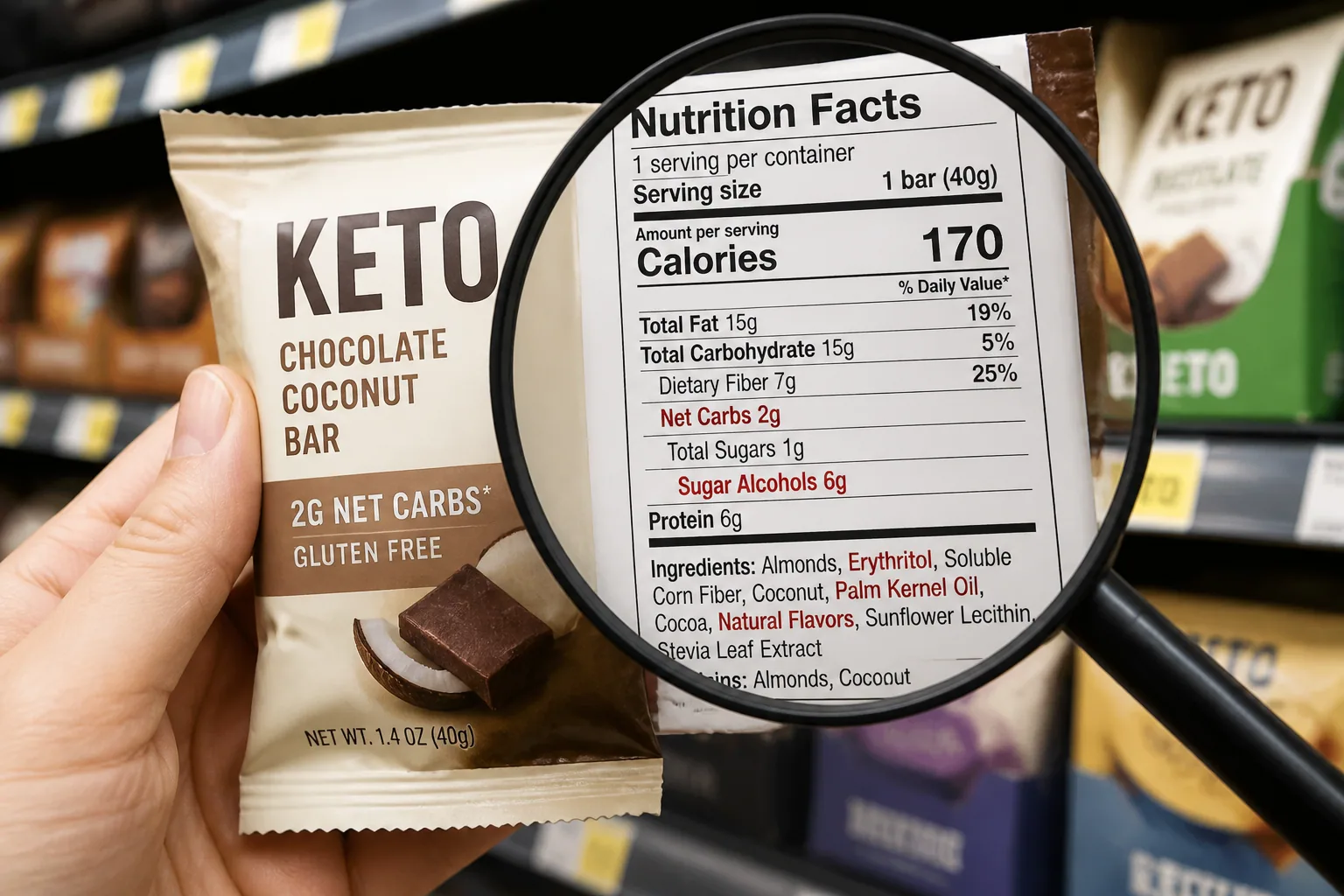
Keto Label Secrets: How to Spot Hidden Carbs and Misleading Claims on Packaged Foods
Packaged keto foods can be convenient, but they are also where a lot of people get stuck. You buy a product that looks low carb, the front label says “keto-friendly,” and the numbers seem to fit your macros. Then ketosis becomes inconsistent, cravings creep in, or your blood glucose reacts more than expected. The problem is not always that the food is openly sugary. Often, the carbs are hidden in plain sight through ingredient choices, tiny servings, rounding rules, and marketing language that sounds more precise than it really is.
The key thing to understand is that the label is not the whole story. In the U.S., “net carbs” is not a legally recognized FDA term, and products are only required to list total carbohydrates, dietary fiber, sugars, and added sugars on Nutrition Facts labels. That means net carb math is mostly a marketing convention, not a standardized rule. Sources like Healthline, the ADA, and RecipeCalc all point out this gap, which is why two products can look similar on the shelf but behave very differently once you actually eat them: https://www.healthline.com/nutrition/net-carbs
Why Packaged Keto Foods Can Quietly Knock You Out of Ketosis
Ketosis is usually disrupted by a steady mismatch between what you think you ate and what your body actually absorbed. Packaged keto products can create that mismatch in several ways. They may use ingredients that are technically classified one way on paper but act more like digestible carbs in the body. They may hide a meaningful carb load behind a small serving size. Or they may lean on sugar alcohols and fibers that are not equally benign for every person.
That is why so many keto shoppers report being “strict” and still not seeing the results they expect. The issue is often not one dramatic mistake, but several small label tricks adding up across the day. A bar here, a wrap there, a dessert made with fiber syrup, and suddenly your carb intake is much higher than the front of the package suggested.
What Net Carbs Really Mean and Where Brands Stretch the Definition
Net carbs usually means total carbohydrates minus fiber and certain sugar alcohols. That sounds simple, but the subtraction rules are not universal. Some people count all fiber as non-impactful, while others only subtract the fibers they tolerate well. Some subtract every sugar alcohol listed, while others only subtract erythritol or allulose because those tend to have minimal glycemic impact. Healthline’s keto guidance makes it clear that not all sugar alcohols behave the same, so blanket subtraction is not reliable.
Brands take advantage of this ambiguity. A package might say “3g net carbs” because the company subtracts fiber, sugar alcohols, or both. But if the fiber is an IMO-style ingredient or the sugar alcohol is maltitol, the math may be far more aggressive than your body would like. In other words, the label may follow a chosen formula, yet still not predict your real blood sugar response.
The Biggest Hidden Carb Ingredients: IMO Syrup, Maltodextrin, Tapioca Fiber, and More
Some ingredients deserve immediate attention because they are frequent troublemakers in so-called keto foods. IMO, or isomaltooligosaccharides, often appears as “soluble tapioca fiber,” “prebiotic fiber,” or simply “tapioca fiber.” Research cited by Keto Peek reports that a 25 g dose of IMO raised blood sugar by nearly 50 mg/dL, which is a very large response for something marketed as fiber. The FDA also rejected IMO in 2020 as meeting the standard definition of dietary fiber because it is digestible by human enzymes, meaning it should not be casually subtracted as fiber under regulatory terms. FDA guidance on dietary fiber explains that only certain intrinsic or approved non-digestible carbohydrates qualify: https://www.fda.gov/food/nutrition-food-labeling-and-critical-foods/questions-and-answers-dietary-fiber
Maltodextrin is another major red flag. It has an extremely high glycemic index, often cited around 100 to 110, which can be as high as or even higher than table sugar. Even small amounts can spike blood glucose and interfere with ketosis. Because it counts toward total carbohydrates and offers about 4 calories per gram, it is not a harmless filler just because it appears in a tiny amount on the label.
Tapioca fiber can be either genuinely useful fiber or a loophole ingredient, depending on what it actually is and how the product is formulated. If the fiber source is really an IMO-based syrup, the label may look very keto while the blood sugar effect tells another story. This is why ingredient context matters as much as the nutrition panel.
Sugar Alcohols Explained: Which Ones Tend to Be Better and Which Can Mislead
Sugar alcohols are not all equal. Some, like erythritol and allulose, are generally considered lower impact and are often tolerated well by people on keto. Others, especially maltitol, are much more likely to act like a meaningful carbohydrate load. Healthline notes that maltitol can have a glycemic index around 35, which is low compared with sugar but still high enough to matter for ketosis if the serving size is generous or the product is eaten often.
This is why subtracting every sugar alcohol automatically can be misleading. A bar sweetened with erythritol may fit a keto plan better than one sweetened with maltitol, even if the front label claims the same net carbs. For some people, sugar alcohols also cause digestive symptoms that make the product a poor fit regardless of the carb math. The lesson is simple: know which sweetener is doing the work, not just how many grams are listed.
Serving Size Sleight of Hand: How Tiny Portions Hide Real Carb Totals
Serving size is one of the oldest label tricks in the book. A snack can look extremely low carb per serving, but the serving may be so small that it bears little resemblance to how people actually eat the product. If a granola, cracker, or dessert is tasty and packaged like a single snack, most people will eat more than the serving on the label, which multiplies the carbs immediately.
FDA serving size rules allow products with larger packages to present the nutrition information in ways that can make the numbers feel smaller than they are on a real-world plate. Under certain conditions, labels may even provide package totals in addition to serving values. That means the safest reading is often not “How many carbs are in a serving?” but “How many carbs will I actually eat?” The serving size itself is part of the marketing.
Rounding Rules on Nutrition Labels That Can Add Up Fast
Rounding rules create another layer of confusion. The FDA allows very small amounts to be rounded down, so a nutrient can appear as 0 g if it falls below the threshold for the label. In practice, this means several ingredients that are each less than half a gram can still add up to a meaningful total across multiple servings or multiple products.
This matters especially for products that lean heavily on “zero sugar” or “zero carb” language. A single bar might contain small amounts of sugar, starches, fibers with digestible fractions, or other ingredients that round down individually but still contribute to your daily total. When you stack several products that all use these rules, the hidden carbs can become enough to slow or interrupt ketosis.
What Low Sugar, Zero Net Carbs, and Keto-Friendly Actually Tell You
Those phrases are not the same thing as a clinical guarantee. “Low sugar” only tells you that sugar is limited, not that total carbohydrates are low or that the product will not affect blood glucose. “Zero net carbs” is a marketing claim built on a calculation method that may or may not reflect your personal response. “Keto-friendly” is even looser, because it often means the company believes the food can fit some keto diet, not that it is objectively safe for every strict keto eater.
The safest interpretation is that front-of-pack claims are starting points, not verdicts. They may be useful for quick shopping, but they are not a substitute for checking the actual carbohydrate count, the ingredient list, and your own results. The ADA consistently emphasizes carbohydrate awareness as a core nutrition skill, which aligns with a more cautious approach to these claims: https://diabetes.org/food-nutrition/understanding-carbs/get-to-know-carbs
How Food Marketing Exploits Regulatory Loopholes Without Technically Lying
A lot of keto marketing works because it stays inside the rules while still creating the wrong impression. A company can choose a definition of net carbs, select a tiny serving size, and highlight the lowest number on the front panel. None of that necessarily violates labeling laws. But it can still leave consumers with the false idea that the product is safer than it is.
This is where legal and practical truth diverge. A label can be technically compliant and still be nutritionally misleading. That is why many experienced keto dieters stop trusting the front panel first and instead go straight to the ingredient list and actual carbs per realistic portion. If the product requires several assumptions to look keto, it is probably not a dependable staple.
Ingredient List Red Flags Every Keto Shopper Should Know
If you want a fast label audit, the ingredient list is often more useful than the claims on the front. Watch closely for IMO, isomaltooligosaccharides, soluble tapioca fiber, resistant starches used as sweet fillers, maltodextrin, dextrose, modified starches, and sweetener blends that hide the dominant ingredient behind a proprietary mix. These are the names that often show up in foods designed to look keto without behaving like simple whole foods.
You should also be cautious when the ingredient list contains several different sweeteners, fibers, or starch derivatives. That is often a sign the manufacturer is engineering a lower net carb number rather than building a naturally low-carb food. A shorter ingredient list is not always perfect, but it is usually easier to trust than a bar with a chemistry experiment in the middle.
How to Use Keto Scanner Apps Without Trusting Them Blindly
Scanner apps can be useful, especially when you are in a store and need a quick answer. A tool like Keeto - Keto Made Easy can help you scan a barcode, see a keto verdict, and track your daily carb budget on the spot: https://findthe.app/keeto-5m0vbj
But even the best app should be treated as a helper, not a final judge. Apps can rely on databases that may be outdated, incomplete, or based on manufacturer-submitted data that uses aggressive net carb logic. If the app says a product is keto-friendly but the ingredient list includes maltodextrin or an IMO-style fiber, trust your label-reading skills first. Use the scanner for speed, then verify the details before buying in bulk.
Best Ways to Cross-Check Products With Databases and Reliable Sources
A smarter system is to compare multiple signals. Start with the Nutrition Facts panel, then the ingredients, then a trusted database or calculator if you want a second opinion. If a product seems borderline, cross-check the specific sweeteners and fibers in reputable sources rather than relying on the app alone. When possible, compare how your own body responds by looking at blood glucose, ketone readings, or both.
That practical feedback loop matters because some foods are technically lower carb but still poor fits for your metabolism. The ADA and keto-oriented nutrition sources both support the idea that the total carbohydrate number and personal response are more informative than a marketing label. If your results are inconsistent, the label may be telling a story that your body is not confirming.
Why Whole Foods Are Still the Safest Keto Default
Whole foods remove most of the guesswork. Eggs, meat, fish, butter, olive oil, avocados, leafy greens, and other minimally processed foods do not need net carb calculations, fiber loopholes, or skeptical interpretation. They generally make it much easier to stay under a strict carb limit without being surprised by hidden starches or sweetener blends.
That does not mean packaged foods are banned. It means they should be evaluated with more caution, especially if your goal is reliable ketosis rather than a loosely low-carb lifestyle. When progress stalls, simplifying the diet with whole foods is often the quickest way to identify whether a packaged product was the culprit.
A Simple Label-Reading Checklist for Smarter Keto Shopping
Use this checklist before you trust a packaged keto food: first, read the total carbohydrates, not just the front claim. Second, check whether the product depends on fiber math or sugar alcohol subtraction. Third, scan the ingredient list for IMO, maltodextrin, tapioca fiber, dextrose, or other red-flag additives. Fourth, compare the serving size to how much you will realistically eat. Fifth, remember that rounding can hide small amounts that add up across the day.
Finally, verify the product against your own response whenever possible. A food that fits someone else’s keto plan may not fit yours. The more processed the product, the more likely it is to depend on technicalities rather than true metabolic friendliness. If you keep that in mind, you will shop with more confidence and fewer surprises, and your keto routine will become much more consistent.