Keto Label Laws Demystified: What Food Labels Must Reveal—and What They Don’t
If you shop keto long enough, you eventually run into the same problem: the front of the package sounds perfect, but the label tells a more complicated story. A product can say “keto-friendly,” “low carb,” or “no sugar added” and still contain ingredients or serving sizes that make it a poor fit for your macros. That is why understanding food label law matters so much for keto shoppers. Once you know what manufacturers are legally required to disclose, you can separate real information from marketing gloss and make faster, smarter decisions in the grocery aisle.
The good news is that U.S. food labeling rules do reveal a lot. The challenge is that they do not always reveal everything in the most intuitive way for low-carb eating. The Nutrition Facts panel, ingredient statement, and allergen disclosures each serve a different purpose, and keto shoppers need to read all of them together. That is especially true when you are trying to track total carbs, fiber, sugars, added sugars, and sugar alcohols, which are not always presented in a way that makes net-carb math obvious.
Why Keto Shoppers Need to Understand Label Law
Keto works best when you are consistent with carbs, ingredients, and serving sizes. Labels are supposed to help with that, but the label system was not designed specifically for keto. It was designed to help consumers compare foods, understand nutrition, and avoid deception. That means some details are required by law, some are optional, and some marketing language is allowed as long as it is not misleading.
For keto shoppers, that creates a gap between what a product looks like on the shelf and what it actually does to your daily carb budget. A package can be technically compliant and still be confusing. That is why you need to know which numbers are mandatory, which claims are regulated, and where loopholes are most likely to show up.
What the Nutrition Facts Label Is Legally Required to Show
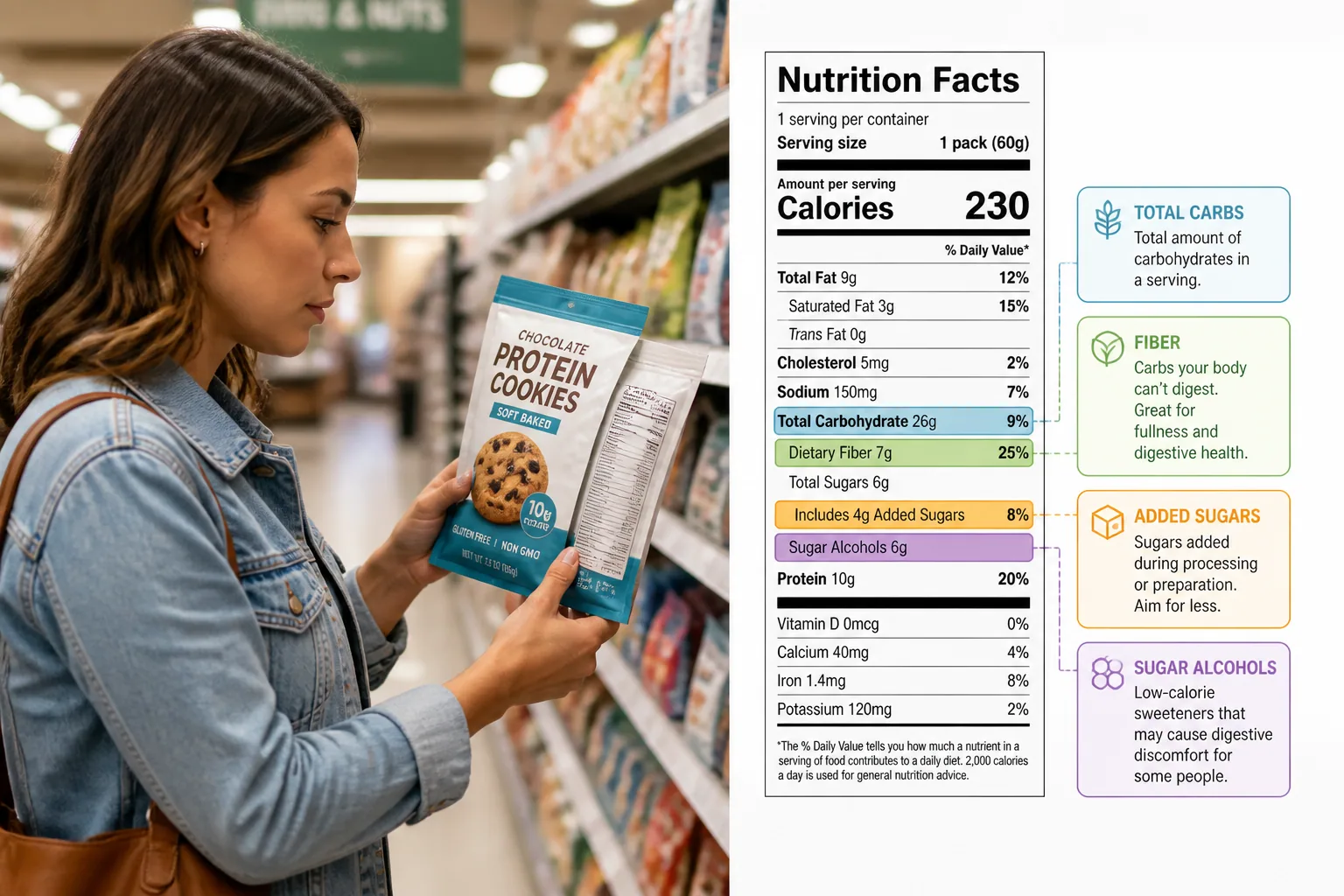
Under FDA rules, the Nutrition Facts label must provide standardized nutrition information so consumers can compare foods more easily. For keto shoppers, the most important line is usually total carbohydrate, because it is the starting point for any carb calculation. Under the label rules, dietary fiber is included within total carbohydrate, not listed separately as something outside of carbs.
That matters because keto eaters often calculate net carbs by subtracting fiber from total carbs. The label makes that possible by requiring fiber to be shown clearly under the carbohydrate section. This is not a keto-specific rule, but it is one of the reasons the Nutrition Facts panel is so useful for low-carb shopping. The relevant federal carbohydrate labeling rules appear in the CFR, which confirms how these values are organized on the label: https://www.govinfo.gov/content/pkg/CFR-2023-title21-vol2/pdf/CFR-2023-title21-vol2-chapI-subchapB.pdf
The FDA also requires added sugars to be declared in grams and as a percent Daily Value on most foods. According to the FDA, the Added Sugars line shows how much sugar has been added during processing, and it appears as part of the updated Nutrition Facts label format: https://www.fda.gov/food/nutrition-food-labeling-and-critical-foods/changes-nutrition-facts-label
Total Carbs, Fiber, Sugars, and Added Sugars: What Each Number Means
The most useful way to read a keto label is to start from the top of the carbohydrate section and work downward. Total carbohydrate is the umbrella number. It includes fiber, sugars, starches, and, depending on how the manufacturer formats the label, sometimes sugar alcohol information may appear nearby or in a separate statement.
Fiber is especially important because it is part of total carbs, but it generally does not have the same blood sugar impact as digestible starches and sugars. That is why many keto shoppers subtract fiber when estimating net carbs. The label law does not call that calculation “net carbs,” but it gives you the information needed to do the math yourself.
Total sugars is another number that needs careful reading. The FDA explains that total sugars include both naturally occurring sugars and added sugars. So if a yogurt, sauce, or snack bar lists total sugars, that number may reflect lactose from dairy, fructose from fruit, or sugar added during manufacturing. When added sugars are present, the label uses the word “Includes” before the added sugars line to show that added sugars are part of the larger total sugars figure: https://www.fda.gov/food/nutrition-facts-label/added-sugars-nutrition-facts-label
That distinction matters a lot for keto. A product can have some naturally occurring sugar and still be reasonable for a low-carb plan, while a similar product with the same total sugar number could be much worse if most of it was added during processing. In other words, the source of the sugar matters just as much as the number.
Sugar Alcohols and Net Carbs: What Labels Often Don’t Make Clear
Sugar alcohols are one of the biggest sources of confusion for keto shoppers. They are often used in sugar-free candies, protein bars, baked goods, and other low-carb products because they can provide sweetness with fewer digestible carbs than regular sugar. But the label system does not force manufacturers to make sugar alcohol information as prominent as total carbs or added sugars in every case.
According to federal labeling rules, sugar alcohols can be listed voluntarily. However, if a claim about sugar alcohols is made, or if total sugars or added sugars are being reported and sugar alcohols are present, then sugar alcohol content must be declared. If only one sugar alcohol is present, the label may name it specifically, such as xylitol: https://www.law.cornell.edu/cfr/text/21/101.9
This is where keto calculations can become tricky. Some people subtract sugar alcohols from total carbs when estimating net carbs, but not all sugar alcohols behave the same way in the body. Some have a smaller blood sugar effect than others, while others can still contribute more than shoppers expect. Because “net carbs” is not a legally defined term, brands can use it inconsistently, and you have to read the actual Nutrition Facts panel rather than trust the front-of-package shorthand.
The term “other carbohydrate” can also appear in regulatory discussions. It is essentially total carbs minus fiber, sugars, and sugar alcohols, but it is not a standard front-of-package shortcut for consumers. In practice, when sugar alcohols are not fully declared, this is one more reason the label can leave keto shoppers doing mental math in the aisle rather than getting a clean answer.
Ingredient Lists: Where Hidden Carbs and Fillers Show Up
If the Nutrition Facts panel gives you the macro numbers, the ingredient list tells you where those numbers are coming from. For keto shoppers, that is where hidden carbs, fillers, thickeners, starches, and sweeteners often show up. A product may look low carb at first glance, but the ingredient list can reveal maltodextrin, tapioca starch, rice flour, dextrose, corn syrup solids, or other ingredients that can add up quickly.
The ingredient list is required to list ingredients in descending order by weight, so the first few ingredients often tell you most of what you need to know. If sugar, starch, or flour appears near the top, that is usually a warning sign. If a product uses several different sweeteners or carb sources in smaller amounts, the total effect may still be meaningful even if no single ingredient looks alarming on its own.
This is also where labels can become misleading in a very legal way. A product can be technically honest about each ingredient while still making it hard for you to see the full carb picture. That is why keto label reading is not just about the Nutrition Facts panel. It is about matching the macro numbers with the ingredient list and asking whether the formulation actually fits your goals.
What Counts as a Regulated Claim—and What Marketing Can Still Get Away With
The Nutrition Labeling and Education Act of 1990 gave FDA authority to regulate nutrient content claims so they meet defined thresholds and do not mislead consumers. That includes claims like “low sugar,” “no sugar added,” and similar statements that sound objective but need legal boundaries to keep them honest: https://www.fda.gov/food/nutrition-food-labeling-and-critical-foods/label-claims-conventional-foods-and-dietary-supplements
Under these rules, claims such as “no added sugars,” “sugar-free,” and “low sugar” are not just casual marketing phrases. They have specific meanings. For example, “no added sugars” can only be used if no sugar or sugar-containing ingredient is added during processing. That sounds straightforward, but it does not mean the food contains zero sugar overall, because naturally occurring sugars may still be present.
This is the key difference many keto shoppers miss. A claim can be legally accurate and still not mean what you assume. If a product says “no sugar added,” it may still have fruit sugars, dairy sugars, or carbohydrate-heavy ingredients. Likewise, a “low sugar” item may still not be low enough in total carbs for strict keto. The claim tells you something limited, not everything you need to know.
Keto-Friendly, Low Carb, No Sugar Added: How to Read These Claims Carefully
Phrases like “keto-friendly” and “low carb” are especially popular because they speak directly to shopper intent. But “keto-friendly” is not a formal FDA-defined term in the way some nutrient content claims are. That means the phrase can be used in a broad marketing sense, and the burden is still on you to check the label details.
For “low carb,” there is another problem: the term sounds precise, but consumers often interpret it differently. One person’s low carb may be another person’s macro disaster. The only reliable way to judge it is to compare the total carbs, serving size, fiber, sugars, and any sugar alcohols against your own daily limit. A product that fits a moderate low-carb plan may still be too high for strict ketosis.
“No sugar added” is a particularly common label that can create false confidence. It means no sugar or sugar-containing ingredient was added during processing, but it does not say anything about total carbs, starch content, or naturally occurring sugars. For keto buyers, that label is a starting point, not a verdict.
The practical rule is simple: treat the front of the package as a suggestion, not a conclusion. If a claim sounds keto-compatible, verify it on the Nutrition Facts panel and ingredient list before putting it in your cart.
How FALCPA and Allergen Rules Matter for Keto Consumers
Keto shoppers are often focused on carbs, but allergen disclosure matters too, especially if you avoid dairy, eggs, nuts, soy, or sesame. The Food Allergen Labeling and Consumer Protection Act, as updated through the FASTER Act, requires disclosure of major food allergens. That disclosure can happen either in the ingredient list with the food source named, or in a separate “Contains” statement next to the ingredients: https://www.fda.gov/food/food-allergensgluten-free-guidance-documents-regulatory-information/food-allergen-labeling-and-consumer-protection-act-2004-falcpa
This is useful for keto because many low-carb products rely on ingredients like almond flour, whey, milk proteins, egg whites, or soybean oil. If you have sensitivities or allergies, a keto label that looks perfect macros-wise may still be a bad fit for your body. The allergen statement helps you quickly screen for major risks before you dig into the ingredient list.
In other words, keto eating is not only about carb counting. It is also about choosing foods you can actually tolerate and trust. Allergen labeling makes that easier, but only if you check it carefully every time, because formulations can change.
Common Label Loopholes That Can Mislead Low-Carb Shoppers
One of the biggest loopholes is serving size. A package may contain multiple servings, and the carb count can look appealing only because the serving is unusually small. If you eat more than the listed serving, the carb math changes fast. This is not a legal loophole in the sense of fraud, but it is a common way compliant labels can still mislead real-world shoppers.
Another issue is ingredient splitting. Instead of using one obvious sugar source, a manufacturer may use several smaller sweeteners or starches so no single ingredient dominates the list. The label remains technically accurate, but the overall effect can be more carb-heavy than expected. Likewise, sugar alcohol blends can make net-carb estimates look better than the actual digestible impact for some people.
Front-of-package buzzwords can also hide a lot. Words like “keto-friendly” may appear alongside graphics, lifestyle imagery, or bold claims that suggest a healthier product than the numbers support. Since the law regulates misleading claims but does not eliminate all marketing spin, the safest move is to treat packaging as advertising and the Nutrition Facts panel as the actual evidence.
This is where many shoppers would benefit from a faster system. If you do a lot of grocery-store scanning and macro checking, a tool like Keeto - Keto Made Easy can help streamline the process. You can learn more here: https://findthe.app/keeto-5m0vbj
A Simple Keto Label-Reading Checklist for the Grocery Store
When you are standing in the aisle, keep the process simple. First, check serving size and servings per container. Next, look at total carbs, then fiber, then sugars and added sugars. If sugar alcohols are listed or appear to be part of the formula, factor them into your own carb estimate carefully rather than assuming they are fully harmless.
After that, scan the ingredient list for obvious carb sources such as starches, syrups, flours, maltodextrin, dextrose, and multiple sweeteners. Then look for allergen statements if you avoid dairy, eggs, nuts, soy, or sesame. Finally, read the front-of-package claim only after you have checked the numbers. That order keeps the marketing from steering your decision before the facts do.
A good keto label does not just say “keto” or “low carb.” It actually fits your macros, your ingredient standards, and your personal tolerance for sugar alcohols and fillers. Once you understand what food labels must reveal, and what they do not, you can shop with more confidence and far less guesswork.