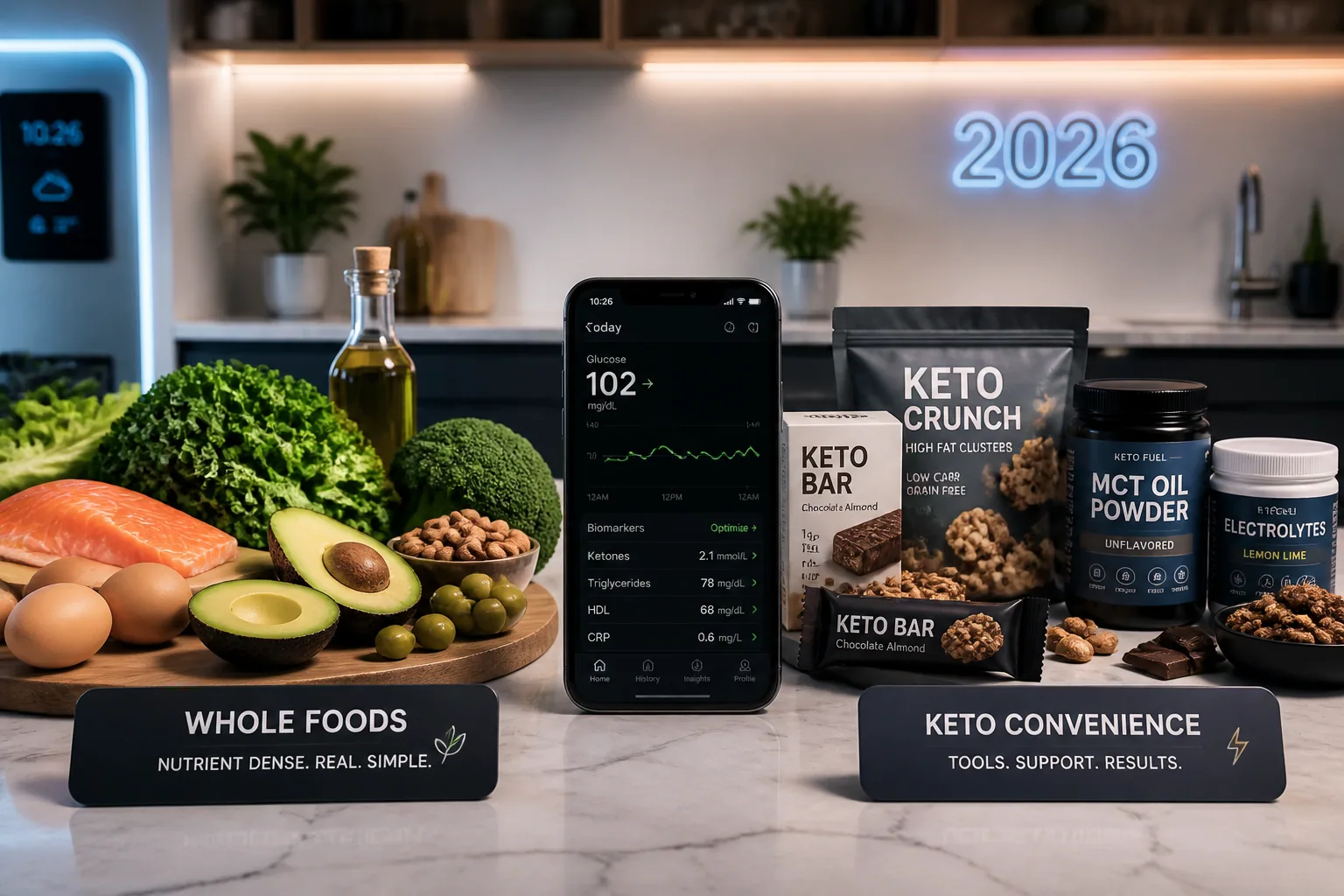
Keto in 2026: Why Your Keto Strategy Needs to Adapt (And How to Do It)
Keto in 2026 is not the same diet many people first tried years ago. The old version was often built around rigid macro percentages, a heavy emphasis on fat, and a one-size-fits-all rulebook that assumed everyone would respond the same way. That approach is getting harder to defend. Newer research is making it clear that keto outcomes depend on much more than carbs alone. Protein, fat, timing, activity, hormones, metabolic health, and even your personal glucose response all matter more than most early keto plans acknowledged.
At the same time, the keto market has exploded. Grocery shelves are filled with bars, breads, snacks, shakes, and packaged foods that promise convenience and ketosis in the same breath. Some of these products genuinely help people stay consistent. Others make keto more confusing, especially when hidden carbs, ultra-processed ingredients, and misleading serving sizes quietly erode progress.
The good news is that a modern keto strategy can be smarter, more flexible, and more sustainable. Instead of following a generic template, you can use better feedback from biomarkers, lab work, continuous glucose monitoring, wearable data, and real-world symptoms to build a version of keto that fits your body and your goals.
Why Keto in 2026 Is No Longer One-Size-Fits-All
The biggest shift in keto thinking is simple: people do not all process the same macronutrient mix in the same way. The old model often treated carbohydrate restriction as the only variable that mattered. Newer research points in a different direction. A 2026 review in Nature Reviews Endocrinology emphasized that interactions between carbohydrates, protein, and fat shape outcomes, and that protein has a particularly strong leverage effect. In other words, the balance between macros matters more than a rigid percentage target alone. The same review also notes that optimal ratios may vary depending on life stage and metabolic state, which is a major reason a generic keto plan can miss the mark. Source: https://www.nature.com/articles/s41574-026-01266-5
That matters because keto is no longer just about weight loss. Some people use it for appetite control. Others want better blood sugar management, athletic performance, cognition, or aging support. Those goals do not always require the same ratio of fat to protein, and they do not always respond well to the old 70 to 80 percent fat rule. In fact, the idea that everyone should push fat as high as possible is looking increasingly outdated.
The evidence also shows that keto can work well in the short term while still requiring a more thoughtful long-term plan. A recent systematic review found that plant-based ketogenic and low-carbohydrate diets produced strong short-term weight loss, roughly 5 to 7 kg over 4 to 52 weeks, along with improvements in HbA1c and LDL. But adherence was a weak point over time, and the more restrictive plant-based ketogenic versions needed supervision. Source: https://www.sciencedirect.com/science/article/pii/S0899900726001309
That is the real 2026 lesson. Keto still works, but the right version of keto is becoming more individual, more data-informed, and less dogmatic.
The Rise of Personalized Keto: Biomarkers, Labs, and Real-Time Feedback
Personalized keto starts with better feedback. For years, many people judged whether keto was working by scale weight alone. That is too blunt. Today, you can look at fasting glucose, triglycerides, HDL, LDL, HbA1c, waist measurement, sleep quality, energy, hunger, training recovery, and ketone readings to get a more useful picture.
Continuous glucose monitoring is one of the most important changes here. A large 2026 study of 8,025 non-diabetic adults used CGM-derived glucose dynamics metrics to stratify metabolic health, and those metrics correlated with liver and vascular health markers. The implication is big: your own glucose response may reveal whether a keto or low-carb plan is truly improving metabolic health, not just lowering carb intake on paper. Source: https://www.nature.com/articles/s43856-026-01523-8
This fits what many people already notice in practice. Two people can eat nearly the same meal and get very different glucose responses. A keto food that keeps one person stable may spike another person because of meal timing, stress, sleep loss, hormonal state, or the total mix of ingredients. A 2026 Frontiers in Digital Health study using CGM and wearable sensors reinforced that meal-to-meal glucose response depends on composition, timing, individual metabolic state, and behavior. That is exactly why static macro plans are starting to feel outdated. Source: https://www.frontiersin.org/journals/digital-health/articles/10.3389/fdgth.2026.1847884/full
Emerging tools may make this even easier. A Nature Biotechnology article highlighted biomolecular profiling through saliva, sweat, and interstitial fluid as a future pathway for tracking ketosis, inflammation, and metabolic shifts without constant blood draws. That does not mean you need every new device on the market. It does mean personalization is moving beyond food logs and bathroom scales. Source: https://www.nature.com/articles/s41587-026-03050-2.pdf
If you want to modernize your keto approach, think in terms of signals, not slogans. Which foods keep your glucose steady? Which meals improve your energy? Which macros support sleep and training? Which lab markers are improving, and which ones need attention? That is the new foundation of a smarter keto strategy.
Cycle-Syncing, Hormones, and Lifestyle Factors That Change Keto Needs
Hormones can change how keto feels from one week to the next, especially for women. A rigid plan that feels easy during one phase of the cycle can feel punishing during another. Appetite may rise, energy may dip, cravings can become stronger, and workouts may feel harder. In 2026, the more useful question is not whether keto is “working” in a general sense, but when and how your body tolerates it best.
This is where cycle-aware keto can help. Some people do better with stricter carb restriction most of the time, then a slightly higher carb intake around ovulation, intense training, or the late luteal phase. Others need more protein and fewer extreme fat targets to stay satisfied and hormonally stable. The point is not to abandon keto every time your needs change. The point is to treat keto as a framework that can flex.
Lifestyle matters just as much. Stress, sleep debt, shift work, heavy training, menopause, thyroid issues, and aging all change carbohydrate tolerance and recovery needs. For some people, forcing very low carb during a period of chronic stress backfires because cortisol is already high. For older adults, the equation may shift in the opposite direction, especially when preserving muscle is a priority.
That is where the newer research on sarcopenia becomes useful. A 2026 review found that ketogenic diets and elevated β-hydroxybutyrate can help prevent muscle loss in older adults, especially when protein is adequate and paired with resistance training. Protein-adequate keto improved muscle mass, strength, and functional outcomes. Source: https://pubmed.ncbi.nlm.nih.gov/41829932/
So yes, keto can still support healthy aging. But it works best when it is matched to training, protein intake, and life stage rather than copied from a generic template on the internet.
What the Keto Product Boom Says About Where the Diet Is Headed
The rise of keto products tells us something important: people want keto to be easier to live with. They want portable food, quick breakfasts, better snack options, and groceries that do not require a full nutritional investigation every time they shop. That demand is understandable. It also explains why the category keeps expanding.
But the product boom has a downside. The more keto becomes mainstream, the more the label gets used as a marketing shortcut. A product can say keto-friendly while still being highly processed, very calorie dense, or only technically low carb in a tiny serving size. That creates a false sense of safety, especially for new keto eaters who assume the label is enough.
The real meaning of the boom is this: keto is moving from a strict elimination diet into a convenience ecosystem. That can be helpful when you need support. It can also make people dependent on packaged foods that do not actually build metabolic health.
The smartest approach is to use keto products as tools, not as the center of the diet. If a product saves time, fits your macros, and helps you stay consistent, it can have a place. If it becomes a substitute for nutrient-dense meals, fiber, protein, and micronutrients, it is probably working against you.
Convenience has real value. A well-chosen keto product can make travel, busy workdays, and post-workout meals much easier. It can reduce decision fatigue and keep you from abandoning the plan when life gets hectic. In that sense, keto products can support adherence, which matters because even the best diet fails if nobody can stick to it.
But convenience should solve a problem, not create a new one. If your fridge and pantry are built around packaged keto bars, breads, and sweets, you may end up eating more often, grazing more, and relying less on actual meals. That can make hunger, cravings, and calorie intake harder to regulate. It can also crowd out protein, fiber, and micronutrients from whole foods.
Whole-food keto still has an edge for most people. Eggs, fish, meat, tofu, tempeh, olive oil, avocado, nuts, seeds, non-starchy vegetables, berries, and fermented foods provide a stronger nutritional base than most keto treats. They also make it easier to adjust your macros based on hunger, training, and health goals.
That does not mean all packaged foods are bad. It means they should be used strategically. A keto wrap can be useful for lunch on the go. A low-carb protein snack can help bridge a long gap between meals. A keto-friendly frozen meal can save you from fast food in a pinch. The key is to ask whether the product supports your long-term plan or just makes keto feel easier in the moment.
This is where a scanner like Keeto - Keto Made Easy can be genuinely practical. When you are standing in the grocery aisle, it helps to know whether a product is actually keto-friendly and how many net carbs it contains. You can learn more at https://findthe.app/keeto-5m0vbj. Used well, a tool like that can reduce guesswork without replacing label literacy.
The New Hidden Carb Problem in Keto Foods
One of the biggest keto mistakes in 2026 is assuming that anything labeled keto is automatically safe. Hidden carbs are still everywhere, especially in ultra-processed products. These can include sugar alcohols like maltitol or sorbitol, which may raise blood sugar more than expected. They can also include bulking agents such as maltodextrin or modified food starch, along with vague ingredients like “natural flavors” that make it harder to know what you are actually eating.
Serving size tricks are another problem. A snack can look very low carb until you realize the label is based on a tiny portion that nobody actually eats. This is one of the main reasons people think they are doing everything right yet fail to stay in ketosis. They are technically following the label, but not the real serving they consume.
Resources that focus on hidden carbs point to the same pattern: keto-friendly packaging often hides enough carbohydrate load to interfere with ketosis in practice. That is why the label is only the starting point. Source: https://www.drberg.com/blog/hidden-carbs
The best defense is a mix of skepticism and habit. Check ingredients, compare serving sizes, watch for sugar alcohols that do not behave like true low-carb ingredients, and use your own glucose response as the final test whenever possible. If a product repeatedly causes cravings, bloating, stalled progress, or glucose spikes, it is probably not helping just because it fits the marketing.
Are Your Macros Outdated? How Protein and Fat Guidance Is Evolving
For a long time, keto advice often centered on one rule: keep carbs very low and drive fat very high. That worked for some people, but the newer research suggests that model is too simplistic. The 2026 Nature Reviews Endocrinology paper on macronutrient mixtures highlights that protein interacts strongly with both carbs and fat, and that the mix matters more than isolated percentages. That means the classic high-fat formula may not be optimal for every body, goal, or age group. Source: https://www.nature.com/articles/s41574-026-01266-5
This matters for appetite, too. Many people feel better on keto when protein is higher than they were told in early versions of the diet. Protein supports satiety, muscle retention, and recovery, and it may make the diet easier to sustain. It also helps explain why some people get leaner and feel better when they reduce fat a little and increase protein within a low-carb framework.
The GLOW Study adds another useful detail. In women who moved from moderate to ketogenic macros over 21 days, body weight, body fat, blood pressure, and blood glucose improved, and ketones rose. But LDL increased, while fat-free mass was preserved rather than increased. Source: https://pubmed.ncbi.nlm.nih.gov/33705257/
That is a reminder that keto can improve some markers while shifting others in an unwanted direction. If your lipid profile worsens, if energy suffers, or if training performance falls off, the answer may not be to double down on fat. It may be to rebalance macros, especially by tightening protein quality, adding fiber, and reducing reliance on saturated fat-heavy processed foods.
There is also a more direct muscle-building reason to rethink old macro advice. For older adults especially, the 2026 review on sarcopenia suggests that protein-adequate keto paired with resistance training can help protect muscle. That makes protein a priority, not an afterthought. Source: https://pubmed.ncbi.nlm.nih.gov/41829932/
Signs You’re Following a Lagging Keto Strategy
A lagging keto strategy usually shows up in predictable ways. You may be stuck chasing net carbs without noticing that your protein is too low. You may rely on packaged keto snacks so often that your intake is highly processed and low in fiber. You may be eating enough fat to stay within keto conventions but not enough whole-food nutrition to support energy, hormones, and digestion.
Other signs include poor workout recovery, persistent constipation, brain fog, trouble sleeping, or plateaus despite strict carb counting. Some people also notice that their hunger swings are worse than they expected on keto. That can happen when the food choices are too low in protein, too low in micronutrients, or too dependent on artificial sweetness and snack foods.
A lagging strategy also ignores feedback. If your CGM shows that certain low-carb products still spike glucose, if your lipids move in the wrong direction, or if your energy improves when you slightly increase carbs around training, those are not failures. They are useful signals. The problem is not that keto is broken. The problem is that the strategy has not evolved with your body.
Smart Keto Upgrades for 2026: Practical Changes to Make Now
The simplest upgrade is to stop treating macros as fixed forever. Reassess your carb ceiling, protein target, and fat intake based on your actual goals. If you are losing weight, preserving muscle, and feeling good, there may be no need to change much. If you are stalled, fatigued, or dealing with abnormal labs, your current ratio may need a reset.
Second, use feedback more intelligently. A CGM can help you see how different meals affect blood sugar. Lab work can show whether your lipid profile, HbA1c, and metabolic markers are improving. Wearables can add context through sleep, heart rate, and activity. None of these tools are perfect on their own, but together they are far more informative than carb counting alone.
Third, prioritize protein and fiber. The research on macronutrient mixtures makes it clear that protein is not just a filler macro. It shapes satiety, energy balance, and disease risk. Fiber also deserves more attention, especially since animal research suggests it may blunt some of the adverse effects seen with standard ketogenic diets. In one 2026 study, lean mice on ketogenic diets developed liver steatosis, inflammation, and fibrosis over 16 weeks, but adding inulin fiber mitigated many of those effects while preserving metabolic benefits. Source: https://www.sciencedirect.com/science/article/pii/S0022316625007916
Fourth, become a better label reader. Do not assume that “keto” equals safe. Check the ingredient list, the sugar alcohols, the serving size, and the total pattern of your diet. Use convenience products as support, not as your nutritional base.
Finally, build in flexibility. Cycle-aware adjustments, training-day adjustments, and life-stage adjustments can all improve sustainability. Keto should fit your real life in 2026, not force your real life to orbit around a rigid macro chart.
Tools, Apps, and Resources That Can Help You Personalize Keto Better
You do not need every gadget to make keto more personal, but a small toolkit can make a big difference. A CGM is useful if you want to see your glucose response to specific meals. A food tracking app can help you notice when protein slips too low or when snack foods are crowding out meals. A wearable can add context by showing how sleep or stress affects your metabolic response.
In everyday shopping, barcode scanning can be a huge help. That is where a tool like Keeto - Keto Made Easy fits naturally into a 2026 keto routine. If you are tired of calculating net carbs in the grocery store, Keeto lets you scan products and instantly see whether they are keto-friendly, how many net carbs they contain, and how much of your daily carb budget they use. It is a practical way to make faster decisions without relying on guesswork. You can find it here: https://findthe.app/keeto-5m0vbj
Other resources matter too: lab testing through your clinician, meal templates that prioritize protein and vegetables, and a simple log of symptoms such as cravings, digestion, sleep, and workout performance. The most useful tool is the one that helps you act on real data instead of chasing internet trends.
Building a 2026-Ready Keto Plan That Fits Your Body and Goals
A 2026-ready keto plan is not about being stricter. It is about being more responsive. Start by defining your goal clearly. Are you trying to lose fat, stabilize blood sugar, preserve muscle, improve energy, or make your diet easier to maintain? Different goals call for different macro priorities and different levels of rigidity.
From there, set a carb range rather than a single magical number. Some people thrive at very low carb, while others do better with a slightly higher intake around training, cycle changes, or long workdays. Use protein as an anchor, not an afterthought. Make fat a tool for satiety and energy, not a target to maximize at all costs.
Then build the diet around whole foods first. Use vegetables, quality proteins, healthy fats, nuts, seeds, and fermented foods as your core. Add keto products only when they truly make your life easier. If you need help in the store, use scanning tools. If you need better feedback, use CGM or lab work. If your needs change, adjust the plan instead of forcing your body to obey an outdated rulebook.
That is what keto in 2026 really looks like: not more extreme, but more intelligent. The people who do best are the ones who move beyond slogans, pay attention to their own data, and treat keto as a living strategy rather than a fixed identity.