Keto for Vegetarians & Vegans: How to Stay in Ketosis Without Eating Meat
Can you really do keto as a vegetarian or vegan? Yes, but it takes more planning than a standard keto diet. The good news is that ketosis does not require meat. What it requires is a consistent pattern of low net carbs, enough fat to fuel satiety and energy, and enough protein to protect muscle mass and support recovery. With the right plant-based fats, smart protein choices, and a close eye on labels, vegetarian and vegan keto can be both practical and sustainable.
The main challenge is not whether it is possible. The real challenge is making sure the diet stays low enough in carbs while still covering key nutrients that plant-based eaters can sometimes miss, especially vitamin B12, iron, zinc, omega-3s, and calcium. That means choosing foods carefully, combining them intelligently, and supplementing where needed.
Can You Really Do Keto as a Vegetarian or Vegan?
Keto is built around carbohydrate restriction, not animal products. In practice, that means vegetarian and vegan eaters can stay in ketosis if they keep net carbs low enough, usually around 20 to 50 grams per day depending on personal tolerance, activity level, and body size. Many people also find that a plant-based keto approach feels easier when they focus on whole foods rather than highly processed meat substitutes or packaged low-carb snacks.
Vegetarians generally have more options because eggs and dairy can make it much easier to hit protein and fat targets without exceeding carb limits. Vegans can do it too, but their food choices need to be more strategic, especially because many classic vegan foods like beans, lentils, oats, rice, and most fruit are too carb-heavy for ketosis in typical portions.
The basic rule is simple: if a food gives you carbs, it needs to earn its place. If it gives you fat or protein without too many net carbs, it is much more useful on plant-based keto.
What Ketosis Looks Like on a Plant-Based Diet
Ketosis happens when your body runs low on glucose and starts using fat and ketones for energy. On a vegetarian or vegan keto plan, the process works the same way as any other keto diet. The difference is in how you build meals. Since plant foods often come with more fiber and sometimes more carbs per serving, portions matter even more.
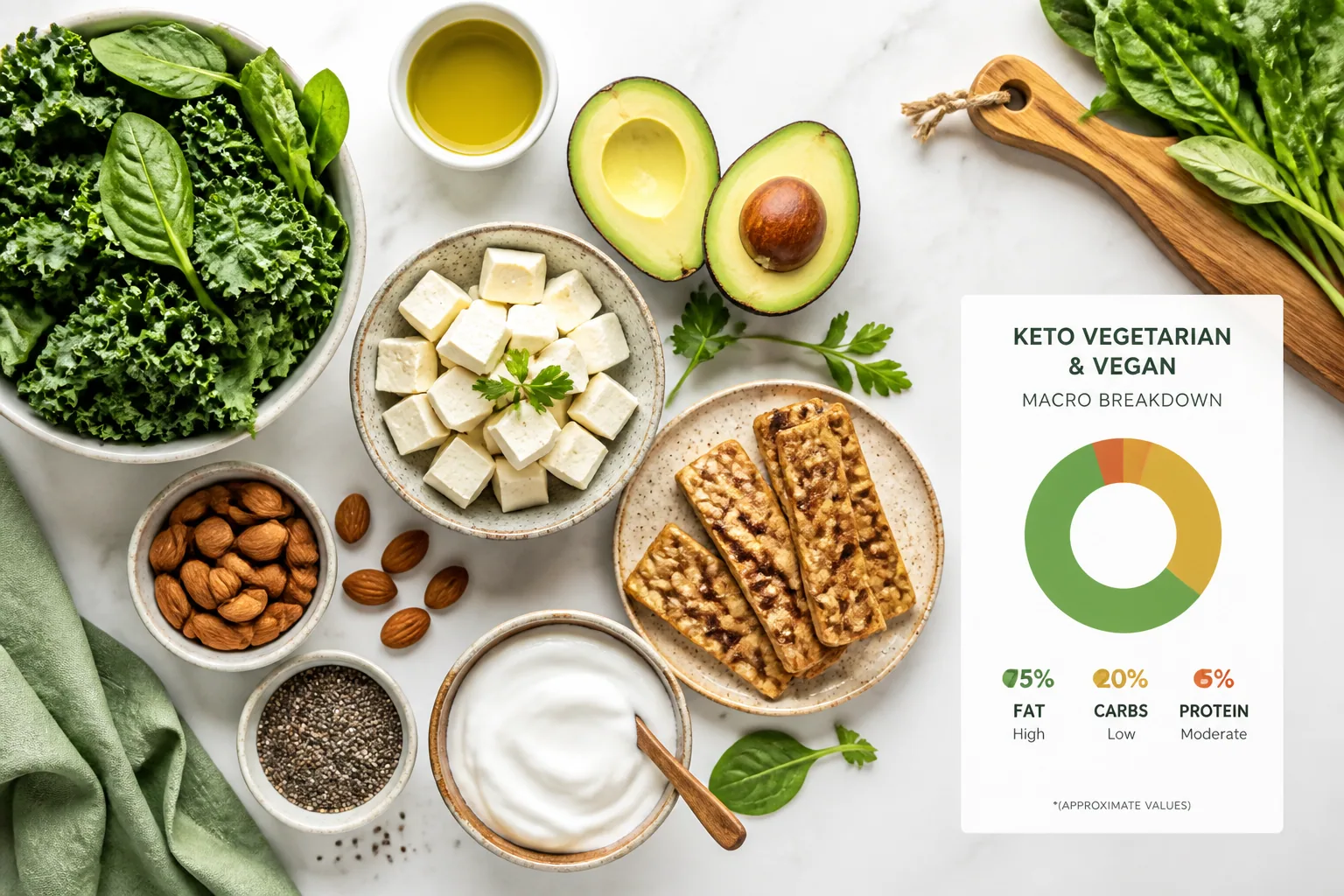
A plant-based keto plate usually centers on non-starchy vegetables, added fats, and a protein source that fits your diet type. For vegetarians, that could mean eggs, Greek yogurt, cottage cheese, halloumi, or whey protein. For vegans, it may mean tofu, tempeh, seitan, hemp hearts, protein powders, nuts, seeds, and oils.
Research shows that some plant proteins are far more keto-friendly than others. Tempeh, for example, offers a useful balance of protein and fat. Healthline notes that a 3 oz serving provides about 16 grams of protein, 10 grams of carbohydrates before fiber, about 7 grams of fiber, and 5 grams of fat, while the same amount of firm tofu provides about 8 grams of protein, 2 grams of carbs, 2 grams of fiber, and 5 grams of fat: https://www.healthline.com/nutrition/tempeh-vs-tofu
That distinction matters because ketosis depends on net carbs, not just total carbs. Higher-fiber foods can still fit into keto if the portions are planned carefully.
The Best Low-Carb Fats for Vegetarian and Vegan Keto
Fat is the backbone of keto, and plant-based eaters have plenty of options. The best choices are usually minimally processed sources that are naturally low in carbs and easy to add to meals.
For vegetarians and vegans, the most useful fats include avocados, avocado oil, olive oil, coconut oil, olives, nuts, nut butters, seeds, chia, flax, hemp hearts, and full-fat coconut products. These foods can raise calories and satiety without pushing carbs too high.
Flax seeds are especially valuable because they bring both fat and fiber. Healthline reports that 1/4 cup, or about 42 grams, provides about 18 grams of fat, 11 grams of fiber, and 7 grams of protein, with roughly half the fat coming from omega-3 ALA: https://www.healthline.com/nutrition/healthy-fats-for-keto
Hemp hearts are another standout. A 3 tablespoon serving, about 30 grams, delivers around 15 grams of fat and is one of the few plant foods that naturally provides all nine essential amino acids. That makes them unusually useful on vegan keto, where both fat and amino acid quality matter.
Walnuts, chia seeds, and macadamias can also be useful in moderation. Medical News Today notes that a handful of walnuts, about 30 grams, provides around 20 grams of fat and 5 grams of protein, which makes them a dense keto snack if you keep the serving under control: https://www.medicalnewstoday.com/articles/vegan-snacks
High-Protein Keto Foods Without Meat
Protein is where many plant-based keto eaters need to be especially intentional. If protein is too low, you may feel hungrier, lose lean mass, and struggle with recovery. If protein comes from higher-carb foods, you may have trouble staying in ketosis. The sweet spot is finding foods that are relatively high in protein and manageable in net carbs.
For vegetarians, eggs and dairy are the easiest high-protein options. Eggs are nearly ideal for keto because they are very low in carbs and versatile. Greek yogurt, cottage cheese, skyr, whey protein, and cheeses like mozzarella or halloumi can all help fill out meals, though labels still matter because carb counts vary by brand and type.
For vegans, tofu, tempeh, seitan, edamame in small portions, hemp hearts, pea protein isolates, soy protein isolate, and low-carb vegan protein powders are common tools. Healthline reports that seitan provides about 25 grams of protein per 100 grams, making it one of the richest plant-based protein sources: https://www.healthline.com/nutrition/protein-for-vegans-vegetarians/
Tempeh also deserves special attention because it is more protein-dense than tofu. According to Healthline, 3 ounces of tempeh provide about 16 grams of protein, compared with about 8 grams of protein from the same amount of firm tofu. That makes tempeh a strong option when you need more protein per serving, though the carb count still needs to be watched carefully.
Tofu remains one of the most flexible vegan keto proteins because it usually has fewer carbs than tempeh and adapts well to savory dishes, scrambles, stir-fries, and baked preparations. If you want a simple benchmark, firm tofu is often easier to fit into stricter keto days, while tempeh works well when you have more carb room.
How to Get All Essential Amino Acids on Plant-Based Keto
One concern people often have about plant-based protein is amino acid completeness. The good news is that you do not need every meal to be perfect. You need your overall daily intake to supply enough essential amino acids.
Some plant proteins are already complete, including soy foods like tofu and tempeh, hemp hearts, and certain protein blends. Others can be combined over the course of the day to cover the full amino acid spectrum. Pairing different protein sources, such as nuts and seeds with soy foods, can help create a more balanced amino acid profile.
This is why hemp hearts are so helpful. They are one of the few plant foods that naturally contain all nine essential amino acids. They are not a complete diet by themselves, but they are an easy upgrade to salads, smoothie bowls, yogurt alternatives, and savory sauces.
A practical way to think about it is this: build each day around a few anchor proteins rather than trying to force every single meal to be nutritionally perfect. If one meal is tofu-based and another uses hemp hearts or a protein powder, your total day can still cover amino acid needs well.
Common Nutrient Gaps: B12, Iron, Omega-3s, and More
Plant-based keto can be nutritious, but several nutrients deserve special attention. This is especially true if you remove both meat and many carb-rich fortified foods from your diet. The main ones to watch are vitamin B12, iron, omega-3 fats, zinc, and calcium.
Vitamin B12 is the most important supplement for vegans, and many vegetarians also benefit from it depending on their intake of dairy and eggs. VeganHealth summarizes evidence from the Adventist Health Study-2 showing that vegans who do not supplement often have lower serum B12, elevated methylmalonic acid, and red blood cell changes linked to anemia, while supplemented vegans show normal biomarkers: https://veganhealth.org/vitamin-b12/b12-status-of-vegan-adults/
Iron is another concern. Plant iron is less bioavailable than heme iron from animal foods, so it helps to pair iron-rich foods with vitamin C-rich vegetables like bell peppers or broccoli. It also helps to avoid taking high-calcium foods or supplements at the same meal as your main iron source. Vegans may consume enough total iron on paper but still have lower ferritin and hemoglobin levels.
Omega-3 fats are often overlooked. The NIH notes that conversion of ALA from plant sources into EPA is generally only about 5 to 10 percent, and conversion into DHA is often even lower, usually below 1 to 5 percent: https://ods.od.nih.gov/factsheets/Omega3FattyAcids-HealthProfessional/?source=organic
That means flax, chia, and walnuts are helpful, but they may not be enough on their own for everyone. VeganMealPlanGuide and NIH-based summaries note that algae-based supplements reliably raise EPA and DHA levels in vegetarians and vegans within 8 to 12 weeks: https://veganmealplanguide.com/vegan-omega-3-foods/
Zinc can also run low because plant foods contain phytic acid, which reduces absorption. VeganHealth reports that about half of vegans fall below reference levels of serum zinc, even when intake looks decent. A modest supplement may be useful for some people, especially if their food choices are limited: https://veganhealth.org/zinc/
Calcium matters too, especially if dairy is off the table. Tofu set with calcium salts, fortified plant milks, almonds, and chia seeds can all help. Many adults need about 1,000 mg of calcium daily, so it is worth checking labels and not assuming a plant-based diet automatically covers it.
How to Read Labels for Hidden Carbs and Animal Ingredients
If you are doing vegetarian or vegan keto, labels matter just as much as ingredient lists. Some products that look keto-friendly on the front may contain enough hidden carbs to interfere with ketosis. Others may include animal-derived additives that are not obvious at first glance.
Start with the nutrition facts panel. Look at total carbs, fiber, sugar alcohols if applicable, and the serving size. Net carbs are usually calculated by subtracting fiber and certain non-impactful sugar alcohols, but the exact impact depends on the ingredient and the brand. That is why a scanner tool can save time when you are shopping.
It also helps to watch for added sugars, starches, maltodextrin, inulin-heavy products that may affect some people, and sauces or marinades that quietly add carbs. Even foods marketed as vegan or high-protein can be surprisingly high in net carbs.
Animal-derived additives can be more subtle. Depending on your ethical choices, you may want to avoid gelatin, casein, whey, lactose, carmine, and certain forms of vitamin D or omega-3s that are not plant-derived. For vegans especially, this matters because a product can be low-carb and still not align with vegan standards.
This is one place where a tool like Keeto - Keto Made Easy can be genuinely helpful. Instead of guessing in the grocery store, you can scan a product, check its net carbs, and see how much of your daily carb budget it uses. If you want a faster way to evaluate packaged foods while shopping, you can look at it here: https://findthe.app/keeto-5m0vbj
Sample One-Day Vegetarian Keto Menu with Macros
Here is a realistic vegetarian keto day built around eggs, dairy, and low-carb plants. Macros are estimates and will vary by brand and portion size.
Breakfast: spinach and mushroom omelet made with 3 eggs, 1 ounce cheddar, and 1 tablespoon butter, plus 1/2 avocado. Estimated macros: about 30 grams of fat, 20 grams of protein, and 4 to 5 grams net carbs.
Lunch: Greek salad with 3 ounces feta, cucumber, olives, leafy greens, olive oil, and pumpkin seeds. Estimated macros: about 28 grams of fat, 15 grams of protein, and 6 grams net carbs.
Snack: full-fat Greek yogurt with chia seeds and a small handful of walnuts. Estimated macros: about 22 grams of fat, 14 grams of protein, and 5 grams net carbs.
Dinner: zucchini noodles with pesto, roasted cauliflower, and halloumi. Estimated macros: about 35 grams of fat, 18 grams of protein, and 7 grams net carbs.
Daily total: roughly 115 grams of fat, 67 grams of protein, and 22 to 23 grams net carbs. That is a workable strict keto day for many people, especially those who tolerate dairy well.
Sample One-Day Vegan Keto Menu with Macros
A vegan keto day takes more precision, but it is still very doable. The key is using tofu, tempeh, protein powder, seeds, oils, and low-carb vegetables strategically.
Breakfast: tofu scramble with spinach, mushrooms, nutritional yeast, olive oil, and 2 tablespoons hemp hearts. Estimated macros: about 24 grams of fat, 22 grams of protein, and 6 grams net carbs.
Lunch: salad with mixed greens, avocado, cucumber, olives, 4 ounces baked tofu, and tahini-lemon dressing. Estimated macros: about 32 grams of fat, 18 grams of protein, and 7 grams net carbs.
Snack: unsweetened vegan protein shake made with pea or soy protein isolate and almond milk. Estimated macros: about 6 grams of fat, 25 grams of protein, and 3 grams net carbs.
Dinner: tempeh stir-fry with broccoli, zucchini, sesame oil, and cauliflower rice. Estimated macros: about 28 grams of fat, 24 grams of protein, and 10 grams net carbs.
Daily total: roughly 90 grams of fat, 89 grams of protein, and 26 grams net carbs. For many people, that is still within keto territory, though more active or carb-sensitive individuals may want to lower the tempeh portion or reduce the shake carbs further.
Mistakes to Avoid When Starting Plant-Based Keto
One of the biggest mistakes is relying too heavily on carbs that sound healthy but do not fit keto well, such as lentils, chickpeas, oats, quinoa, and large servings of fruit. These foods can be nutritious, but they usually make ketosis much harder to maintain.
Another common mistake is under-eating protein. Because many plant foods are higher in fiber and lower in protein density, people can accidentally build meals that are too fat-heavy and not protein-sufficient. That often leads to hunger later, poor recovery, or a frustrating lack of progress.
A third mistake is ignoring micronutrients. A diet can be technically ketogenic and still leave you low in B12, iron, zinc, iodine, omega-3s, or calcium. Keto is not automatically complete just because carbs are low.
Finally, many beginners forget that packaged vegan foods can be deceptive. A veggie burger, meatless sausage, or plant-based cheese may be highly processed and more carb-heavy than expected. Reading labels is essential.
Who Should and Shouldn’t Try Vegetarian or Vegan Keto
Vegetarian or vegan keto may be a good fit if you want to stay aligned with ethical choices, you enjoy structured eating, and you are willing to track food more carefully than average. It can also work well for people who already love eggs, dairy, tofu, tempeh, nuts, and low-carb vegetables.
It may be a poor fit if you have a history of disordered eating, you struggle with restrictive food rules, you have kidney disease or another condition that affects protein tolerance, or you are pregnant, breastfeeding, or managing a medical condition that requires more individualized nutrition support. In those cases, it is best to work with a qualified clinician or dietitian.
People who exercise heavily or do intense endurance training may also need a more flexible version of keto, because plant-based low-carb eating can make it harder to get enough total calories and recovery support.
Final Tips for Staying in Ketosis Without Eating Meat
The simplest way to succeed on vegetarian or vegan keto is to keep your meals repetitive at first. Pick a few reliable proteins, a few dependable fats, and a short list of vegetables that fit your carb budget. Then rotate them rather than reinventing every meal.
Focus on tofu, tempeh, eggs, dairy if you eat it, hemp hearts, flax, chia, avocado, olive oil, coconut products, nuts, seeds, and low-carb vegetables. Keep an eye on net carbs, make sure your protein is high enough, and do not ignore B12, iron, zinc, calcium, and omega-3s.
Most of all, remember that keto is a framework, not a single food list. If you choose the right plant-based building blocks and stay consistent, you can absolutely stay in ketosis without eating meat.