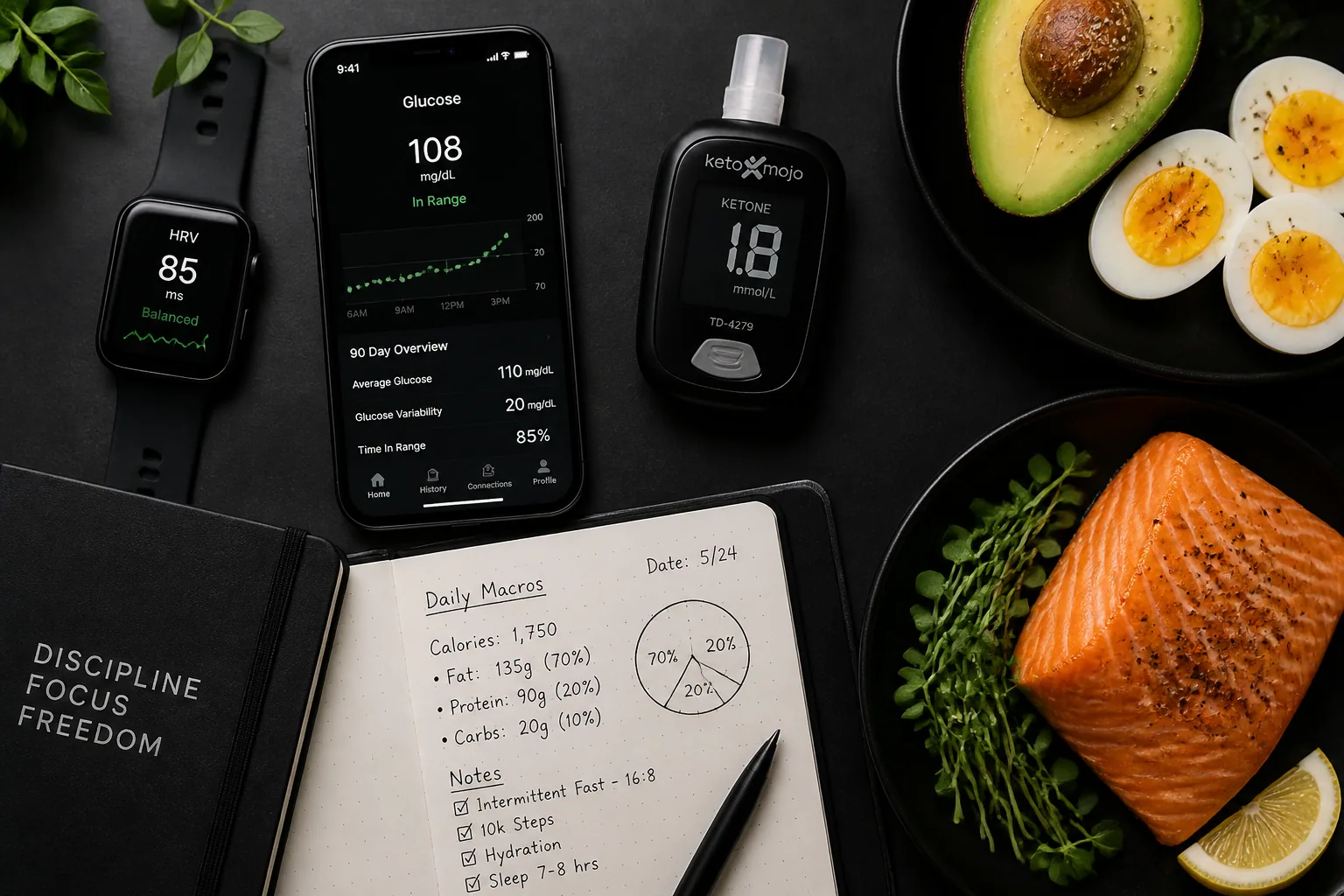
Is Ketosis Enough? How Biohacking Tools and Wearables Reveal What Carbs Alone Can’t
Ketosis is a useful target, but it is not the whole picture. If you have been keto for a while, you already know that net carbs matter. What becomes clearer with experience is that two people can eat the same amount of carbs and have very different glucose responses, ketone levels, sleep quality, recovery, and energy. That is where biohacking tools and wearables come in. They help you move beyond food labels and into a more complete view of metabolic health.
The goal is not to chase gadgets for their own sake. It is to use the right tools to answer better questions. Are you actually staying in nutritional ketosis? Are you recovering from stress and exercise well? Are your meals spiking glucose more than you think? Are sleep debt and stress masking your progress? With the right data, ketosis becomes a starting point rather than the finish line.
Why Ketosis Alone Doesn’t Tell the Whole Story
Ketosis is only one marker of how your body is handling fuel. It tells you that your liver is producing ketones and that your carb intake, energy balance, activity, and adaptation are lining up in a way that supports fat-derived fuel use. But ketosis does not automatically mean optimal insulin sensitivity, great sleep, low stress, or strong metabolic flexibility.
That is why many experienced keto followers eventually run into a familiar problem. They can keep carbs low and still feel flat, sleep poorly, or see unstable glucose. Others may measure decent ketones but still have stubborn post-meal spikes or elevated resting heart rate. In other words, ketosis can coexist with a stressed or under-recovered system.
The newer view of keto is broader. Instead of asking only, “Am I in ketosis?” it helps to ask, “How is my whole metabolic system responding?” That is where glucose trends, ketone exposure, sleep data, heart rate variability, and resting heart rate all start to matter.
What Metabolic Health Looks Like Beyond Net Carbs
Net carbs are still useful, especially for keeping intake consistent. But metabolic health is really about how efficiently your body uses fuel across changing conditions. Someone with good metabolic flexibility can handle a meal, a workout, a stressful workday, or a poor night of sleep without falling apart.
In practical terms, that means looking at several patterns at once. A stable fasting glucose, modest post-meal rises, decent overnight recovery, and ketones that appear when expected all suggest a system that is adapting well. On the other hand, repeated glucose spikes, low sleep quality, and poor HRV can suggest that the body is under more strain than carbs alone would reveal.
This broader approach also helps with troubleshooting. If weight loss stalls, for example, the issue may not be hidden carbs at all. It could be stress, poor sleep, late training, too little protein, or excessive caloric restriction. Wearables and metabolic trackers help identify which lever is most likely to matter.
How Continuous Glucose Monitors Add Context to Keto
Continuous glucose monitors, or CGMs, measure interstitial glucose rather than blood glucose directly. The value is not just the number itself, but the patterns over time. The CDC notes that CGMs provide time-in-range metrics, glucose variability, and real-time feedback, which can give insight into insulin sensitivity and metabolic health beyond simply counting carbs https://www.cdc.gov/diabetes/treatment/continuous-glucose-monitors.html
For keto followers, this is powerful. A CGM can show whether a supposedly keto meal is quietly spiking glucose more than expected. It can also reveal whether your morning glucose rises from dawn phenomenon, whether exercise improves your response, and whether stress or poor sleep changes your baseline. That kind of feedback turns guesswork into experimentation.
The most useful part is often not one meal, but the pattern across days. If your glucose is stable most of the time but spikes after late dinners, that points to timing. If you see higher overnight glucose after poor sleep, that points to recovery. If a walk after meals smooths your curve, you have found a simple intervention with real payoff.
Research is also starting to show that CGM patterns combined with wearable data can help identify metabolic subphenotypes, including people with repeated post-meal glucose spikes and poor recovery signals even when they are not clinically diabetic. That means glucose data becomes more meaningful when it is interpreted alongside HRV, resting heart rate, and sleep patterns.
Breath vs Blood Ketone Meters: What They Really Measure
If CGMs help you understand glucose, ketone meters help you understand fuel use. Blood ketone testing measures beta-hydroxybutyrate, or BHB, and it remains the most accurate and reliable way to assess real-time ketosis status. Breath tests measure acetone in exhaled air, while urine strips measure acetoacetate, which is less useful once you are keto-adapted and renal excretion changes.
The key point is that ketone readings are not fixed numbers. In the research by Suntrup et al., breath acetone and blood BHB both fluctuated by roughly 44 to 46 percent across a day in people on ketogenic and standard diets, which shows how noisy a single point measurement can be. They found only moderate correlation at single time points, with stronger agreement when data were averaged across the full day, where daily ketone exposure showed a high correlation between blood and breath data, R² around 0.80 https://pubmed.ncbi.nlm.nih.gov/33024634/
That same study also found that breath acetone could discriminate blood BHB thresholds of 0.3 to 1.5 mmol/L with ROC AUCs between 0.85 and 0.94, which suggests breath testing can be useful for trends and threshold awareness. Still, the consensus view remains that blood BHB is best for accuracy, breath is useful for noninvasive trend tracking, and urine is mostly a beginner tool https://pmc.ncbi.nlm.nih.gov/articles/PMC9294575/
If you want the most practical interpretation, think of blood ketones as the clearest snapshot, breath ketones as a trend tool, and urine strips as an early-stage marker that becomes less informative over time. For most experienced keto users, the question is not whether ketones are present at all, but whether your broader routine is producing the fuel pattern you want.
What Wearables Can Reveal About Sleep, Stress, and Recovery
Smartwatches and fitness wearables do not measure metabolic health directly, but they do capture important clues. Most use heart rate and movement data, and some use respiration proxies and skin temperature to estimate sleep duration and sleep stages. They are useful, but not perfect. Harvard Health notes that wearables often overestimate sleep duration and sleep efficiency, and that algorithms differ widely across brands, with polysomnography still the gold standard https://www.health.harvard.edu/blog/wearables-and-sleep-what-they-can-really-tell-us-2019122018488
That limitation does not make the data useless. It just means the data should be read as directional rather than clinical. A wearable can help you notice that your sleep deteriorates after late caffeine, heavy evening exercise, alcohol, travel, or stress. It can also help you see whether your body is recovering well enough from training or whether you are accumulating strain.
For keto followers, this matters because stress hormones can influence glucose and ketone patterns. A poor night of sleep can raise morning glucose, lower HRV, and make hunger harder to control. If you only look at carbs, you may miss the real reason progress slowed down.
Using Heart Rate Variability to Understand Adaptation and Strain
Heart rate variability, or HRV, is one of the most useful wearable metrics for people trying to understand recovery. It reflects the variation between heartbeats and is commonly used as a signal of autonomic balance, cardiovascular fitness, readiness, and overall physiological stress. In practice, a higher HRV often suggests better recovery, though your own baseline matters more than any universal target.
Wearables usually measure HRV at rest or during sleep using optical sensors. The important part is trend interpretation. A sudden HRV drop can reflect illness, psychological stress, travel, under-recovery, dehydration, or hard training. It does not automatically mean your diet is failing. That is why context is everything.
The CDC-linked research summary on longitudinal studies also supports the idea that resting HRV is associated with stress load and recovery patterns. When paired with glucose data, HRV can help you understand whether your body is adapting smoothly or compensating under strain. In other words, HRV helps separate “I ate something wrong” from “my system is overloaded.”
A practical way to use HRV is to compare it against your normal range rather than obsessing over absolute values. If your HRV is consistently low after late meals, intense training, or short sleep, that gives you a reason to adjust. If it bounces back when you improve sleep and hydration, that is useful feedback, not just a number on a screen.