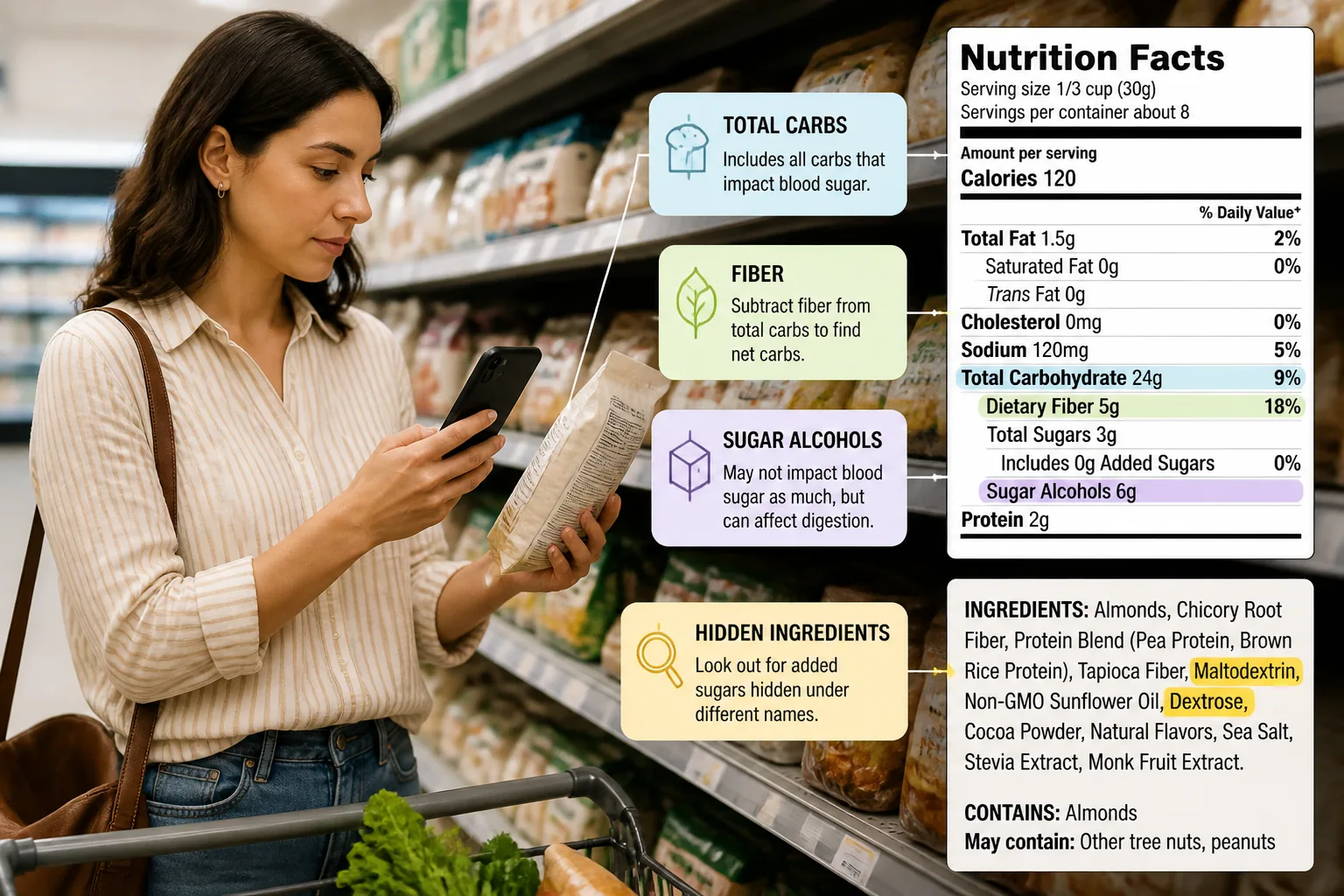
How to Decode Nutrition Labels for Keto Success
If you follow keto, the most important skill you can build is not cooking, it is label reading. Front-of-package claims like “low carb,” “keto friendly,” or “sugar free” can sound reassuring, but they often hide the real story inside the Nutrition Facts panel and ingredient list. A product may look perfect on the shelf and still contain enough starches, sugars, or serving-size tricks to push you out of ketosis.
The good news is that once you know what to look for, nutrition labels become much easier to understand. You do not need to memorize every ingredient in the store. You just need a simple system for spotting the numbers and ingredients that matter most for keto, so you can shop with more confidence and less guesswork.
Why Nutrition Labels Matter More Than Front-of-Package Keto Claims
Marketing is designed to get your attention, not to protect your macros. A box can say “keto,” “diet,” or “no added sugar” while still containing ingredients that raise blood sugar quickly. That is why the Nutrition Facts label matters more than the front of the package. It tells you the actual carb content, the serving size, and the amount of sugar-related ingredients that affect ketosis.
This is especially important with packaged foods, sauces, condiments, and ready-made meals. These products are where keto mistakes happen most often because carbs are hidden behind tiny serving sizes, thickeners, starches, and sweeteners that sound harmless. A careful label check helps you separate real keto options from products that are only keto in name.
The 5 Label Numbers Keto Shoppers Should Check First
When you pick up a package, focus on these five things first: serving size, servings per container, total carbohydrates, fiber, and added sugars. Those numbers give you the quickest snapshot of whether a food is likely to fit your daily carb limit.
Serving size tells you what the nutrition numbers actually refer to. Servings per container shows you whether the package contains one portion or several. Total carbohydrates is the starting point for keto math. Fiber helps you estimate net carbs. Added sugars reveal sugars that were included during processing, from sources like syrups, honey, or other sweeteners. The FDA notes that added sugars must now be listed on US labels in grams and percent Daily Value, which makes this check much easier than it used to be. Source: https://www.fda.gov/food/nutrition-facts-label/added-sugars-nutrition-facts-label
Serving Size: The Small Detail That Can Double Your Carb Count
Serving size is one of the easiest places to get fooled. A bag of snacks may look like a single serving, but the label might define a serving as only half the bag. A jar of sauce might show carbs for two tablespoons, even though most people use four or five. If you eat the whole package and only count the listed serving once, you may undercount your carbs by a lot.
This is why the updated FDA label format is helpful. Serving size and servings per container are now bolded and more prominent, and calories and serving size declarations are displayed in larger type. Source: https://www.fda.gov/food/nutrition-food-labeling-and-critical-foods/changes-nutrition-facts-label
A simple habit can save you: always ask yourself, “How much will I actually eat?” Then multiply the carbs by the real amount. If the serving size is smaller than your normal portion, adjust before you decide the product is keto-safe.
Total Carbs vs Net Carbs: What Actually Matters on Keto
For keto shoppers, total carbohydrates is the first number to inspect, but net carbs is usually the number that matters most. Net carbs refers to the carbohydrates that actually raise blood sugar and affect ketosis. In many cases, it is calculated by subtracting fiber and, sometimes, sugar alcohols from total carbohydrates. Source: https://www.healthline.com/nutrition/net-carbs
A common shortcut is: net carbs = total carbs minus fiber. That works for many packaged foods, but it is not always enough. Some products contain sugar alcohols, and not all sugar alcohols behave the same way in the body. For processed foods, a more accurate formula is often net carbs = total carbs minus fiber minus half of sugar alcohols, except erythritol, which is typically subtracted fully because it has almost no glycemic impact. Source: https://www.medicalnewstoday.com/articles/326457
That means two products with the same total carbs can affect you very differently depending on the type of fiber, sweetener, and sugar alcohols they contain. If you are strict keto, it is smart to be cautious with any label that relies on sugar alcohols to make the carb count look lower.
Fiber on Labels: When It Helps and When It Misleads
Fiber is often your friend on keto because it is not digested like regular carbohydrates. That is why it is usually subtracted from total carbs when calculating net carbs. High-fiber foods can look carb-heavy on paper while still fitting well into a low-carb day.
But fiber on a label is not a magic pass. Some products add isolated fibers or fiber blends to improve the nutrition panel while keeping the food highly processed. If a packaged snack claims a very low net carb count but is built around starches, sweeteners, and synthetic fibers, the label may be more of a loophole than a sign of a truly keto-friendly food. In those cases, the ingredient list becomes just as important as the numbers.
Sugar Alcohols Explained: Which Ones Are More Keto-Friendly?
Sugar alcohols can be helpful for keto, but they are not all equal. Erythritol is generally the most keto-friendly because it has a glycemic index of about 0 and is usually subtracted fully from net carbs. Xylitol and sorbitol have low glycemic indexes, but they can still affect some people and may cause digestive discomfort. Maltitol is the one to watch closely because it can raise blood sugar much more than many shoppers expect.
Healthline notes that sugar alcohols differ in their effect on blood sugar, with erythritol around GI 0, xylitol and sorbitol around 9 to 13, and maltitol ranging roughly from 35 to 52 depending on the form. Source: https://www.healthline.com/nutrition/sugar-alcohol-keto
That is why the label shortcut “sugar alcohols total” is not enough on its own. If the sweetener is erythritol, the product may be more keto-compatible. If the product uses maltitol, especially in candies, bars, or desserts, the impact can be much higher than the label suggests.
Added Sugars and Hidden Carb Ingredients to Watch For
The added sugars line is one of the easiest ways to spot trouble, but it does not catch everything. The FDA definition includes sugars added during processing and from ingredients such as syrups and honey, which means this line gives you an important warning if a food is sweetened beyond its natural ingredients. Source: https://www.fda.gov/food/nutrition-facts-label/added-sugars-nutrition-facts-label
Even if added sugars are low, the ingredient list may still contain hidden fast-digesting carbs. Common names to watch for include maltodextrin, dextrose, glucose syrup solids, modified food starch, and some carrier ingredients in “natural flavors.” These ingredients can act like carbs even when they are not listed as plain sugar. Source: https://huhuly.com/maltodextrin-in-food-why-its-not-listed-as-sugar/
Modified food starch and related starch derivatives, such as modified corn starch and dextrin, are especially important because they are processed carbohydrates that can be rapidly converted to glucose in the body and are often used as thickeners. Source: https://www.drberg.com/blog/modified-food-starch
Common Label Tricks on “Low-Carb,” “Diet,” and “Sugar-Free” Foods
Some label claims are technically true but still misleading. A “sugar-free” product may still contain starches or sugar alcohols that affect blood sugar. A “low-carb” product may be low per serving, but the serving may be unrealistically small. A “diet” food may have fewer calories but still be too carb-heavy for ketosis.
The trick is to avoid reading only the claim on the front. Go straight to the Nutrition Facts panel, then the ingredient list. If the product is relying on tiny serving sizes, maltitol, starches, or multiple sweeteners to make the numbers look better, that is a warning sign. Keto success is less about catchy packaging and more about consistent, honest carb counting.
How to Read Condiment, Sauce, and Dressing Labels Without Getting Burned
Condiments and sauces are one of the most common sources of hidden carbs because they are often eaten in small amounts, which allows manufacturers to keep the carb count looking low. Ketchup, barbecue sauce, teriyaki sauce, honey mustard, salad dressing, and marinades can all contain sugar, syrups, starches, or modified food starch.
When reading these labels, check the serving size first. Then compare total carbs, added sugars, and ingredients. If a sauce contains more than one carb-containing sweetener, or if starch appears in the ingredient list, the real carb count may be higher than the panel makes it seem. For keto, even small spoonfuls add up quickly when used repeatedly across meals.
Real Label Scan Examples: What People Think They Mean vs Reality
Example one: a “sugar-free” flavored syrup lists 0 grams of sugar and only 1 gram of net carbs per serving. That sounds ideal, but the ingredient list includes maltitol and modified starch. On a strict keto plan, that is a caution flag because the sweetener may affect blood sugar more than expected, and the starch is not helping.
Example two: a salad dressing shows 2 grams of carbs per serving, but the serving size is only one tablespoon. If you use three tablespoons on a salad, you are now at 6 grams of carbs before you even count any other meal components. What looked like a tiny carb cost has become a meaningful portion of your daily limit.
Example three: a ready-made soup says “low carb” on the front and has 4 grams of net carbs per serving. But the can contains two servings, and the ingredient list includes modified corn starch and dextrose. The label is not necessarily false, but it is easy to overeat the serving and underestimate the impact.
A Simple Formula for Checking Packaged Foods Before You Buy
You do not need a complicated system in the aisle. Use this quick checklist: start with serving size, then check total carbs, subtract fiber, and evaluate sugar alcohols carefully. If the sweetener is erythritol, the product may be more forgiving. If it contains maltitol, starches, or obvious sugar ingredients, be more skeptical.
Here is the practical version: ask how much you will really eat, multiply the carbs by that amount, and then scan the ingredient list for warning signs like maltodextrin, dextrose, syrups, and modified starch. If the math seems too good to be true, it probably is. Keto shopping becomes easier when you treat every label as a mini investigation rather than a promise.
How a Scanner Tool Like Keeto Can Help You Shop Smarter
Even when you understand the label, grocery shopping can still be slow. That is where a scanner can help. With Keeto - Keto Made Easy, you can scan a barcode and get an instant keto verdict, see the net carbs, and track how the product fits into your daily carb budget. It is a practical way to reduce mental math when you are comparing packaged foods in real time. You can learn more here: https://findthe.app/keeto-5m0vbj
For beginners especially, that kind of support can make the difference between staying consistent and getting overwhelmed. Instead of second-guessing every label, you can build better shopping habits faster, save your favorites, and move through the store with more confidence. Over time, that means fewer surprises, fewer carb mistakes, and a much easier path to keto success.