Eco-Keto: How to Follow a Low-Carbon Footprint Keto Diet Without Sacrificing Flavor or Health
Keto and sustainability do not have to be at odds. In 2026, more people are paying attention not only to macros, but also to where their food comes from, how it was produced, and what kind of footprint it leaves behind. The good news is that you can absolutely keep keto satisfying, nutrient-dense, and delicious while making choices that are gentler on the planet.
The key is not perfection. It is pattern. A few smarter protein swaps, better fat sourcing, less waste, and more seasonal shopping can make a real difference without turning your meals into a compromise. If you also want an easier way to check whether packaged foods fit your keto targets while you shop, Keeto - Keto Made Easy can help with quick barcode scans and net-carb tracking: https://findthe.app/keeto-5m0vbj
Why Eco-Keto Matters in 2026
Food systems are a major driver of climate impact. According to Our World in Data, food systems account for roughly 26 to 31 percent of global greenhouse gas emissions, and livestock and fisheries contribute nearly one-third of that total. That means the foods you choose for keto can have a meaningful environmental cost, especially when they rely heavily on high-impact animal products.
This matters even more for keto because many traditional keto plates lean hard on beef, butter, cheese, and other animal-based staples. That does not mean these foods are off-limits, but it does mean the details matter. The sourcing, the species, the farming method, and even the amount of food that ends up wasted all shape the final footprint. The goal of eco-keto is to keep the metabolic benefits of keto while making more climate-aware decisions along the way.
There is also a broader efficiency issue. One review found that animal-based foods contribute about 57 percent of emissions linked to the global food system, while foods consumed directly as plants contribute about 29 percent. In practical terms, the more your plate depends on resource-intensive animal products, the higher the environmental burden tends to be. That is why thoughtful substitutions can matter so much.
The Carbon Footprint of Common Keto Proteins
Not all keto proteins are created equal. Research consistently shows that beef and lamb have the highest carbon footprint per unit of protein, followed by dairy, eggs, pork, and seafood, while poultry and plant-based proteins rank lower. Another source cited in the research found that beef emits about 25.2 kg CO2e per kilogram of meat, compared with roughly 10.3 kg CO2e for pork. In other words, beef can produce around 2.5 times more emissions than pork per kilogram of edible meat.
The difference is not just about carbon, either. Feed conversion efficiency helps explain why some proteins are more resource-intensive than others. The research summary notes that beef may require about 24 to 49 units of plant feed to produce 1 unit of animal product, while pork needs around 3 to 9, chicken and turkey around 2 to 5.4, dairy and eggs about 2.4, salmon about 1.3, and marine fish around 1.9. The more feed, land, and energy required upstream, the higher the environmental cost tends to be.
This is why two keto meals with the same macros can have very different footprints. A ribeye-heavy plate and a salmon-and-egg plate may both be low in carbs and high in fat and protein, but their emissions profiles are not identical. Understanding that difference gives you room to make keto choices that support both health and environmental goals.
There is one more point that is easy to overlook: waste. The EPA reports that about one-third of all food produced in the U.S. is never eaten. When high-carbon foods like meat are wasted, the environmental damage is amplified because the land, water, feed, transport, and refrigeration inputs have already been spent. Yale E360 also reported that, in university cafeterias, wasted meat and eggs produced greenhouse gas emissions about three times larger than all other wasted foods combined, with discarded beef accounting for over half of those emissions in some cases.
Better Protein Swaps: From Beef to Eggs, Poultry, and Seafood
If beef is a frequent center of your keto meals, the simplest eco-keto move is not to eliminate it entirely. It is to reduce how often it plays the starring role. Swapping even a portion of your beef intake for lower-impact proteins can cut emissions substantially while keeping meals satisfying and flexible.
Eggs are a classic keto staple and, while not the lowest-impact animal protein, they usually compare more favorably than beef and lamb. Poultry is another smart option because chickens and turkeys convert feed more efficiently than cattle. That efficiency shows up both in cost and in environmental impact, which is why chicken thighs, turkey burgers, and roasted drumsticks can be excellent anchor proteins for eco-keto meal prep.
Seafood can also fit well, especially when you choose species with lower impacts and stronger sourcing practices. The research summary notes that salmon and many marine fish have much better feed conversion ratios than beef. That does not make every fish choice automatically sustainable, but it does mean seafood can be a strong keto protein when you select it carefully. Look for responsibly managed fisheries, lower-trophic species, and products with clear origin information.
A practical way to think about it is this: make beef and lamb the occasional indulgence, not the everyday default. Use eggs for breakfasts and quick lunches. Rotate poultry into bowls, salads, casseroles, and soups. Use salmon, sardines, mackerel, trout, mussels, and similar options when you want a richer fat profile with a smaller footprint than many red meats. Over time, those swaps add up without making your diet feel restrictive.
How to Choose Sustainable Keto Fats and Oils
Keto is famous for fat, but the source of that fat matters. The best keto fats are not only low in carbs and flavor-friendly, they also come from sourcing practices you can feel good about. Olive oil, avocado oil, coconut products, butter, and fish-based fats can all have a place in an eco-keto kitchen, but they are not all equal in sustainability.
Extra-virgin olive oil is often one of the best choices because it is versatile, stable enough for many uses, and generally associated with strong culinary and nutritional benefits. The sustainability story can be even better when the producer uses regenerative methods. A recent example highlighted California Olive Ranch, which brought over 4,600 acres of olive orchards under verified regenerative certification using cover cropping, composting, livestock grazing, hedgerow planting, and minimal or no tillage to support soil health and carbon sequestration. That kind of approach can make olive oil a genuinely climate-aware keto fat when sourced well.
Avocado oil is another popular keto option, especially for higher-heat cooking. Here, the key questions are traceability and processing. Because avocado supply chains can vary widely, look for brands that are transparent about origin, extraction methods, and quality controls. If possible, prioritize third-party verification and brands that can document responsible farming and handling.
Coconut products can also be useful for keto baking, curries, and smoothies. As with any tropical crop, though, sustainability can depend on sourcing, farm practices, and transport. Butter and ghee can be excellent for flavor and satiety, but they do come from dairy, which generally carries a higher footprint than many oils. For that reason, it makes sense to use them intentionally for taste rather than as the automatic base of every meal.
Fish-based fats, such as omega-3-rich oils, can be valuable from a nutritional standpoint, but again, sourcing matters. When choosing these products, pay attention to species, harvest methods, and third-party oversight. In eco-keto, a fat is not just a macro, it is a supply chain.
What Labels and Certifications Actually Mean
Labels can be helpful, but only if you know what they are telling you. For sustainable keto fats and oils, some of the most useful signals include Regenerative Organic Certified, certified organic, A Greener World Certified Regenerative, Land to Market verification, and, in some cases, third-party certifications that evaluate seed oil-free status. These do not automatically guarantee perfection, but they do provide a stronger basis for trust than vague marketing language.
Regenerative Organic Certified, for example, goes beyond basic organic standards by focusing on soil health, animal welfare, and social fairness. Land to Market emphasizes ecological outcomes and verification of regenerative sourcing. These are especially relevant if you want your fats and oils to align with a broader environmental philosophy rather than just a keto-friendly nutrition label.
The takeaway is simple: do not stop at the front of the package. Read the sourcing details, look for third-party verification, and favor brands that explain how they farm, extract, and process their products. A transparent label is usually a better sign than a flashy claim.
Low-Waste Keto: Meal Planning, Freezing, and Whole-Animal Cooking
One of the easiest ways to make keto greener is to waste less food. Since so much of food’s environmental impact happens before it ever reaches your plate, every leftover you save is a small win for both your budget and the climate. On keto, this is especially important because protein and fat-rich foods tend to be the most resource-intensive items in the cart.
Meal planning is the foundation. Build your week around a few repeatable components such as roast chicken, hard-boiled eggs, salmon patties, leafy salads, cauliflower mash, and a couple of versatile sauces. That way, leftovers can become lunch bowls, lettuce wraps, omelets, or soups instead of forgotten containers in the back of the fridge. Keto often works best when the ingredients are flexible enough to recombine in new ways.
Freezing is another powerful tool. Cook in larger batches, portion meals before they spoil, and freeze fats, cooked proteins, soups, and low-carb sauces in single-serving containers. If you buy in bulk, freeze immediately rather than waiting until you are already tired of the food. This matters because the EPA notes that roughly one-third of U.S. food is never eaten, and high-carbon foods are especially costly when discarded.
Whole-animal cooking can also reduce waste while deepening flavor. Use bones for broth, render fat where appropriate, roast the skin for texture, and transform scraps into salads, omelets, or filling soups. When you buy a bird or a piece of fish, think beyond the first meal. That mindset turns one purchase into several satisfying keto meals and helps justify the environmental cost of the protein you chose.
Seasonal, Keto-Friendly Foods With a Lower Environmental Impact
Seasonal shopping is one of the most underrated eco-keto habits. Foods that are in season often need less energy for storage, transport, and artificial growing conditions. They also tend to taste better, which matters on a diet that should feel rich and enjoyable rather than repetitive.
For a lower-impact keto plate, build around vegetables that are both low in carbs and easy to source locally when in season. Think zucchini, cabbage, kale, spinach, lettuce, cucumbers, asparagus, cauliflower, broccoli, radishes, mushrooms, and herbs. These ingredients work well in stir-fries, roasts, salads, casseroles, and egg dishes, and they provide texture and micronutrients that make keto more sustainable nutritionally.
You can also use seasonal produce to reduce reliance on imported or heavily packaged items. For example, zucchini noodles in summer, roasted Brussels sprouts in fall, cabbage slaw in winter, and herb-heavy salads in spring can keep your plate varied without raising your carb count. The more your meals reflect the season, the more likely they are to feel fresh and the less likely you are to burn out on keto.
A Sample Eco-Keto Grocery List and Meal Ideas
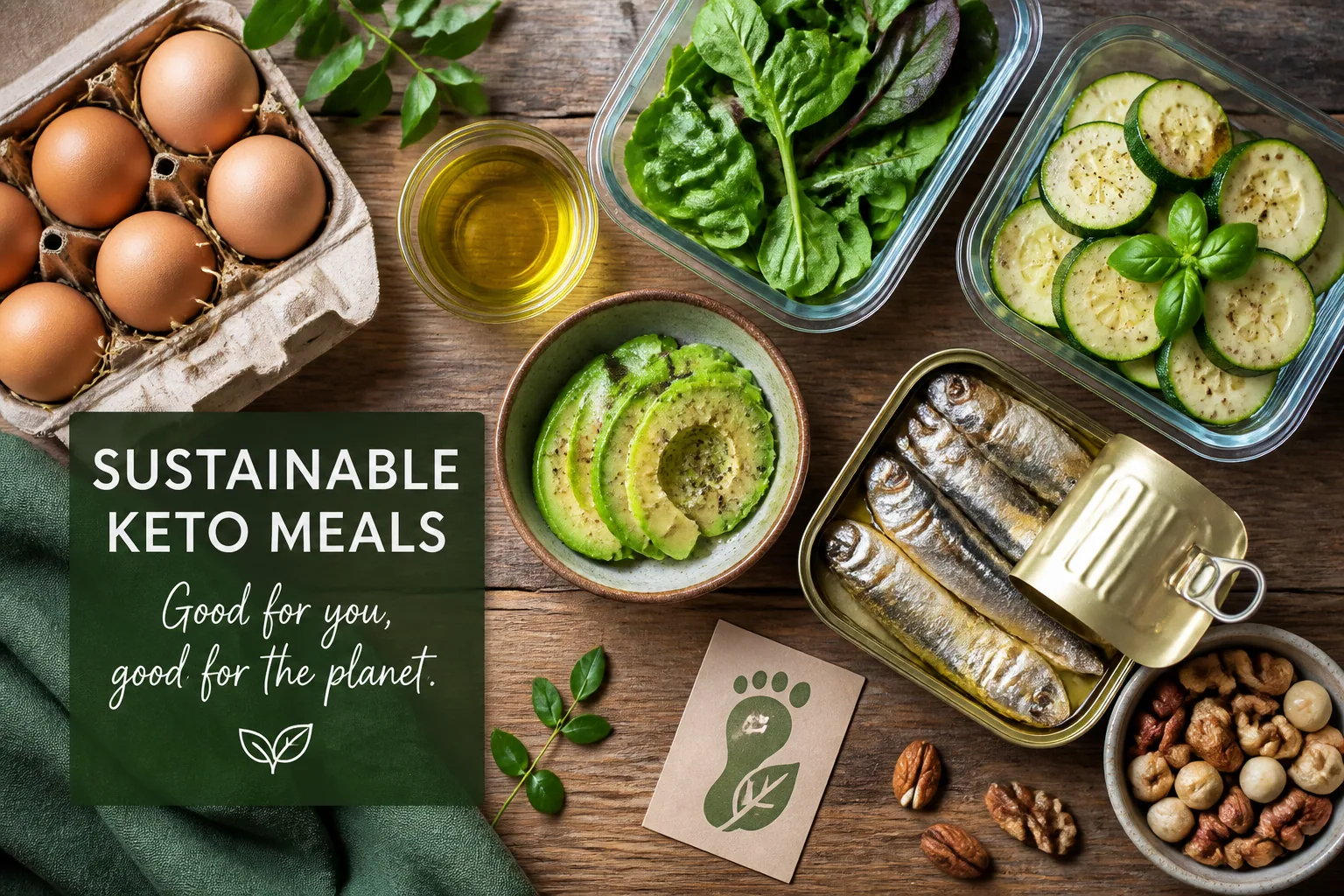
A good eco-keto grocery list is built around lower-impact proteins, sustainable fats, and vegetables that give you volume and nutrients without many carbs. Start with eggs, chicken thighs, turkey, canned sardines, salmon, and, when it makes sense for your budget and values, occasional grass-fed beef rather than beef as an everyday habit.
For fats, choose extra-virgin olive oil, avocado oil, butter or ghee used strategically, coconut milk or coconut cream for recipes that benefit from them, and fish oil or fish-based products from transparent sources. For vegetables, focus on leafy greens, crucifers, zucchini, mushrooms, asparagus, cucumber, herbs, and avocados. Add nuts and seeds in moderate amounts if they fit your carb target.
A few meal ideas make this easy to put into practice. Try a spinach and feta omelet with avocado on the side. Make roasted chicken thighs with cauliflower mash and olive oil herb drizzle. Build salmon salad bowls with cucumber, celery, and leafy greens. Prepare turkey lettuce wraps with mushrooms and sesame oil. For dinner, use sardines or mackerel over a warm cabbage and herb salad with lemon and olive oil. These meals stay keto-friendly, but they also lean into ingredients with a more manageable footprint than a heavy red-meat menu.
How to Balance Sustainability, Nutrition, and Budget
Eco-keto works best when it is realistic. If a more sustainable option blows up your grocery budget or makes meal prep too complicated, it is unlikely to stick. That is why the smartest approach is often not the most expensive one. Eggs, chicken, canned fish, seasonal vegetables, and well-chosen oils can keep costs manageable while still lowering your environmental impact compared with a beef-heavy diet.
Nutrition still has to come first. Keto should provide enough protein, enough fat, and enough variety to support satiety and micronutrient intake. If you cut back too aggressively on animal foods, you may need to be more intentional about iron, B12, zinc, omega-3s, and overall protein quality. The point is not to chase purity. It is to make tradeoffs thoughtfully so that your diet remains effective and nourishing.
Budget-conscious eco-keto is often built on planning. Buy in season, cook from scratch when possible, use leftovers intelligently, and keep a list of staple meals that you can repeat without boredom. A well-structured grocery routine can save money, reduce waste, and make sustainable choices feel less like an extra chore and more like the default.
Small Changes That Make Your Keto Diet Greener
You do not need to redesign your entire diet overnight. A few small changes can meaningfully reduce the footprint of your keto routine. Replace one beef meal per week with poultry or seafood. Use eggs for quick meals instead of more resource-intensive proteins. Choose olive oil from brands with regenerative practices when possible. Freeze leftovers instead of letting them spoil. Shop seasonally. Buy less, waste less, and cook more flexibly.
Even simple habits like checking packaged foods before you buy can help keep keto easier and more consistent. That is where a tool like Keeto - Keto Made Easy can be especially useful, since it lets you scan products quickly, track net carbs, and make faster decisions in the store without mental math: https://findthe.app/keeto-5m0vbj
Eco-keto is really about alignment. It lets you eat in a way that supports your goals, tastes good, and reflects a more responsible relationship with food. When you choose proteins more carefully, source fats with intention, and waste less along the way, your keto plate becomes not just lower in carbs, but smarter, cleaner, and more climate-aware too.