Choosing the Right Fats for Keto: Smoke Points, Health Trade-Offs, and the Safest Oils for Cooking
If you are doing keto, fat is not just fuel. It is also one of the biggest choices you make in the kitchen every day. The fat you cook with can affect flavor, how well your food holds up to heat, and even how stable the oil is while it is being used. That means choosing the right fat is about more than calories or net carbs. It is about matching the fat to the cooking method, the temperature, and your health goals.
For keto beginners, this can feel confusing fast. One guide says avocado oil is best, another says olive oil is healthier, and then there are animal fats like ghee, butter, lard, and tallow, each with different strengths. On top of that, smoke point gets treated like the only number that matters, when in reality it is only part of the story.
This guide breaks down the practical side of keto fats in a simple way. You will learn what smoke point actually means, why overheating oils can damage flavor and quality, how refined and unrefined oils differ, and which fats tend to work best for high-heat cooking versus dressings and finishing. You will also see how to read oil labels like a pro and what to look for when scanning packaged fats with Keeto, the keto scanner that helps make grocery decisions faster and easier: https://findthe.app/keeto-5m0vbj
Why Fat Choice Matters on Keto
On keto, fat is a major energy source, so quality matters. Most keto fats have zero net carbs, but that does not mean they are all equally useful in the pan. A fat that performs beautifully in a salad dressing may not be the best choice for searing meat. A fat with a high smoke point may still be less stable than a saturated fat if it is high in polyunsaturated fatty acids.
That is why the best keto approach is usually practical, not ideological. Choose fats based on how they behave under heat, how processed they are, and how much oxidation they are likely to undergo during cooking and storage. If you cook often, this small decision can affect both taste and the long-term quality of your meals.
What Smoke Point Actually Means
Smoke point is the temperature at which an oil or fat starts to visibly smoke. At that point, the fat is breaking down enough that smoke and unpleasant flavors appear. In other words, smoke point is a warning sign that the cooking fat is approaching the limit of its comfort zone.
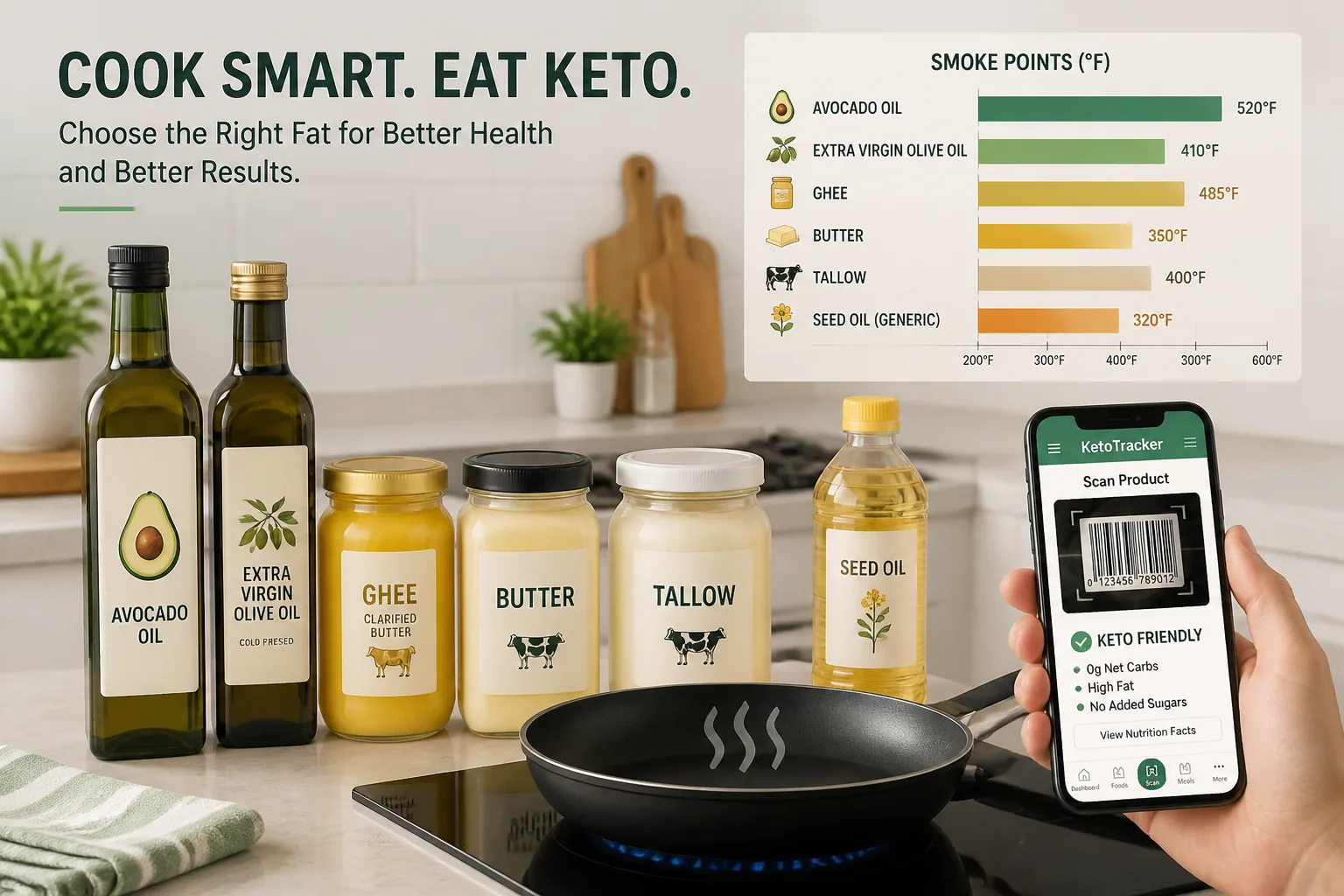
A higher smoke point does not automatically mean an oil is healthier or more stable in every situation. It simply means it can usually tolerate more heat before visible smoking starts. For example, refined avocado oil has a smoke point around 520 °F (271 °C), while unrefined or virgin avocado oil is closer to 480 °F (249 °C) according to ADA Cooking’s smoke point chart, and the difference comes from processing and composition: https://ada.cooking/tools/smoke-point-chart/
That is why smoke point is useful, but not enough on its own. It gives you a starting point, not the full answer.
Why Overheating Oils Can Hurt Flavor and Quality
When oils are overheated, several things can happen. First, the flavor changes. A fresh, clean fat can turn bitter, burnt, or stale. Second, the oil may begin to oxidize faster, which hurts shelf life and can make it taste off even before it looks visibly damaged. Third, decomposition products can form, including irritating compounds that you do not want in your food.
One important compound is acrolein, a highly reactive aldehyde that can form when fats are heated past smoke point or when oxidation progresses. A review on the origin and fate of acrolein in foods notes that exposure from food is a recognized concern, which is one reason cooking oils should not be pushed well beyond their limits: https://pmc.ncbi.nlm.nih.gov/articles/PMC9266280/
This is also why repeatedly heating the same oil is not ideal. Even if an oil has a high smoke point, repeated exposure to high heat can steadily degrade its quality.
Smoke Point vs. Real-World Oil Stability
Smoke point and stability are related, but they are not identical. Smoke point tells you when visible breakdown begins. Stability tells you how well the fat resists oxidation and degradation while heating and storing. A fat can have a decent smoke point but still oxidize more quickly if it contains a lot of polyunsaturated fat.
That is why high-saturation fats and high-oleic monounsaturated fats are often favored for cooking. Saturated fats resist peroxidation well, and oils that are rich in oleic acid sit in a useful middle ground. A high-PUFA oil may be fine for a cold dressing, but it is usually less ideal for prolonged high heat.
Research comparing heated oils has shown that industrial seed oils high in PUFA, such as corn, soybean, or sunflower oil, produce much higher levels of lipid peroxidation products during heating than fats with lower PUFA content like lard or dripping. One FEBS Letters paper found significantly more oxidation byproducts when high-PUFA oils were heated at 180 °C for 30 to 90 minutes, which is one reason this category gets extra scrutiny: https://www.sciencedirect.com/science/article/pii/0014579394011478
Refined vs. Unrefined: What Changes and Why It Matters
Refining changes more than just appearance. It can remove free fatty acids, pigments, odor compounds, and other minor components that affect taste and thermal behavior. In general, refined oils tend to have a higher smoke point and a cleaner, more neutral flavor than their unrefined counterparts. Unrefined oils usually keep more character, but they can be less heat tolerant.
The ADA Cooking chart notes that unrefined versus refined versions of the same oil can differ by about 15 to 25 °C in smoke point, depending on source, processing, and storage. That is a big enough gap to matter when you are choosing a fat for frying, searing, or roasting: https://ada.cooking/tools/smoke-point-chart/
For example, extra virgin olive oil is more flavorful and less processed, but its smoke point is typically around 375 to 405 °F (190 to 207 °C), with quality and freshness playing a role. Higher free fatty acid levels, which can happen in older or lower-quality bottles, tend to lower smoke point. That makes label reading and bottle quality more important than many people realize.
Keto Oil Comparison Chart: Smoke Points, Stability, and Best Uses
Here is a practical way to compare the most common keto-friendly fats. The exact numbers can vary by brand, storage, and refinement, but the general pattern is consistent: saturated fats and high-oleic fats usually hold up better than high-PUFA seed oils.
Refined avocado oil: about 520 °F, refined, high in monounsaturated fat, very good for high-heat cooking. Unrefined avocado oil: about 480 °F, less processed, still useful for medium to moderately high heat. Ghee: about 485 °F, clarified butter with low moisture and no milk solids, very heat stable. Extra virgin olive oil: about 375 to 405 °F, unrefined, flavorful, best for medium heat, dressings, and finishing. Butter: about 300 to 350 °F, contains water and milk solids, best for lower heat unless mixed with another fat. Lard: around 370 to 374 °F depending on refinement, good for many everyday cooking tasks. Beef tallow: very heat stable, roughly 50% saturated fat, 42% monounsaturated fat, and about 4% polyunsaturated fat, which makes it a strong high-heat option.
A composition study on ghee found that studied samples contained about 65 to 70% saturated fatty acids, 20 to 25% monounsaturated fatty acids, and only 3 to 4% polyunsaturated fatty acids. That helps explain why ghee performs well under heat and is often preferred over whole butter for frying or sautéing. Beef tallow shows a similar stability profile, with a high proportion of saturated and monounsaturated fat.
Best Fats for High-Heat Keto Cooking
For frying, searing, roasting at high temperatures, and any situation where the pan is going to get very hot, you usually want fats that are both stable and relatively low in PUFA. That makes refined avocado oil, ghee, beef tallow, and well-rendered lard some of the strongest practical choices.
Refined avocado oil is one of the most versatile high-heat keto fats because it combines a high smoke point with a favorable fatty acid profile. It is especially useful when you want a neutral flavor and the ability to cook aggressively without the oil breaking down too early.
Ghee is another standout. Since the milk solids and most water are removed, it handles heat better than whole butter and produces less burning in the pan. That is why it is often a better choice than butter for browning or frying.
Beef tallow is also excellent for high heat because it is naturally rich in saturated and monounsaturated fats and low in PUFA. This gives it strong oxidative stability, which is useful if you want a more traditional cooking fat for fries, searing, or cast-iron cooking.
Best Fats for Low-Heat Cooking, Dressings, and Finishing
For salad dressings, drizzling over vegetables, or finishing cooked food, flavor often matters more than extreme heat tolerance. This is where extra virgin olive oil shines. Its taste is a major advantage, and because it is less processed, it is often the preferred choice when you are not subjecting it to prolonged high temperatures.
Unrefined avocado oil can also be used when you want a milder taste and are working with medium heat. If the dish is gentle, there is no reason to force a high-heat fat where a more flavorful oil would work better.
Butter is also great for flavor, but it is better suited to low or moderate heat because the milk solids burn relatively quickly. In practice, butter works best for finishing sauces, light sautéing, or adding richness near the end of cooking rather than as the sole frying fat.
Butter, Ghee, Lard, and Tallow: Animal Fats Explained
Animal fats often fit keto well because they are naturally low in carbohydrates and can be highly stable. But they are not interchangeable, and understanding their differences makes cooking easier.
Butter contains water and milk solids, which means it browns beautifully but also burns sooner. That is why it usually has a lower practical smoke point than clarified butter. The milk solids are the main reason butter is less suitable for high heat.
Ghee is butter with the water and milk solids removed. That small processing step changes its performance dramatically, giving it a much higher smoke point and making it more forgiving in the pan. For many keto cooks, ghee is the easiest animal fat to use for everyday heating.
Lard, when properly rendered, can be a useful cooking fat with good heat behavior and a familiar savory flavor. Leaf lard may be slightly cleaner and more heat tolerant depending on how it is processed. It is a practical option for roasting and sautéing when you want a classic fat with less PUFA than many seed oils.
Tallow, especially beef tallow, is one of the most heat-stable traditional fats. Its high saturation and relatively low PUFA content make it a smart choice for high-heat cooking. If you want a fat that performs well in a hot skillet and stays stable, tallow deserves serious consideration.
Industrial Seed Oils: What Keto Users Should Know
Industrial seed oils like corn, soybean, sunflower, and similar blends are where keto users often get tripped up. They may be cheap and common, but they are usually richer in polyunsaturated fats, which makes them more vulnerable to oxidation during cooking. That does not mean every seed-derived oil is automatically bad, but it does mean they are generally not the first choice for high heat.
The concern is not just smoke point. It is also what happens to these fats when they are repeatedly heated. Studies have shown much higher levels of lipid peroxidation products in high-PUFA oils when compared with more stable fats. In addition, harsh refining can leave behind issues that keto shoppers may prefer to avoid, including traces of trans fats or residual solvents in some products. Properly rendered seed-free fats like ghee, butter, tallow, and lard avoid many of these problems.
If you are trying to keep your kitchen simple and keto-friendly, it often makes sense to rely on a short list of reliable fats rather than buying every bottle at the store.
Do Oils Affect Net Carbs? The Quality vs. Carb Question
Pure fats and oils generally contain zero net carbs, so from a strict macro-counting perspective they do not move your carb total much. But keto success is not only about carbs. It is also about food quality, digestibility, cooking performance, and how easily your meals stay on plan.
So while oils do not usually affect net carbs directly, they absolutely affect the quality side of the equation. A refined oil, a cold-pressed oil, and a highly processed blend may all be technically keto, but they may not be equally suitable for your goals or your cooking method.
This is why smart keto shopping is not only about checking carbs. It is also about checking the actual fat source, the refinement level, and the intended use of the product.
How to Read Oil Labels Like a Pro
When you pick up a bottle of oil, look beyond the front label. The front may say things like pure, light, or premium, but the ingredient list and small print tell the real story.
First, check whether the oil is refined or unrefined. Refined versions usually tolerate more heat. Unrefined versions often have more flavor but lower stability. Second, look for blends. A product labeled as avocado oil or olive oil may actually contain other oils mixed in, which can change the fatty acid profile and cooking behavior. Third, check for intended use statements like for high heat, sautéing, dressings, or finishing. Those clues help you match the fat to the task.
You can also think in terms of freshness. For extra virgin olive oil, higher free fatty acids can lower smoke point and usually suggest lower quality or poorer storage. For packaged fats, a stale smell, cloudy appearance where it should not be cloudy, or vague labeling can all be signs to slow down and read more carefully.
What to Scan in Packaged Fats Using Keeto
This is where Keeto can make shopping much easier. If you are standing in the grocery aisle trying to decide between two oils, the scanner helps you move faster and make a smarter call without doing manual carb math or label detective work.
When scanning packaged fats, pay attention to the product type, the ingredient list, and whether the label mentions refined, unrefined, virgin, extra virgin, or blended oils. Keeto is especially useful for quickly checking whether the product fits your keto plan and for helping you spot hidden ingredients or blends that do not match what you expected. Because it gives you an instant keto verdict and tracks your carb budget, it reduces the guesswork that often slows shoppers down.
That means you can use Keeto not just for packaged snacks and sauces, but also for the fats you cook with. Scan the bottle, confirm what is inside, and move on with confidence.
Quick Rules for Picking the Right Oil Every Time
Here is the simplest way to choose: use the most stable fat that still fits the job. For high heat, choose refined avocado oil, ghee, tallow, or well-rendered lard. For medium heat and flavor, choose extra virgin olive oil or unrefined avocado oil. For low heat, dressings, and finishing, prioritize taste and freshness.
Remember that smoke point is a guide, not a guarantee. Refinement, fatty acid profile, freshness, storage, and how long the oil is heated all matter. High-PUFA oils are generally less ideal for repeated high heat, while saturated and high-oleic fats usually handle cooking better over time.
If you want the fastest decision rule, keep it simple: match the fat to the heat, check the label for refinement and blends, and use Keeto when you want an instant keto-friendly check while shopping. That combination will save time, reduce confusion, and help you build a kitchen full of fats that actually support your keto routine.